Shujaat Ali Quadri
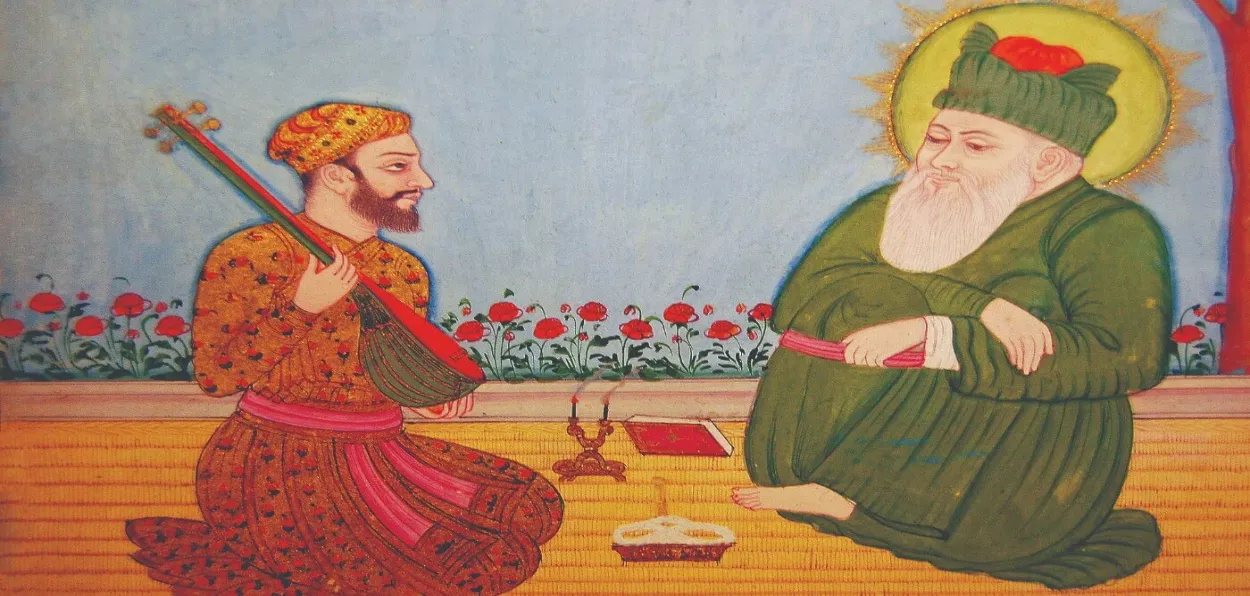
In the ongoing churn over identity, belonging, and nationalism in India, the voice of Amir Khusro echoes with striking relevance. Often remembered as a poet, musician, and disciple of Nizamuddin Auliya, Khusro was, in many ways, among the earliest articulators of a distinctly Indian cultural consciousness, one that was inclusive, layered, and deeply rooted in the lived realities of its people.
At a time when political and social narratives tend to reduce identity into rigid binaries, Khusro offers a radically different framework. His idea of India was not built on exclusion but on absorption; not on purity but on synthesis. Writing in Persian yet singing in Hindavi, Khusro blurred the lines between elite and folk, between courtly refinement and popular expression. He did not merely live in India; he belonged to it in a civilizational sense.
This belonging was not superficial. Khusro celebrated India’s languages, seasons, music, and social diversity with an intimacy that suggested ownership, not distance. He famously expressed pride in the land’s cultural wealth, placing India at par with, if not above, other great civilisations of his time. In doing so, he quietly dismantled the notion that cultural legitimacy must come from elsewhere. For Khusro, India was not a periphery; it was the centre. Crucially, this sense of Indianness was inseparable from his Sufi worldview. The Chishti tradition, to which he belonged, emphasised love, openness and service to humanity. Under the influence of Nizamuddin Auliya, Khusro internalised a spiritual ethic that rejected rigid orthodoxy and embraced human connection. His Sufism did not withdraw from society; it immersed itself in it.
Perhaps the most powerful expression of this was his use of local cultural forms to communicate spiritual ideas. Whether through qawwali, poetry, or folk traditions, Khusro ensured that the language of devotion was accessible to all. In doing so, he created shared cultural spaces where religious identities did not have to be erased but could coexist meaningfully. This was not syncretism as a slogan; it was syncretism as lived experience.
Contemporary India finds itself at a crossroads where questions of identity are increasingly framed in oppositional terms. For many Indian Muslims, in particular, the pressure to constantly negotiate between faith and nationality has intensified. In such a climate, Khusro’s life offers a quiet but powerful rebuttal to the idea that these identities are inherently in conflict.
Khusro was unapologetically Muslim and yet profoundly Indian. There was no contradiction in this duality because, in his worldview, no such contradiction existed. His legacy challenges both the internal tendency towards cultural isolation and the external narrative of alienation. It suggests that rootedness in India’s cultural fabric is not only possible but historically authentic.
Equally important is the role Khusro’s thought can play in countering radicalisation. At a time when sections of youth are vulnerable to absolutist and exclusionary ideologies, whether religious or political, his emphasis on love, plurality, and intellectual openness offers a necessary corrective. Khusro’s Islam was not defined by rigidity but by compassion; not by separation but by engagement. This is particularly relevant in an age of digital echo chambers, where simplified and often distorted versions of identity gain rapid traction. Revisiting Khusro is, therefore, not about romanticising the past but about reclaiming a framework that allows for complexity, coexistence, and confidence in one’s multiple identities.
For India as a whole, Khusro represents something larger than any single community. He embodies the idea that the country’s strength lies in its ability to absorb and harmonise differences. His life stands as a reminder that cultural confidence does not come from exclusion but from integration. In the end, the question is not whether Khusro belongs to history, but whether we are willing to learn from him.
ALSO READ: Two-time world kickboxing champion Tajamul Islam is an ode to human spirit
At a moment when the social fabric often appears strained, his legacy offers not just inspiration but direction. It invites us to imagine an India where identity is not a battleground, but a bridge. That is the idea of India, Amir Khusro lived and the one we urgently need to recover.
( Dr Shujaat Ali Quadri is the National Convener of the Muslim Youth Organisation of India)