Riyadh
In a significan archaelogical excavation in Saudi Arabia's Medina region, the authorities have uncovered a remarkable stone inscription engraved in ancient Arabic script, believed to date back to the earliest years of Islam. overall, the Saudi Heritage Commission has just announced the discovery of over 1,700 ancient inscriptions and rock carvings in the Madinah region (Al-Mahd), dating back to the time of Prophet Muhammad and Umar ibn al-Khattab.
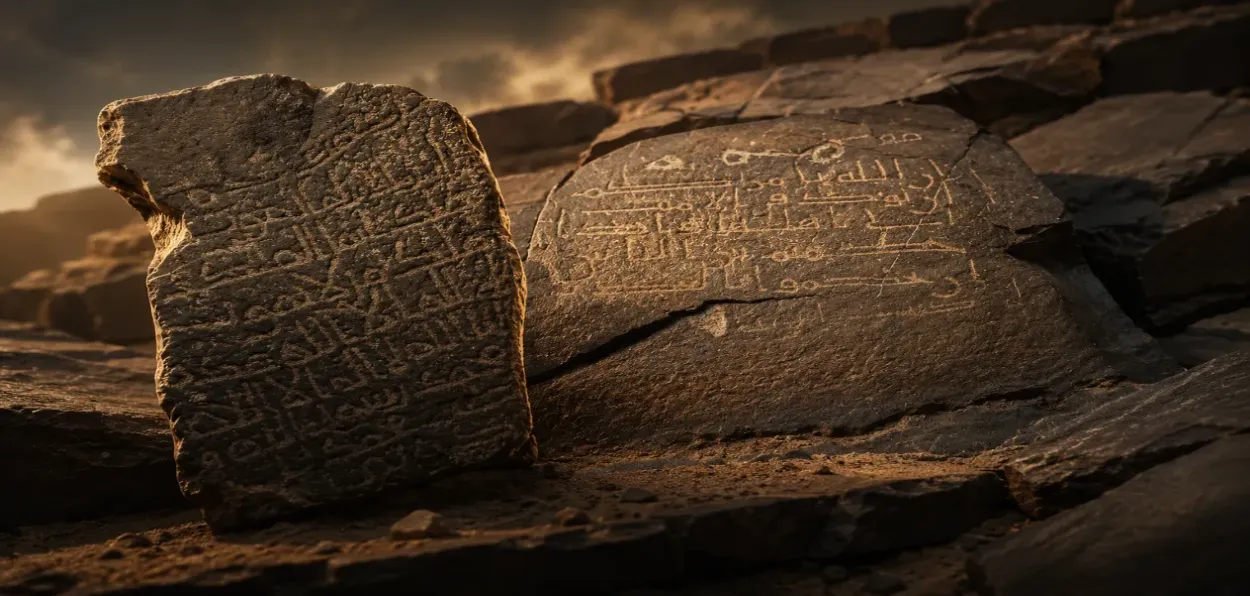
What makes the discovery particularly significant is the clear mention of Caliph Umar ibn al-Khattab, Islam's second caliph and one of the most influential rulers in Islamic history. The inscription was found during ongoing archaeological work in Al-Mahd Governorate, located in the Medina province.
According to experts from the Saudi Heritage Commission, the inscription holds immense historical value. It is written in the ancient Hijazi script, one of the earliest forms of Arabic writing used during the formative years of Islam.
The inscription translates into English as: "Allah is the protector of Umar ibn al-Khattab in this world and the Hereafter, and there is no god but Allah. Muhammad (peace be upon him) is the Prophet of Allah."
Historians say the inscription offers a rare glimpse into the beliefs, social fabric, and religious foundations of the early Islamic community. Its significance lies not only in mentioning Umar ibn al-Khattab—one of Prophet Muhammad's closest companions—but also in providing valuable documentary evidence from the period of his rule.
Caliph Umar led the rapidly expanding Muslim state from 634 to 644 CE, overseeing one of the most transformative periods in Islamic history as the empire extended across vast territories.
The Saudi Heritage Commission has just announced the discovery of over 1,700 ancient inscriptions and rock carvings in the Madinah region (Al-Mahd), dating back to the time of Prophet Muhammad ﷺ and Umar ibn al-Khattab (RA).
— Islamic Reflections (@Islamic_reflec) June 12, 2026
Most remarkably, one of the rocks bears the name of… pic.twitter.com/TIo6Hip3hS
The Saudi Heritage Commission has also released details of a large-scale archaeological survey conducted across three major areas of Al-Mahd Governorate—Al-Suwairiqiyah, Al-Muwaihiyah, and Hadhah. During the first and second phases of the survey, researchers documented 1,774 archaeological discoveries, significantly enhancing the historical and cultural importance of the region.
Among these findings were 173 previously unknown archaeological sites that had remained hidden for centuries. These locations provide compelling evidence of ancient human settlement and the movement of civilizations through the region.
The newly discovered inscription bearing the name of Umar ibn al-Khattab is only one among many remarkable finds unearthed in the desert landscape of Al-Mahd.
 One of the excavated rocks bearing the name of Umar ibn al-Khattab
According to the Heritage Commission, archaeologists documented 1,259 rock art images depicting animals, daily life, and various aspects of ancient cultures. In addition, 461 Islamic inscriptions were discovered, offering valuable insights into the evolution of early Arabic writing.
Researchers also uncovered 34 inscriptions in the pre-Islamic Thamudic script, shedding light on cultures that existed in the Arabian Peninsula long before the rise of Islam.
The excavations revealed numerous ancient structures, including 11 stone-built installations, the remains of three historic palaces, two milestones used to measure distances along caravan routes, and four wells that once served as vital sources of water for travelers and settlements.
Historically, Medina province—and particularly the Al-Mahd region—was a major center of trade and pilgrimage. Situated at the crossroads of ancient commercial networks and early Islamic pilgrimage routes, the area witnessed the movement of merchants, nomads, and travelers for centuries.
As they crossed the harsh desert landscape, many travelers carved inscriptions into rocks to record their presence, offer prayers, commemorate journeys, or leave messages for those who would follow.
Saudi Vision 2030 and Heritage Preservation
The discoveries also align with Saudi Arabia's broader efforts under Vision 2030, an ambitious national program aimed at diversifying the economy while preserving and promoting the Kingdom's cultural heritage.
The Saudi Heritage Commission has pledged to continue archaeological surveys, excavations, and documentation projects across the country in an effort to uncover and protect the nation's rich historical legacy.
READ MORE: Srinagar: leaders, civil society members protest against PoJK killings
Beyond their academic and historical value, these discoveries serve as a reminder that history is not confined to books and archives. It is etched into the landscapes, stones, and memories of a nation. The newly discovered inscription in Medina stands as one of the most significant recent examples of that enduring legacy.