New Delhi
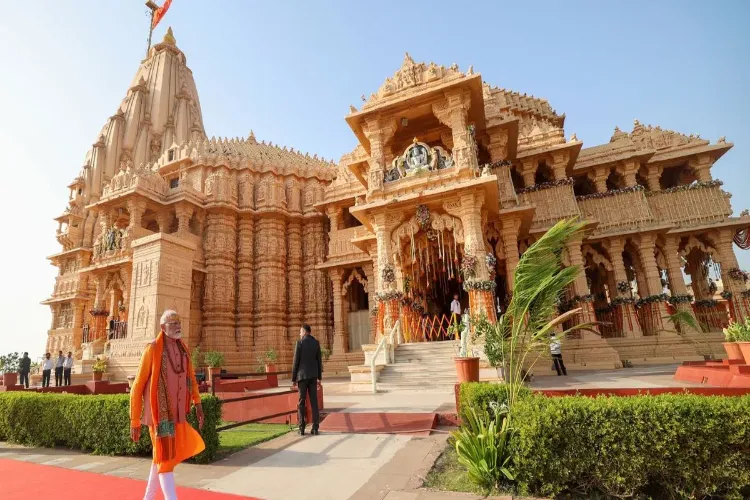
Prime Minister Narendra Modi on Monday penned an OpEd reflecting on the destruction and resurrection of the Somnath temple, asserting that merely hearing the name “Somnath” fills hearts and minds with pride.
Recalling that the first destruction of the revered shrine took place exactly 1,000 years ago in 1026 AD, the Prime Minister underscored that despite repeated attacks over centuries, the temple today stands in unparalleled glory.
In a blog post, PM Modi highlighted the enduring strength of India’s civilisation, stating, “The story of Somnath, a thousand years after the first attack, is not defined by destruction. It is defined by the unbreakable courage of crores of children of Bharat Mata.”
“There can be no better example of our civilisation’s indomitable spirit than Somnath, which stands gloriously, overcoming odds and struggles,” he added.
Referring to the book Somanatha: The Shrine Eternal by K M Munshi, the Prime Minister noted that Mahmud of Ghazni began his march towards Somnath on October 18, 1025, and after nearly 80 days, attacked the fortified temple town on January 6, 1026.
The blog also highlighted the decisive role played by Sardar Vallabhbhai Patel in rebuilding the temple after Independence, noting that Patel initiated the reconstruction on November 13, 1947, with Munshi standing firmly by his side.
PM Modi recalled that although the temple was ready for inauguration in 1951, then Prime Minister Jawaharlal Nehru opposed the participation of President Dr Rajendra Prasad in the event.
“Finally, on May 11, 1951, a grand temple in Somnath opened its doors to devotees and Dr Rajendra Prasad was present there. The great Sardar Sahib was not alive to see this historic day, but the fulfilment of his dream stood tall before the nation,” PM Modi wrote, adding that Dr Prasad stood firm despite reservations expressed by the then Prime Minister.
Drawing parallels with contemporary India, PM Modi said the same spirit of resilience is visible in the nation today, describing India as one of the brightest spots of global growth.
“It is our value systems and the determination of our people that have made India the centre of global attention today. The world is seeing India with hope and optimism. They want to invest in our innovative youngsters,” he asserted.
Citing historical accounts referenced by Munshi, the Prime Minister noted that nearly 50,000 defenders were believed to have lost their lives protecting the shrine, which was plundered and desecrated after the attack.
The blog recounted that the Somnath temple was repeatedly destroyed and rebuilt between the 13th and 18th centuries, facing attacks in 1299, 1394 and 1459. While it continued as a Hindu shrine, Aurangzeb ordered its demolition in 1669, its destruction beyond repair in 1702, and its conversion into a mosque in 1706. Queen Ahilyabai Holkar later built a new temple nearby in 1783.
PM Modi also recalled Swami Vivekananda’s visit to Somnath in the 1890s, quoting him as having described temples like Somnath as living sources of wisdom that reveal more about India’s history than books.
“The aggressors of the past are now dust in the wind, their names synonymous with destruction. They are footnotes in history, while Somnath stands bright, radiating far beyond the horizon,” PM Modi wrote.
Emphasising the message for the present and future, the Prime Minister said that if Somnath could rise again despite centuries of attacks, India too could restore the glory it embodied before the invasions.
READ MORE: IUML's Fatima Muzaffar Ahmed is the epitome of Muslim woman leadership
“With the blessings of Shree Somnath Mahadev, we move forward with a renewed resolve to build a Viksit Bharat, where civilisational wisdom guides us to work for the welfare of the whole world,” he added.



.png)





_(2).webp "Shiv Sena (UBT) president Uddhav Thackeray and Maharashtra Navirman Sena (MNS) chief Raj Thackeray")

.webp)