Ashhar Alam/New Delhi
US President Donald Trump has said Iran is under intense American surveillance as a “massive fleet” of US naval assets moves toward the Gulf region, signalling heightened military readiness amid escalating tensions with Tehran.
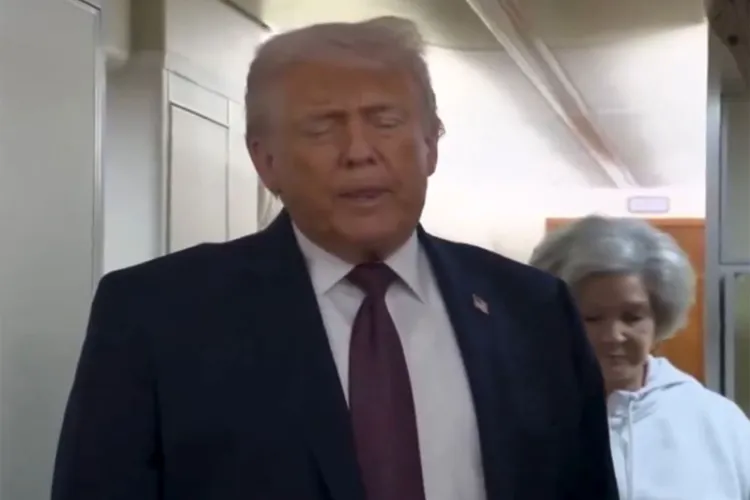
Speaking to reporters aboard Air Force One on Thursday while returning from the World Economic Forum in Davos, Trump issued a sharp warning to Iranian authorities, particularly over alleged executions and any revival of Tehran’s nuclear ambitions.
“I said, if you hang those people, you’re going to be hit harder than you’ve ever been hit,” Trump said, according to Fox News. “It will make what we did to your Iran nuclear look like peanuts.”
The President confirmed that a significant US naval deployment is already en route, though he stopped short of confirming imminent action. “We have a massive fleet heading in that direction, and maybe we won’t have to use it. We’ll see,” he said, adding that a “big flotilla” was moving as a precautionary measure.
US media reports over the past week indicated that the aircraft carrier USS Abraham Lincoln and its strike group were diverted from exercises in the South China Sea toward West Asia. Ship-tracking data later showed the carrier passing through the Strait of Malacca, a strategic maritime corridor linking the Pacific and Indian Oceans, placing it just days away from the Gulf region.
While US defence officials have not formally disclosed the strike group’s destination, its presence in the Indian Ocean has fuelled speculation of a potential escalation.
Trump, in a separate interview with CNBC, said he hoped further military action would not be necessary but warned that the United States would respond forcefully if Iran resumed its nuclear programme. “If they do it, it’s going to happen again,” he said.
Washington previously carried out air strikes on Iranian nuclear facilities in June 2025, when the US joined Israel during a 12-day conflict with Tehran.
Iran, meanwhile, has issued its own warning. Foreign Minister Abbas Araghchi, writing in The Wall Street Journal earlier this week, said Tehran would respond decisively to any renewed attack.
“Our powerful armed forces have no qualms about firing back with everything we have if we come under renewed attack,” Araghchi wrote, stressing that his remarks were not a threat but a reflection of reality. He cautioned that a full-scale confrontation would be prolonged, destabilising and far-reaching.
“An all-out conflict would engulf the wider region and affect ordinary people around the globe,” he said.
Amid the rising tensions, Iran temporarily shut its airspace last week, reportedly anticipating a possible US strike, while diplomats from Gulf Arab states and other regional players sought to dissuade Washington from military action.
ALSO READ: Bihar: Muslims donate land for World's largest Ramayan Temple
The geopolitical standoff comes as Iran continues to grapple with internal unrest following some of the largest anti-government protests since the 1979 Islamic Revolution. Human rights groups are still verifying casualty figures, though US-based monitors estimate that thousands have been killed and tens of thousands arrested during the crackdown.
As naval forces reposition and rhetoric sharpens on both sides, the situation in West Asia remains volatile, with global markets and regional powers watching closely for the next move.









.jpg "Representational Image")