.webp "Professor Salma Begum")
Saniya Anjum/Bengaluru
Some lives do not announce their impact loudly. They unfold quietly, through classrooms, conversations, and consistent choices made over decades. Professor Salma Begum’s journey is one such life. It is a story shaped not by ambition alone, but by conviction, a belief that education, when delivered with empathy and purpose, can transform individuals and society alike.
Looking back at her early years, she recalls the uncertainty that followed her post-graduation. “After my post-graduation, I was keen on a career,” she says. “But in the 1980s, the concept of career counselling or aptitude tests was very rare.” Like many women of her generation, she explored the available paths, working briefly with LIC and later in a private bank. Yet neither felt fulfilling.
“I did not like to continue,” she says with clarity. The turning point came when she accepted an offer to teach in a private college. “Right from day one, I knew this was my calling. This was the moment. I knew this is what I wished to do. I was happiest teaching.”
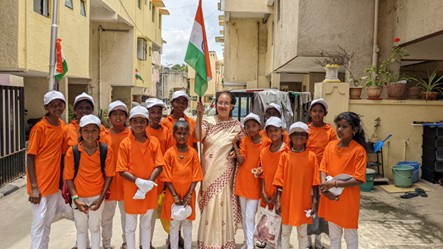 Celebration of Republic day with Kids
Her sense of purpose was deeply rooted in her upbringing in Krishnagiri. Born to a small-scale industrialist, she grew up in a household where values mattered more than material success. Her mother and grandparents played a profound role in shaping her worldview. “English and Urdu literature were part of everyday discussion and recitation in our family,” she recalls.
“Shakespeare, Rumi, and the Panchatantra were all familiar names.” Literature was not merely academic; it was lived, discussed, and absorbed. These early influences cultivated her sensitivity to language, thought, and expression, qualities that would later define her teaching style.
When she speaks about girls’ education, her conviction is unmistakable. “From childhood, I witnessed that girls’ education was not a priority in families,” she says. “Girls were brainwashed to believe that education beyond the basics was not required.”
Schooling, for many, was seen as a temporary phase until marriage. Her own family, however, held a very different belief. “In our family, education was a very important priority, more so for girls,” she explains.
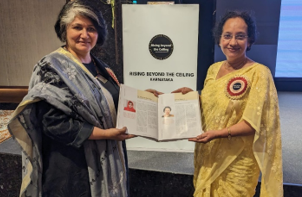 Salma Begum with Farah Usmani
Her mother’s philosophy left a lasting imprint. “She believed strongly that education builds character and personality. It builds courage and understanding. It equips you to face life’s challenges with grit. Above all, it helps you to be discerning.” Her parents believed in doing the right thing regardless of cost. “Dignity was more important than material things,” she says. These values shaped her lifelong belief that education is the greatest equaliser in society, especially in a girl’s life.
A defining chapter in her career began when she was posted to Channapatna, where classes were conducted entirely in Kannada. “The students understood only Kannada,” she explains.
“So, it became a necessity for me.” Determined not to let language become a barrier, she began learning Kannada during her daily train journeys. “It was challenging,” she admits. Slowly, with persistence and help from her students, she mastered the language and the economic vocabulary required to teach.
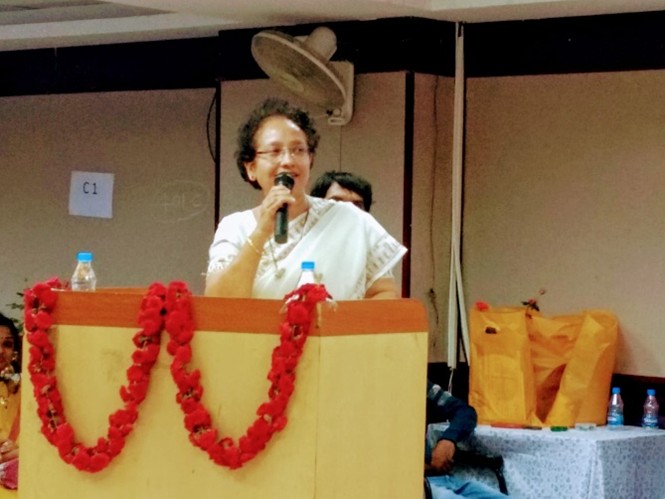 Professor Salma Begum Quiet Strength, Lasting Impact
“This changed my view completely,” she reflects. “A subject can be made simple and easy to understand if we teach in the language the students know, rather than the language we are proficient in.” Her confidence grew steadily, and her engagement with students deepened. In time, she became so proficient that she was invited to teach Kannada medium classes even at Maharani College.
Economics, for Professor Salma Begum, has always been more than a subject. “Economics as a field of study, like any other, is of immense use and value,” she says. “Every aspect of business, finance, trade, and commerce is associated with it.” She speaks of its vast scope and relevance with quiet enthusiasm. “Its wide scope and unlimited opportunities for research and development of newer areas of study are of great help to everyone.”
The growing interdisciplinary approach has only strengthened her belief in the subject. “It makes Economics even more attractive,” she says. “In terms of opportunities of engagement, it is one of the foremost sciences and therefore very popular.” This philosophy defines her classroom approach. “I go into my class with the objective of instilling a love for Economics in my students.”
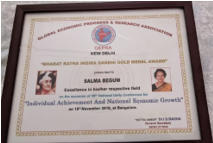 Salma Begum honored with the Bharat Ratna Indira Gandhi Gold Medal Award by GEPRA at the National Unity Conference, Bangalore.
Her reflections on literature reveal another dimension of her intellectual life. “Literature is at the core of any language,” she explains. “It is through literature that refinement and sophistication are brought into expression and communication.” She speaks with equal reverence for English and Urdu literature. “Both languages are very rich and have a great legacy.” From poetry and drama to stories and novellas, literature, she believes, disciplines the spoken and written word. “Hence the rules,” she adds thoughtfully.
She acknowledges history’s role in shaping literary influence. “English literature gained popularity due to the colonial empire and the introduction of English education in colonies.” Speaking of Urdu, her admiration is evident. “Urdu is a young language, but its literature is vibrant and beautiful. Its sensitivity and delicate treatment of subjects bring a unique charm and character to the art form.”
Academically, her journey is distinguished. She earned her PhD from Bangalore University in 1995 on government policies and their impact on women's entrepreneurship. She is a Certified Facilitator in Total Quality Management and Human Resource Development, and a Certified Psychological Counsellor from NIMHANS and the Department of Psychology, Bangalore University. She has authored five books and numerous national and international publications.
Beyond academia, her commitment found expression in SABALA, an association she founded to address the long-felt and long-denied need for a formal forum for women students and staff. “It was meant to sensitise, create awareness, and empower,” she says. SABALA focused on law awareness, rights and responsibilities, communication skills, teamwork, and entrepreneurship. “Even creating awareness can be empowering,” she notes. “SABALA did that very successfully.”
When she speaks to young women aspiring to leadership, her message is firm yet hopeful. “Women have taken the lead in almost all areas,” she says. Yet she also observes a persistent imbalance. “While women head institutions, management is still in the hands of men.” Her advice is clear and resolute. “Lead and not follow. Most of us are timid and afraid of breaking paths or displeasing society. Women need to come out of these fears and take on leadership roles.”
READ MORE: ACP Najma Farooqi's authority stems from empathy, integrity
Professor Salma Begum’s life reflects a quiet revolution built on classrooms, language, empathy, and courage. Through Economics and literature, policy and practice, she has shaped minds and strengthened voices. Her journey reminds us that true education is not merely taught, it is lived.

.webp "Representational Image")











.webp)