.webp "Fouqia Wajid, Founder-CEO of Zooq Films")
Saniya Anjum/Bengaluru
“I grew up believing that excellence is not about competition, but about constantly raising your own bar,” reflects Fouqia Wajid. Isn’t that precisely what her name means, ‘to excel’? What’s even more intriguing is that, despite the family’s scepticism toward astrology, an astrologer suggested the Arabic name “Fouqia.”
Though they didn’t strictly adhere to such beliefs, the name endured, almost prophetically guiding her journey and resonating deeply with her commitment to perpetual self-improvement. Born in 1992 into a household where scholarship, language, and intellectual curiosity infused daily life, she grew up with a mother who had just completed her PhD thesis, subtly defining learning as a pursuit far beyond mere academic credentials.
Growing up in a literary environment meant that art was not introduced to Fouqia; it was a part of her surroundings. Literature was not an extracurricular activity but a way of understanding life with all its ups and downs. From childhood literary gatherings to conversations rooted in poetry and thought, her worldview was shaped early. Writing came naturally to her. She penned her first poem, Sky, in Grade 1, and by the age of 16, her English poetry collection Screech was published. Looking back, she says, “Writing was never a choice for me. It was how I made sense of the world.”
.jpg) Fouqia Wajid
Fouqia Wajid
Her decision to pursue mass communication was both deliberate and defiant. At a time when creative careers were often dismissed as impractical, especially for women, Fouqia faced criticism for her choice. “When I chose mass communication, I was questioned constantly,” she recalls. “But I knew this was an important tool. If you don’t control your narrative, someone else will.” She went on to complete her Master’s in Mass Communication from Jamia Millia Islamia, New Delhi, where she also emerged as a student leader, serving as the students’ president. Leadership, even then, was rooted in inclusion rather than authority.
At just 19, Fouqia founded an NGO that functioned more like a movement than an organisation. It aimed to challenge the idea that young people lacked seriousness or credibility in creative fields. Within 45 days, it drew the attention of renowned figures like Ashok Sahni and M S Sathyu. “Youngsters are often told to wait their turn,” she says. “I wanted to build a space where talent mattered more than age.”
Her creative journey soon entered mainstream media. Fouqia became one of the first four writers selected for Colors Kannada under Viacom and contributed to 150 episodes of Radha Ramana. Despite holding a seat in engineering, she chose storytelling over certainty. Her work led her to Mumbai, where she worked as a producer in creative and development at Viacom 18 Motion Pictures, handling pan-India scripts and contributing to high-profile projects.
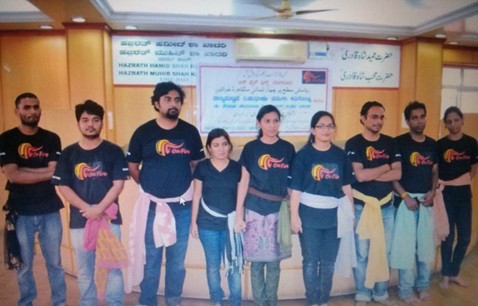 Fouqia Wajid (Second fro left) with artists of street play Group
Yet, commercial success never diluted her purpose. “Big platforms give you reach,” she says, “but intent decides whether your work will have meaning.”
Her deeper calling lay in documentary filmmaking and cultural preservation. Fouqia directed documentaries on eminent Urdu writers of Karnataka under the Karnataka Urdu Academy, bringing neglected literary voices into public memory. Along with her husband Rizwan, she also worked on 16mm film projects in Madurai, including Fouzia Naama, a documentary on her mother, Fouzia Choudhary. “This film was not just about my mother,” she shares. “It was about documenting a generation of women whose intellectual labour often goes unseen.”
As the Founder-CEO of Zooq Films, Fouqia today balances artistic integrity with industry realities. From producing independent documentaries to working with reputed brands like MTR and Mercedes-Benz, Zooq Films reflects her belief that meaningful content and commercial work can coexist. Her leadership style is shaped by empathy and mentorship. “I know how hard it is to find space,” she says. “So, when I lead a team, my first responsibility is to make sure voices are heard.”
Fouqia’s work consistently engages with issues of women, representation, and social conditioning. Through podcasts and films addressing challenging subjects, she urges women to step out of comfort zones. “Women have immense potential,” she asserts, “but conditioning, laziness, and fear often hold us back. And yes, for women, it is ten times harder.” Yet she remains hopeful, especially in the age of digital media. “OTT platforms and digital tools have changed the game,” she notes. “Today, women can create their own content in a male-dominated world.”
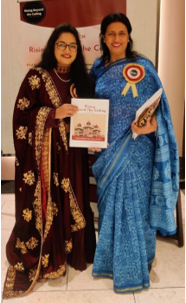
Fouqia Wajid With the writer poetess Shaista Yusuf
She is also sharply aware of the consequences of silence. “Lack of representation leads to narratives we accept blindly,” Fouqia warns. “When our stories are missing, others define us.” This belief fuels her advocacy for mass communication as a powerful instrument. “Radio and television may have slowed down,” she says, “but storytelling hasn’t. Create content. Use the tools. Nobody has the right to say journalism, politics, or media is not meant for you.”
ALSO READ: Unyielding determination: Inspiring journey of Dr. Zahida Khan from Hubli to success
As she steps into a new decade of life, pursuing a PhD in Mass Communication while expanding her creative enterprise, success for Fouqia has taken on a deeper meaning. “Success today is impact,” she says.
“It’s about whether your work creates awareness, shifts perspective, or empowers someone else.”








_(2).webp "Dr. Zahida Iqbal Siddiqui")
.webp "V P Suhara, Muslim women's Rights activist")