New Delhi
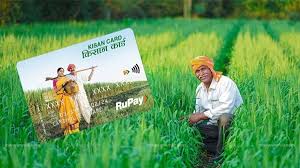
The Union government has taken various steps to support farmers, including small and marginal, through increasing access to Kisan Credit Cards (KCC), and promoting their digital issuance in all States/UT.
According to a statement released by the Ministry of Finance, "the Priority Sector Guidelines of Reserve Bank of India (RBI) issued to banks, and Ground Level Agriculture Credit (GLC) Target by the Government to banks act as key policy instruments in scaling up KCC coverage and enhancing financial inclusion among farmers."
In terms of extant guidelines on Priority Sector Lending (PSL) issued by RBI, Commercial Banks including Regional Rural Banks, Small Finance Banks, Local Area Banks and Primary (Urban) Co-operative Banks (UCBs) other than Salary Earners' Banks are mandated to allocate at least 18 per cent of their Adjusted Net Bank Credit (ANBC) or Credit Equivalent of Off-Balance Sheet Exposures (CEOBSE), whichever is higher, to agriculture, out of which a sub-target of 10 per cent is prescribed for Small and Marginal Farmers (SMFs).
Further, the PSL guidelines also prescribe an incentive framework for districts with comparatively lower flow of credit to the priority sector (which also includes credit to agriculture and Small & Marginal farmers) and a disincentive framework for districts with comparatively higher flow of priority sector credit for more equitable distribution of the credit flow to the agricultural sector.
Furthermore, since 2019, KCC scheme has been extended to cover working capital requirements of animal husbandry, dairying and fisheries.
The Government of India's Modified Interest Subvention Scheme (MISS) offers short-term agricultural loans to farmers at a concessional interest rate of 7 per cent through Kisan Credit Cards (KCC). Farmers who repay promptly receive an additional 3 per cent incentive, effectively reducing their interest rate to just 4 per cent.
The limit for collateral free short-term agricultural loans, including loans for allied activities, has been raised from Rs 1.60 lakh to Rs 2 lakh per borrower by RBI with effect from January 1, 2025. This move enhances credit accessibility, particularly for small and marginal farmers (over 86 per cent of the sector), who benefit from reduced borrowing costs and the removal of collateral requirements.
In order to bring awareness about the benefits of the KCC scheme among farmers, Union/State Governments, RBI, NABARD and Banks conduct various financial literacy and awareness programmes through Centre for Financial Literacy (CFL), Financial Literacy Camps (FLCs), etc.
Besides this, RBI also conducts Financial Literacy Week (FLW) every year to propagate the message of financial education on various themes among members of the public across the country.
Kisan Credit Card (KCC) scheme offers features such as an ATM-enabled debit card, one-time documentation, in-built provision for cost escalation in the credit limit, and the flexibility to make multiple withdrawals within the sanctioned limit, among others.
READ MORE: Alfiya Pathan: The rising boxing Star from Nagpur, aspiring to be the Next Mary Ko
The Jan Samarth portal has been started as a one-stop digital platform for linking Government-sponsored loans and subsidies Schemes including Kisan Credit Card. It provides a quick and efficient way to apply for loans and obtain approvals based on a digital evaluation of the applicant's data.
NABARD has also introduced the e-KCC portal for Regional Rural Banks (RRBs) and Rural Cooperative Banks (RCBs) through which the process of loan application has been digitised, and farmers can submit their applications to RRBs and RCBs without visiting their branches.


.webp "Justice Poonam A. Bamba with Captain Amarinder Singh")









.webp "Representational Image")


.webp)


.webp)