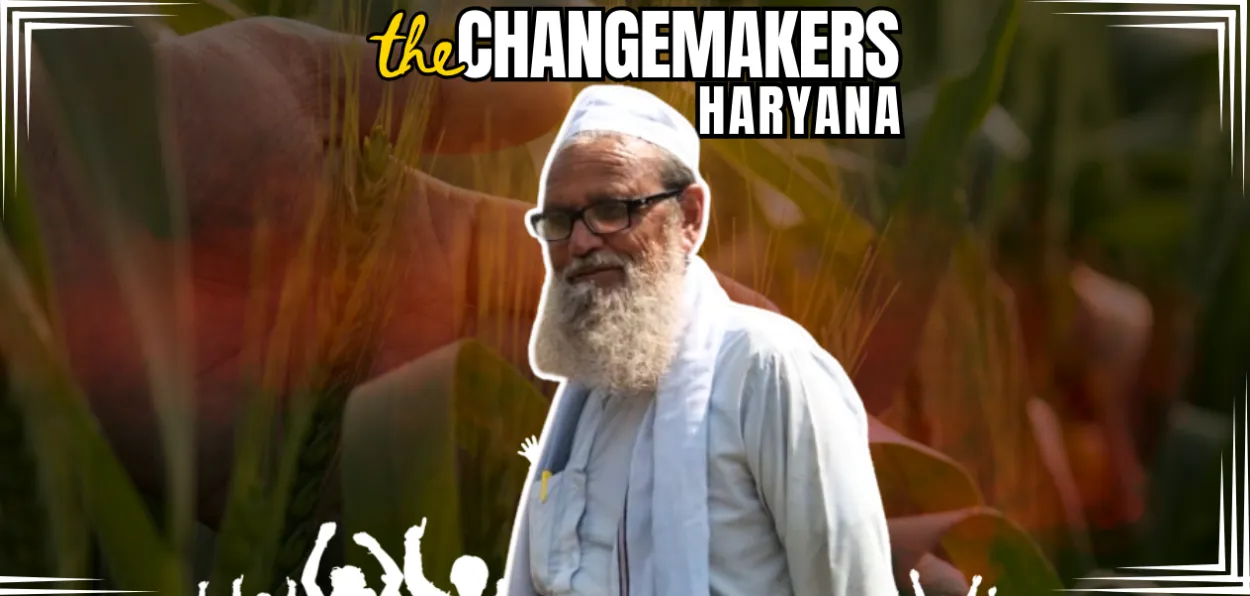
Firdous Khan/Mewat
For Haji Ibrahim Khan, who hails from the Mewat region of Haryana, water conservation is a mission to protect life on the planet. As a child, he understood the harsh consequences of water scarcity. Born in Baghol village of Nuh district, he saw women walking miles every day to collect drinking water. These struggles left a lasting impact on him and led to his commitment to water conservation.
His work is evidence that one person’s resolve can transform the destiny of society.
For the past three and a half decades, he has worked as President of the Mewat-based Aravalli Jal Biradari. His concern stems from the rapidly deepening water crisis and soaring temperatures.
.jpeg) Haji Ibrahim Khan receiving an award
Haji Ibrahim Khan receiving an award
He says: “Absence of trees and the rocky terrain of the Aravalli hills are intensifying heat, while the expansion of the Delhi–Mumbai Expressway is exerting additional pressure on the environment.” In such circumstances, conserving water becomes even more critical, he says.
Inspired by Rajendra Singh, known as the “Waterman of India,” Haji Ibrahim took his first major step by building a dam between two hills in Ghata Shamshabad village. This initiative ensured regular drinking water, giving relief to the local population.
With support from Shri Mahant Tiwari’s organisation Desaj Pratishthan and Rajendra Singh’s Tarun Bharat Sangh, the project began in 2000.
.jpeg) Haji Ibrahim Khan at a revived johad
Haji Ibrahim Khan at a revived johad
Later, he developed several johads (traditional water bodies) and ponds across villages along the Aravalli foothills—including Pat Khori, Firozpur Jhirka, Giyasaneya Bas, Mewli, Ghata Shamshabad, and Shahpur—benefiting both villagers and wildlife.
Haji Ibrahim believes that water conservation cannot be one person’s responsibility; it demands collective action. Community participation, he says, helps people understand the value of water and their responsibility toward it.
To strengthen awareness, he has organised multiple “Water Yatras,” travelling through villages across Haryana, Rajasthan, and Madhya Pradesh. He also joined the Ganga Sadbhavna Yatra, from Gomukh to Gangasagar, to spread the message of water protection.
.jpeg) Haji Ibrahim Khan inspecting a site
Haji Ibrahim Khan inspecting a site
Haji Ibrahim has been honoured with many awards at the national and state levels. In January 2020, the Ministry of Jal Shakti awarded him the Jal Prahari Samman 2019.
He has received awards from RSS leader Ram Lal, BJP Delhi President Manoj Tiwari, and Union Minister Rajendra Shekhawat.
Recently, he received special appreciation during the Golden Jubilee celebrations of Tarun Bharat Sangh at Bhikampura in Alwar district.
His contribution goes beyond building ponds and dams. He has been a strong voice on water policy. When the Rajasthan government issued licenses to 43 liquor factories to be situated between Bhiwadi and Alwar, and as it would further strain the water resources, he vehemently opposed it in the interest of the public.
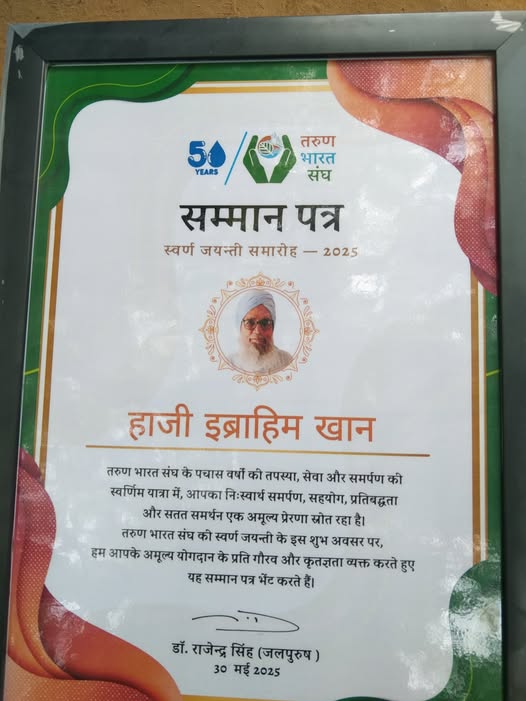 Haji Ibrahim Khan speaking at a An honour from Tarun Bharat Sangha for Haji Ibrahim Khan
As a result of his efforts, 39 of those licenses were cancelled.
Highlighting the gravity of India’s water challenge, he says that water availability is closely linked to climatic and geological conditions. However, with the population rising, per capita availability is declining sharply.
ALSO READ: Dr. Siddiq Ahmad Meo has chronicled Mewati Culture for posterity
In 2021, it stood at 1486 cubic meters, projected to fall to 1367 cubic meters by 2031. Any figure below 1700 cubic meters indicates a water-stressed region, while a figure below 1000 cubic meters marks extreme scarcity.
.jpeg)
The life of Haji Ibrahim Khan teaches us that water conservation is not just an environmental responsibility—it is a moral and social duty. His dedicated work has uplifted not only the people in his region but also its ecosystem. Under his leadership, numerous villages in Mewat and the Aravalli belt have developed sustainable water structures that continue to provide relief to thousands of residents and wildlife.
ALSO READ: Dr. Siddiq Ahmad Meo has chronicled Mewati Culture for posterity
His journey proves that when communities come together to protect nature, even the most daunting crises can be tackled. His story is a reminder that water conservation is not a short-term campaign, but a lifelong commitment to preserving life and ensuring a better future for all.