Sreelatha M
D. Sharifa Khanam’s story is inseparable from the stories of the women she has spent her life trying to help. Like many women around her, Khanam, 62, grew up watching male dominance and patriarchy and accepting them as part of the natural order. That acceptance cracked at a moment of realization that a woman, too, has an identity of her own, and is not merely meant to comply with the expectations of a male-dominated society.
Khanam was the youngest of ten children, growing up in a village in Tamil Nadu. She studied in an Urdu school where her mother taught. Her mother had separated from her father and struggled to raise the children.
One of Khanam’s elder brothers went on to study at IIT Kanpur and later helped her secure admission to Aligarh Muslim University for her degree. At AMU, she was exposed to the world outside her village.
After completing her studies, Khanam worked as a translator at a women’s conference held in Patna in the late 1980s. As she translated speeches and discussions from Hindi and English into Tamil for delegates, a larger truth became impossible to ignore: women were suffering everywhere, in all communities, and all states.
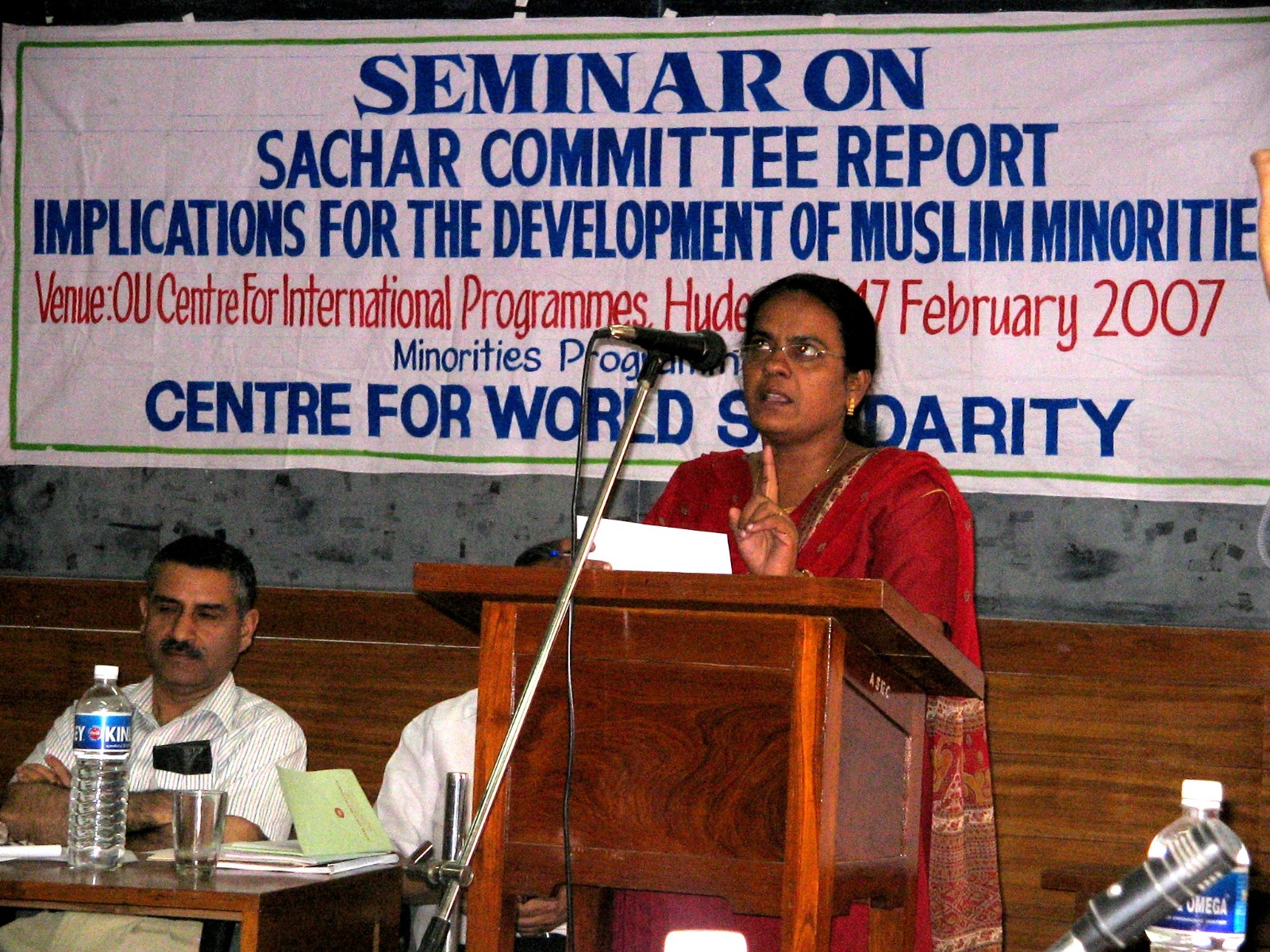 D. Sharifa Khanam speaking at a seminar
The constant travel, the growing awareness of women’s rights—and the glaring absence of those rights in everyday life—left her determined to act. In one of her interviews, she says that she considered herself like Cinderella waiting for her fairy godmother. But after this epiphany of awareness, she decided to become her own godmother and also of those around her.
She began by working with a small group of women in Pudukkottai, pooling the money she earned from giving tuitions and reselling saris.
In 1987, this effort took shape as the STEPS organisation. Women came to her with problems of divorce, domestic violence, abandonment, poverty, and social isolation. She tried to find solutions through counselling, mediation, and legal channels. Impressed by her work, the district collector at the time allotted her land to launch the project on a large scale.
In an interview with Rediff, Khanam says she was not even conscious of her Muslim identity for a long time until communal riots broke out in neighbouring areas.
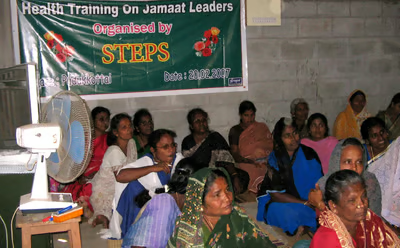 Women attending a workshop of STEPS
Witnessing the vulnerability of Muslims—especially women—changed the direction of her work. This led her to the idea of a Muslim women’s jamaat. A jamaat is traditionally a gathering attached to a mosque, usually consisting of male elders who discuss and resolve community issues. Khanam felt that these judgments were almost always skewed against women.
In 1991, she launched al Jamaat of Muslim women, believing that this was the only way they would be heard. She felt that secular organizations were often reluctant to take up issues concerning Muslim women, possibly out of fear of offending religious elders or existing jamaats.
She concluded that Muslims have to address their own problems. Over time, this work took a more organised form, and in 2000, the Tamil Nadu Muslim Women’s Jamaat Committee emerged as an offshoot of STEPS.
Khanam believed that Muslim women had nowhere to turn when they faced injustice. Sudden divorces, triple talaq, denial of maintenance, domestic violence, and other forms of abuse were often dismissed by the police as matters falling under Shariat or Muslim personal law.
These cases were pushed under the carpet when they came before male-dominated jamaats, which Khanam has described as functioning like kangaroo courts. One reason for this, she pointed out, was the misinterpretation of the Quran by men thanks to its Arabic script.
.jpeg) Women attending mediation camp of STEPS
Women attending mediation camp of STEPS
This also left women without the knowledge or confidence to challenge those interpretations. When Khanam read the Tamil translation of the Quran, she found a wide gap between the text and the versions being enforced by mosque-linked jamaats.
The women’s Jamaat began conducting workshops on Shariat and lobbying the government on issues such as the abolition of triple talaq and the enforcement of women’s property rights. According to the Jamaat website, the Tamil Nadu Muslim Women’s Jamaat Committee has faced sustained opposition, including death threats from clerics and male-led organisations.
The jamaat meets monthly at the district level and once every three months at its headquarters in Pudukkottai. Women bring their cases to these meetings, where attempts are made to resolve them through counselling, the police, or the courts. Matters that remain unresolved are taken up at the central-level meetings. Khanam has said on several platforms that since the Jamaat began its work, even some mosques in Tamil Nadu have started creating space for women.
Alongside this, the STEPS Women’s Development Organisation functions as a protective space for women facing violence and abuse. It provides short-term residential support for battered women and works closely with both local communities and the police. Over time, STEPS has also taken up issues of women’s livelihoods, land rights, and employment.
.avif) D. Sharifa Khanam receiving an award from PM A B Vajpayee
D. Sharifa Khanam receiving an award from PM A B Vajpayee
Despite repeated attempts to reach her, Khanam was unavailable for interviews at the time of writing. Her office did not respond to queries regarding the jamaat or the mosque she has, at times, spoken about building exclusively for women. On other platforms, however, she has clarified that the mosque itself was never the central idea. What mattered more was women coming together, speaking openly, and collectively addressing their problems—something the jamaat already does. Her long-held dream of a short-stay home for battered women is being addressed through STEPS.
The STEPS website states its core belief: self-respect is fundamental to women’s liberation. The organisation focuses on providing support and counselling to women facing various forms of violence—dowry-related abuse, divorce disputes, sexual harassment, child sexual abuse, and domestic violence. Through its interventions, STEPS claims to have assisted nearly 3,500 women.
The STEPS began by working with school and college students, and rural women through awareness programmes such as workshops, poster exhibitions, competitions, and self-defence training. Over the years, it has evolved into a centre for women in distress, taking up issues at both local and state levels and pushing for practical solutions.
ALSO READ: Kashmir: Naranag offers ensemble of spiritualism, history, nature, and life
For nearly two decades, D. Sharifa Khanam has remained an active presence in India’s women’s movement. From its base in Pudukkottai, STEPS continues to intervene daily in cases of violence, working across families, communities, and institutions. At its core lies a simple idea: that women, especially those pushed to the margins, deserve to be heard.

.jpg "Gujarat’s women entrepreneurs bring their craftsmanship to life during Navratri")









.webp)