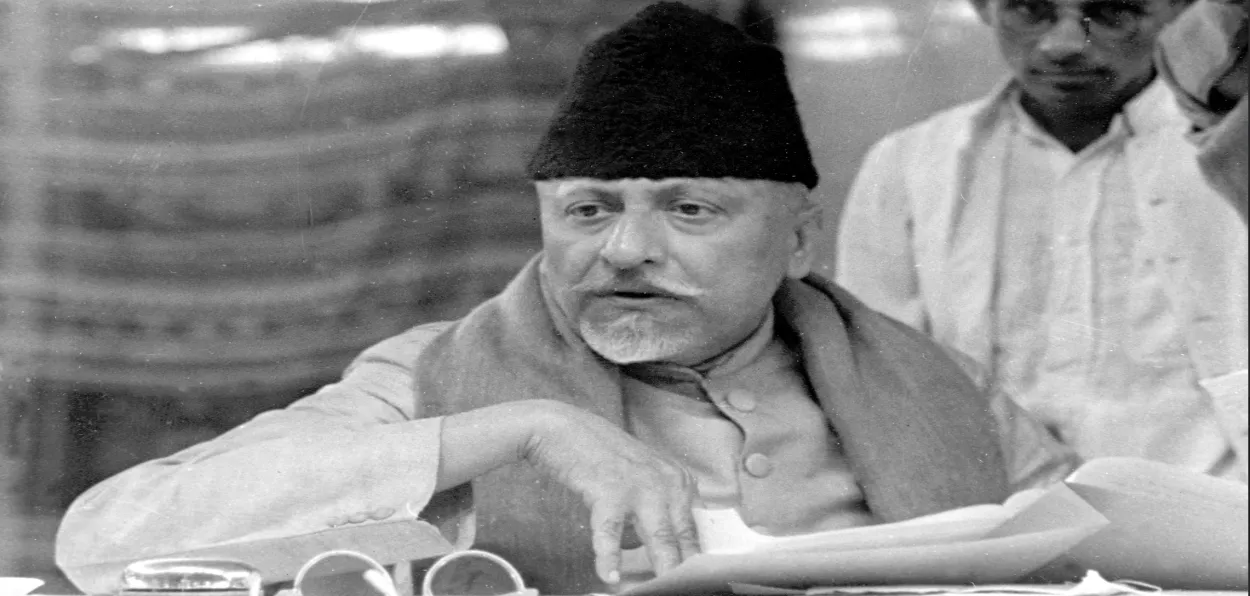
Saquib Salim/ New Delhi
“The greatest mistake of the Muslims is to involve themselves in the minority or majority of numbers. They seek to add to their numbers, not strengthen their hearts. But Islam does not attach importance to numbers.”
This is what Maulana Abul Kalam Azad wrote in 1912 while discussing the question of the religious conversion drive by the Arya Samaj and Muslims opposing it. After more than a century, India still deals with these questions. Hindu and Muslim right wings often exchange allegations that the other religious community is trying to convert its people to increase its population. Thus showing a fear that the number of a particular religion will go down in future.
In 1912, when similar slogans were being raised, Maulana Azad addressed the Indian Muslims, advising them that the whole debate around numbers was not only misleading but also against the teachings of Islam.
.jpg) Abul Kalam Azad with Jawaharlal Nehru and Mahatma Gandhi (Wardha, August-1935)
Abul Kalam Azad with Jawaharlal Nehru and Mahatma Gandhi (Wardha, August-1935)
In an article published in Al-Hilal of 1 September 1912, Maulana wrote, “.... we would like to assure our Hindu and Arya Samajist contemporaries that if they consider this campaign to be useful, they may gladly continue it. If all the Ismaili Hindus adopt the Hindu religion, we would lose nothing. Till now, they revered a man as God; henceforth, they would worship the innumerable images of the Hindus. They were no asset to Islam whose loss should be regretted.”
Maulana argued that Muslims dominated the world not on the basis of their numbers but through their belief in Allah. The rise of Islam was not based on the numbers but on how good the followers of Islam were.
Maulana said, “A true Momin dominated over thousands of men and there is no reason why he should not again dominate, provided he becomes a true Momin. What is the use of becoming numerically large by collecting all the rubbish and dirt of the world when your hearts have nothing in them? Those who are going away, let them go. Were they Muslims that you bemoan their conversion to Hinduism? When you came into this world, what was your number? But when you made peace with God, the whole world had to accept defeat at your hands. Why are you worried about strengthening your numbers? First, strengthen your relations with God.”
To bring home the point with his Muslim audience, Maulana quoted verse 8:26 from The Quran, “Call to mind when ye, Were a small (band), Despised through the land, And afraid that men might, Despoil and kidnap you, But he provided a safe asylum For you, strengthened you With His aid, and gave you, Good things for sustenance; That ye might be grateful.”
In view of Maulana, this fear of being in the minority has harmed the cause of the Indian Muslims more than anything. He believed, “The fear of numbers, of small and large numbers, does not emanate from the inner selves of our hearts, but has been put by the alarmists from outside. And now it has become the pivot of the entire circle of our misfortune. We cannot join the Congress because we are few in numbers; the Hindus will overwhelm us.
We cannot join the demand for self-government because the number is few and it will become a Hindu government. We do not deny the blessing of education, but excuse us, the Hindus are more in number. Becoming educated, they will drive us out of India. The fear psychosis has become so dominant that even on the issue of non-affiliating universities, it is not permissible for Hindus and Muslims to join together in protest. Objectives may be common, and the area of unity defined, even then, we appear to be fearful lest the demon of excess numbers may devour us!”
Maulana asked his readers why Muslims, who believe that a few Muslims from the lands of Arab, could change the course of history, but now, when their number had swelled to millions they are afraid of a numerically superior Hindu community. He asked Muslims to stop showing fear of Hindus and start cooperating with them for a future India. Maulana asserted, “There is no need to be afraid of the Hindus; you should, of course, be afraid of God.
You are the army of God. But you have thrown away the uniform given to you by God. Put it on and the whole world would be afraid of you. You have to live in India, therefore embrace your neighbours (Hindus) and live actively. You have seen the consequences of living in isolation from them. Now unite with them. If there are impediments from their side, do not care. You should look at your position among the nations of the world. You are God’s viceregent on earth; and so like God look at everybody from above. If they do not behave well with you, you behave well with them. The elders overlook and excuse the mistakes of the young; they do not cry at their pin-pricks.”
READ MORE: Non-Muslim volunteers cook sheri for fasting Muslim students of Kota
Maulana Azad had no qualms in saying that it was within the lines of Islamic teachings that Muslims should not fight to win converts just to increase their numbers. They should cooperate with Hindu community, even if they did not actively cooperate with Muslims and stop pointing out every mistake of the other community. This thought was carried by Maulana till his death and changed the minds of several Muslim leaders of that time. It is important that his teachings should be revisited by the Muslims of India.











.webp)