Ghulam Rasool Dehlvi
The scholars reimagining or reinterpreting Hinduism focus on redefining the age-old Vedic tradition in the 21st century. But they must acknowledge that Hinduism’s strength has historically been its ability to integrate belief with lived experience. A way of life without a spiritual foundation becomes mere culture; a religion without lived ethics becomes hollow ritual. The enduring vitality of any faith tradition lies in the unity of the two.
Shashi Tharoor’s latest book, The Sage Who Reimagined Hinduism: The Life, Lessons and Legacy of Sree Narayana Guru, profoundly and precisely does that. It moves beyond biography and rings with the deeper philosophy of the Advaita’s non-dualism.
As a student of comparative religion and Sufi tradition, it struck me that at a time when religious identities are mobilised for exclusion, through majoritarian nationalism or extremist interpretations of Islam, returning to these deeper currents of Advaita and Wahdat al-Wujud offers a corrective.
In this context, Narayana Guru’s message emerges as a shared moral horizon between Islam and Hinduism — a call for equality, dignity, and universal brotherhood grounded in the very heart of their metaphysical visions, and not a dilution of distinct faiths.
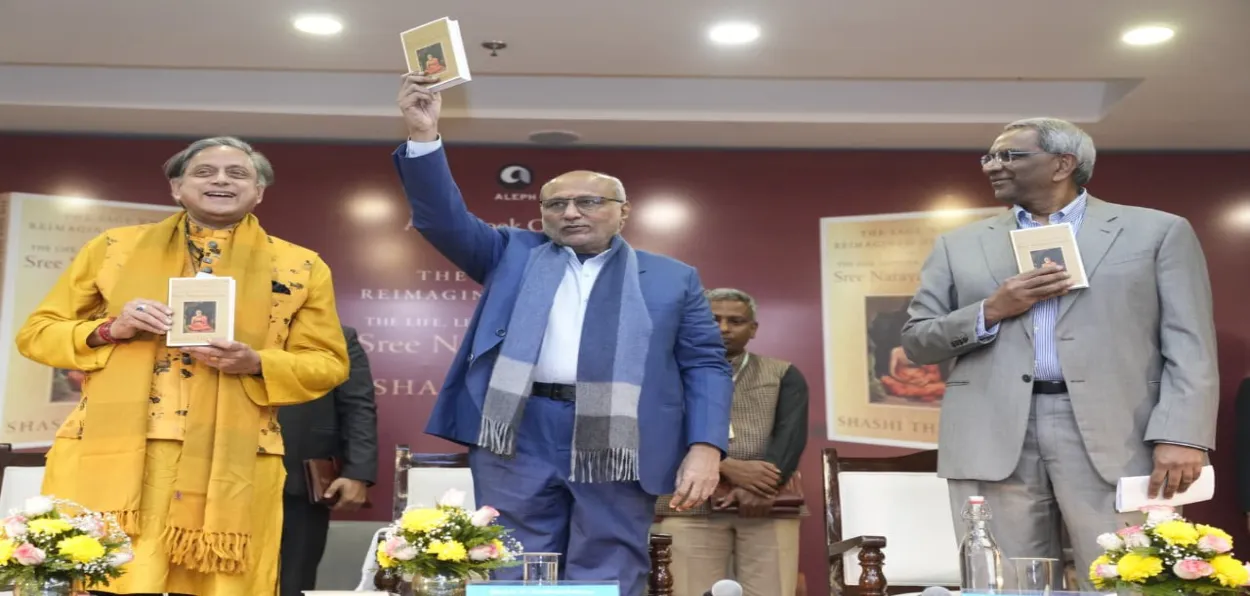
Tharoor’s book, released by Vice-President C. P. Radhakrishna, in many ways is an attempt to restore a forgotten moral clarity about India’s national and civilisational consciousness.
Tharoor said, "Narayana Guru emerged in 19th-century Kerala at a time when caste discrimination was not only widespread but sanctified. Social hierarchies were so rigid that Swami Vivekananda once described Kerala as a “lunatic asylum”. Into this deeply unequal order, Narayana Guru introduced a spiritual revolution. What makes Narayana Guru historically significant is that he did not attack religion to reform society. Instead, he reinterpreted religion to liberate society. By consecrating temples open to all castes, promoting education, and instilling self-respect among the oppressed, he demonstrated that faith could be reclaimed from the grip of hierarchy."
Tharoor’s central achievement lies in repositioning Sree Narayana Guru not merely as a mystic but as a social revolutionary. By consecrating temples open to all castes, promoting education among marginalised communities, and articulating a radically inclusive vision of faith, Narayana Guru confronted caste hierarchy without abandoning spiritual tradition. His declaration — “One Caste, One Religion, One God for humankind” — was at once metaphysical and political, devotional and emancipatory.
Seen through this comparative lens, Narayana Guru’s message emerges as a civilisational bridge. His proclamation was not an erasure of religious diversity, but an affirmation that beneath caste, creed, and constructed divisions lies a shared ontological ground.
Tharoor structures the book into The Life, The Lessons, and The Legacy, moving smoothly from narrative to philosophy to impact. His prose is lucid and measured, translating complex spiritual ideas into accessible language. The chapters addressing caste oppression are particularly effective, grounding theology in lived social suffering. Spirituality, in this telling, is not abstraction — it is social ethics.
In an era marked by ideological polarisation — whether through majoritarian interpretations of Hindu identity or reactionary strands within Muslim discourse — reclaiming reformist, non-dual, and unity-centred traditions becomes urgent. Advaita and Wahdat al-Wujud both dissolve supremacist impulses by grounding human existence in shared divine reality.
The Sage Who Reimagined Hinduism does more than narrate a life echoes deeper civilisational currents that have long flowed beneath India’s spiritual history — currents that affirm unity without uniformity, diversity without division, and faith without domination. In that resonance lies the book’s enduring value.
India today faces twin ideological distortions: majoritarian exclusivism on one side and religious extremism and radical Islamism on the other. The politicised interpretation of Hindu identity associated with Hindutva often reduces a vast, plural, philosophical civilisation into a narrow cultural nationalism. Simultaneously, radical strands within sections of Muslim discourse seek to weaponise religion as a marker of separation rather than coexistence. These tendencies do not merely coexist; they actively reinforce one another.
In such a climate, reimagining Hinduism in the inclusive and ethical spirit of Sree Narayana Guru becomes not merely an internal Hindu reform project but a national necessity. His universalism directly challenges exclusionary definitions of Hindu identity. A Hinduism anchored in spiritual equality and human dignity leaves little room for majoritarian domination.
There is also a strategic dimension. Extremist ideologies thrive on portraying religions as monolithic and perpetually antagonistic. By foregrounding reformers like Narayana Guru, India reminds itself — and the world — that its religious traditions possess deep histories of self-critique and moral evolution.
Tharoor’s book thus performs a dual task: restoring Narayana Guru to national consciousness while presenting him to a global audience, and re-centring an understanding of Hinduism that is philosophical rather than political, ethical rather than ethnic.
For Muslims committed to India’s constitutional pluralism, supporting such a reimagining of Hinduism is not an act of concession but an affirmation of shared civilisational space. A confident, inclusive Hinduism and a self-critical, reform-minded Islam can together resist extremism on both sides.
ALSO READ: Assam's Taekwondo wonderkid Omar Faruk fought disability
The book launch felt symbolically significant. It suggested that India’s future may depend less on ideological confrontation and more on moral retrieval — recovering voices like Sree Narayana Guru, who remind us that the deepest religious truths dissolve hierarchy and affirm human dignity.
The author has written a book, “Ishq Sufiyana: Untold Stories of Divine Love”

.webp "Union Home Minister Amit Shah")