Firdous Khan
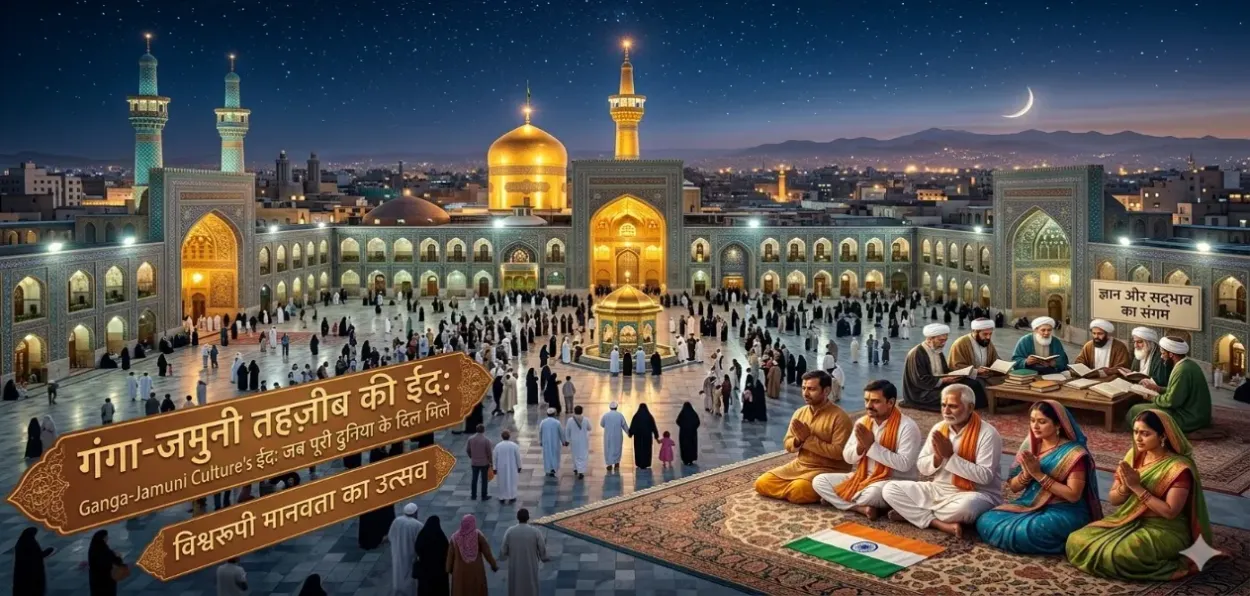
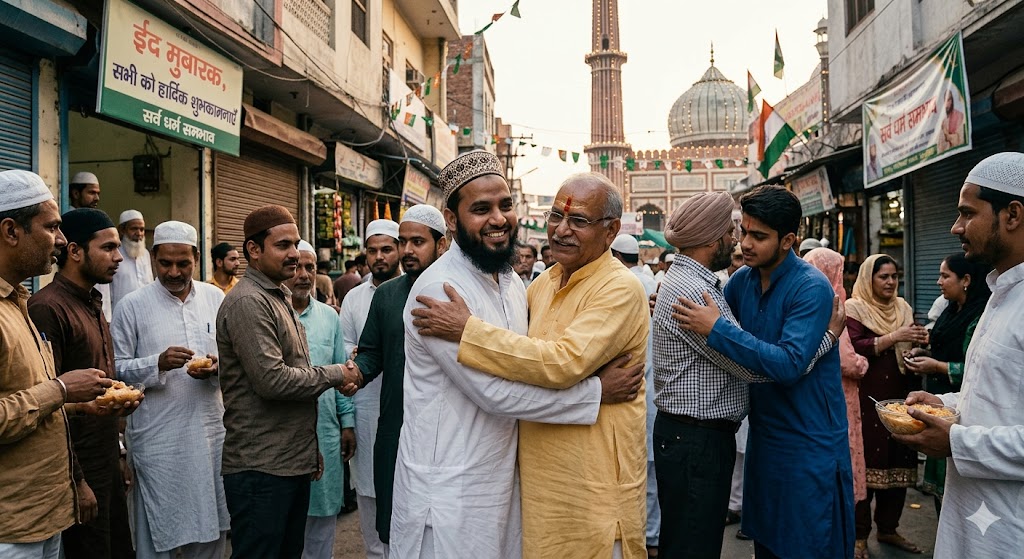
For centuries, a cultural current of diversity and unity has flowed through the soil of India. The festivals celebrated on its soil are not merely religious rituals; they serve as symbols of social harmony and the warmth of human relationships. Among these festivals is Eid—a celebration that brings with it the radiance of love, brotherhood, and shared joy.
Interestingly, the festive splendour of Eid is not depicted solely by the Muslim community; Hindu poets and bards, too, have long portrayed this spirit in their literary works with a profound sense of kinship.
For Hindu writers, Eid is not merely a religious occasion, but a celebration of human emotions—a time when the distances between hearts vanish, and relationships are filled with sweetness. It is for this very reason that the numerous works written on Eid in Hindi and Urdu literature serve as a reminder of that shared culture or the ‘Ganga-Jamuni Tehzeeb.’
The renowned poet Ram Prakash Rahi has presented Eid as a symbol of patience, hope, and spiritual illumination. In his verses, the Eid moon is not merely an astronomical phenomenon, but rather the cool, soothing shade of tranquillity found after enduring the intense heat of anticipation.
He views Eid as a destination that inspires individuals to look inward and purify their character. In his words, the true essence of Eid lies in piercing through the darkness to reach the light, and in embracing truthfulness, purity, and harmony in one’s conduct.
Similarly, Rangeshwar Dayal Saxena's Sufi has woven Eid and Holi together, viewing them as two strands of the same thread. For him, these two festivals serve as occasions to enrich the sweetness of human relationships.
He asserts that there is no room for discrimination during these festivals; rather, they are a time for hearts to unite. In his works, Eid emerges as a key that unlocks the closed doors of love, dispelling hatred, envy, and alienation.
Poet Rajesh Saklani’s poem, ‘Eid Ke Din’ (On the Day of Eid), portrays a magnificent confluence of nature and festivity. In his work, Eid is not confined merely to human interactions; rather, it spreads as a celebration throughout the entirety of nature. The lush greenery of the trees, the vibrancy of the fields, the crimson glow of the sky, and the fragrance carried by the breeze—all seem to unite as if offering their greetings for Eid.
This imagery conveys that festivals are not merely social occasions, but also profound natural experiences. In Saklani’s poem, the joyous laughter of children, the flight of kites, and the tender affection of a grandmother all combine to create a vivid tableau that lingers long in the reader's mind.
 Tansen, the great musician and poet of the Bhakti era, also present the joys of Eid in a truly regal style. He regards Eid as a festival of prayers, reverence, and generosity. In his compositions, Eid is not merely a source of personal delight but an opportunity to reinforce the tradition of mutual respect and the exchange of virtues within society.
The progressive poet Kedarnath Agarwal has portrayed Eid as a symbol of human unity. In his poetry, Eid signifies embracing one another—much like flowers blooming together on a single branch.
He views this festival as a sweet lotus amidst the saline ocean of life—one that inspires us to smile and move forward, even in the face of adversity.
In his vision, Eid represents a force that, despite every pain and struggle, keeps humanity steadfast on the path of hope and love.
Poet Shakuntala Mathur has depicted the celebration of Eid with tenderness, portraying it through the lens of the bond between a mother and child. In her poem, the morning of Eid begins with the playful insistence of a young child, filling the home with the scent of 'sewaiyan' (vermicelli), new clothes, and a new cap. This portrayal transforms Eid into a deeply domestic, familial, and emotional experience. The sparkle in the child's eyes, combined with the maternal affection woven into the mother's love, together bring the true essence of Eid to life.
The poet Himanshu Bajpai has described Eid as a festival of hope. In his works, the Eid moon signals a new beginning—a moment when the clouds of sorrow dissipate, and the radiance of joy spreads far and wide. He believes that Eid is an opportunity to rekindle fresh hope within the human heart. His verses convey the message that Eid serves to lift the human spirit out of despair and guide it toward hope.
Abot the Eid moon, it takes on a particularly profound symbolic significance. The renowned poet and lyricist Gulzar (A Sikh by birth) has captured this sense of anticipationabpout the festival with Moon's exquisite beauty.
In his poetry, the moon's delayed appearance symbolises the longing and pangs of separation from something valuable. It is precisely this anticipation that deepens the joy of Eid.
Poet Harbans Singh ‘Tasavvur’ also carries this very sentiment forward. For him, the Eid moon is not merely a visual spectacle in the sky, but rather an emotional experience—one that finds its true fulfilment in the arrival of a beloved. This sentiment conveys to us that the true essence of Eid lies in relationships, where the mere presence of a loved one renders the festival complete.
In the poetry of Kishan Kumar ‘Waqar’ as well, the Eid moon emerges as a symbol of love and allure. He associates it with the delicate nuances and beauty of romance, wherein a single fleeting glimpse is enough to set hearts aflutter.
The perspectives of all these writers make it clear that Eid is not merely a religious observance, but a celebration of human values. The sense of kinship and depth with which Hindu poets and bards have used this festival stands as a beautiful testament to India’s cultural unity.
Indeed, their works convey a message that festivals are not confined to one single community. They belong to society, and their purpose is to unite hearts, eradicate hatred, and foster love.
READ MORE: Kolkata's Dr Honey Qureshi is an angel for childless couples
.webp "Rocks bearing inscription in ancient Arabic excavated in Saudi Arabia's Madina region")








_(1).webp)