Ghulam Rasool Dehlvi
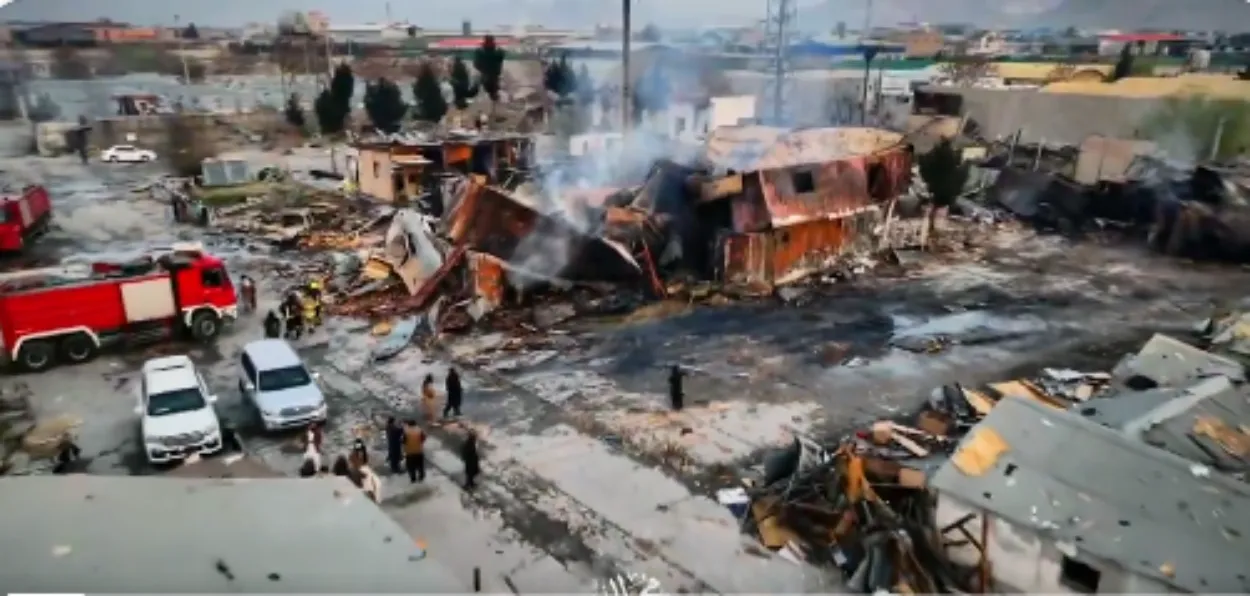
Pakistan striking a hospital in Kabul during the Ramadan—a month devoted to self-restraint, compassion and moral accountability—is a moral rupture and not just a tragedy. In a time when violence is to be restrained and compassion elevated, the killing of innocent civilians in a place of healing stands in stark contradiction to the very spirit of Islam. The reported Pakistani airstrike on a Kabul hospital has shaken not only a conflict-weary region but also the moral conscience of those who claim adherence to Islam. A time meant for restraint, mercy and heightened awareness of human suffering has instead been marked by an act that raises profound ethical questions.
How far can power go against humanity and the moral boundaries laid down by religion?
Hospitals are not battlefields. They are sanctuaries of healing, spaces where the weak, the sick and the vulnerable seek refuge. In Islamic thought, such spaces carry an implicit sanctity. To bomb a hospital—whether by intent or reckless indifference—is not merely a strategic or operational failure, it is a direct violation of the moral limits placed by Islam in warfare. It represents not just destruction, but fasad fil-ard—the spreading of corruption and chaos on earth.
No justification can erase the tragedy that befell patients buried under rubble, of children who are dead before they even understood the world, and of bereaving families. The Qur’anic principle is unequivocal: the taking of one innocent life is akin to the killing of all humanity. By this standard, the mass killing of civilians in a place of care is not collateral damage—it is a grave moral transgression of the highest order.
India’s Ministry of External Affairs has strongly condemned the attack during the holy month of Ramadan. Randhir Jaiswal, MEA Spokesperson, said that the timing of the strikes during the sacred month as particularly “reprehensible” and “unjustified”. In Islam, Ramazan is not merely about fasting; it is about disciplining power, curbing anger, and embodying mercy. To carry out or justify such violence during this sacred period is to stand in stark contradiction to its very spirit.
BREAKING 🚨
— FalconUpdatesHQ (@FalconUpdatesHQ) March 17, 2026
🇵🇰 🇦🇫 UN rights expert labels Pakistan’s Kabul hospital strike a war crime.
Over 400 civilians dead, 300+ injured in PAF bombing. pic.twitter.com/9k6v8vLV0n
Islamic teachings leave no ambiguity on the conduct of war. The Prophetic traditions laid down strict and binding ethical constraints: women, children, the elderly, the sick and all non-combatants are inviolable. Even in the heat of conflict, Muslims are commanded not to destroy crops, not to harm places of worship, and not to transgress limits. A hospital—occupied by the wounded and those providing care—represents the clearest possible category of protected non-combatants. To strike it is to violate these principles in their most explicit form.
It must also be stated clearly that condemning such violence does not amount to endorsing any militant group or ideology. Many of us have consistently opposed violent extremism, including the Taliban’s model of enforcing Islam through armed force. The idea that religion can be imposed at gunpoint has always been morally and intellectually untenable. However, rejecting militancy cannot—and must not—translate into accepting the indiscriminate use of force by states.
There can be no moral double standards. If the killing of civilians by non-state actors is condemned as terrorism, then the killing of civilians by state forces must be condemned with equal moral clarity. Islam demands consistency in justice, not selective outrage.
And yet, perhaps the most disturbing aspect of this entire episode is not just the violence itself, but the silence that surrounds it.
The silence of large sections of Pakistan’s religious leadership is both striking and deeply troubling. In Islamic ethics, remaining silent in the face of injustice is not neutrality—it is a failure of duty. A well-known Prophetic teaching makes this explicit: one must oppose wrongdoing by action, by speech, or at the very least, by moral rejection in the heart. Silence, when speech is possible, signals a dangerous erosion of moral courage.
But why is it that the same ulema in Pakistan who castigated Israeli airstrikes on Iranian children with such conviction now fall silent when innocent civilians and patients are killed in an Afghan hospital? This selective outrage undermines the very moral authority they claim to uphold.
The same Pakistani ulema who speak with urgency on matters of sectarian identity or theological debate appear hesitant when confronted with the mass killing of innocent civilians. This silence cuts across sectarian lines—whether Salafi, Deobandi, Ahl-e-Hadith or others. It raises an uncomfortable question: has the sanctity of human life become secondary to political convenience? This inconsistency raises serious questions about moral and theological integrity.
The consequences of such silence are profound. It creates moral confusion, weakens ethical clarity, and allows more extreme and less responsible voices to dominate public discourse. When principled voices withdraw, unprincipled narratives take their place.
🚨BIG --- PAKISTAN WILL PAY THE BILLS!
— Major Sammer Pal Toorr (Infantry Combat Veteran) (@samartoor3086) March 18, 2026
This is the funeral of those who were martyred in the brutal bombing of the 2,000-bed hospital by the Pakistani military regime. This is a grave crime that cannot be forgiven. We will inevitably take revenge. pic.twitter.com/Rhomn7SKTu
Beyond the moral dimension, the strategic consequences of such actions are equally alarming. History has shown that indiscriminate force does not eliminate threats—it multiplies them. Every civilian casualty becomes a seed of resentment. Every destroyed home becomes a legacy of anger passed from one generation to the next.
The region, already burdened by decades of conflict, cannot afford another cycle of violence. Escalation will not bring stability; it will deepen instability. The path forward lies not in overwhelming force, but in restraint, accountability and sincere dialogue.
There is an urgent need for transparent and impartial investigations into incidents involving civilian casualties. Justice must not only be done—it must be seen to be done. Without accountability, such tragedies will continue to repeat themselves, eroding both political legitimacy and moral order.
Ultimately, the question before us is simple yet profound: do we still believe in the sanctity of human life as affirmed by both conscience and faith, or have we reduced it to a casualty of strategy?
Because if hospitals can be bombed, if civilians can be dismissed as collateral damage, and if religious voices remain silent in the face of clear injustice, then the crisis before us is not merely political—it is civilizational.
From an Islamic ethical perspective, the bombing of a hospital is indefensible under any circumstance. It violates the Qur’anic sanctity of life, the Prophetic prohibition on harming non-combatants, and the long-standing Islamic protection of places of care and refuge. Islam does not permit the targeting of civilians under any pretext—whether by non-state actors or by states. Legitimacy of power does not grant immunity from moral accountability. When power turns indiscriminate, it forfeits its moral claim.
ALSO READ: Pregnant Bushra Bano appeared for the Interview, became an IPS Officer
This is not merely a political failure of Pakistan—it is a breach of core Islamic principles.
Ghulam Rasool Dehlvi is an Indo-Islamic scholar and author

.webp "Union Home Minister Amit Shah")