Ashfaq Qayamkhani/Jhunjhunu
Rajasthan is the land of brave men and women who are known for their valour, discipline, and patriotism. It’s not only the men of the desert state who wear the badge of honour, but even the daughters of the soil working in the Indian Army are highly placed and have made Indians proud.
Among them is a woman from Nuaan, a small village in the Jhunjhunu district, who has left an imprint on history by becoming the first top-ranking Muslim woman in the Indian Army.
She is Colonel Ishrat Ahmed, who comes from a family where generations joined the administration, police and the military Services. For this reason, Nuaan village is the “village of officers”.
Recently, Colonel Ishrat Ahmed was entrusted with the command of an Ordnance Unit of the Indian Army in Meerut.
This achievement is not merely a job promotion, but a moment of pride for the Qayamkhani community and Rajasthan. She is the first woman officer from this community to reach such a top position and hold a key responsibility in the Army.
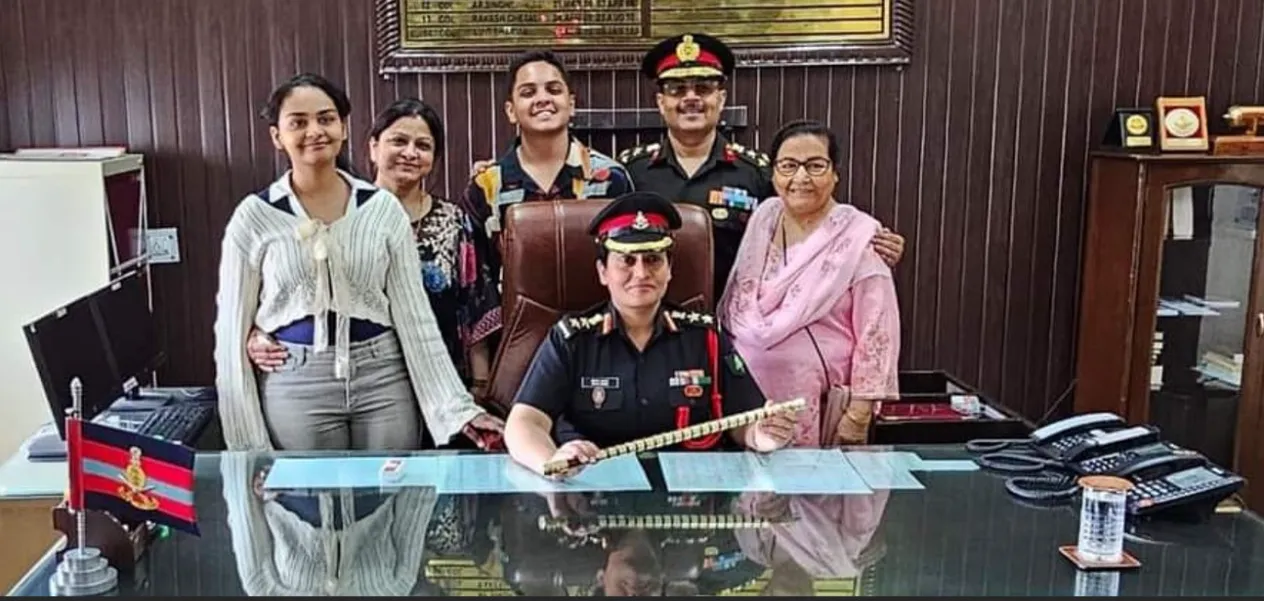 Col Ishrat Ahmed with her family at the time of taking command of the Ordrance unit
Ammunition Ishrat Ahmed's choice of profession is from her family. However, she worked hard for it.
Her father, the late Lieutenant Colonel Zaki Ahmed, was the first officer from Nuaan village to receive a direct commission in the Army Education Corps in 1971. Discipline, integrity, and patriotism were the cornerstones of his life—values that deeply shaped Ishrat and her siblings.
Her brother, Saqib Hussain, serves as a Brigadier in the Indian Army. He holds the distinction of being the first Brigadier from the Qayamkhani community.
Ishrat’s maternal grandfather also served as a Captain in the Army.
Growing up surrounded by uniforms, medals, and an atmosphere of discipline, joining the Army was not merely a career choice for Ishrat—it was a natural calling.
When she was commissioned into the Indian Army in 2001, she stepped in fully prepared to face every challenge. She proved that legacy is not sustained by name alone; it must be carried forward through merit and capability.
Colonel Ishrat’s family legacy extends beyond the military into administrative services as well. Her uncles, Ashfaq Hussain and Zakir Hussain, served in the Indian Administrative Service, holding posts such as District Collector.
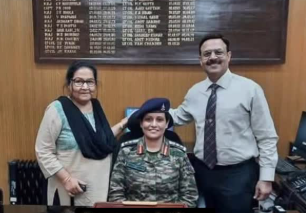 Col Ishrat Ahmed with her brother and mother in her office
The family’s son-in-law, Qamarul Zaman Chaudhary, is currently the District Collector of Sikar. In the police services, the late Liaqat Ali Khan became Rajasthan’s first Muslim Inspector General.
Her sister Farah Hussain is an officer in the Indian Revenue Service, while another sister, Kayanat Khan, serves as a Legal Draftsman in the Jaipur Secretariat.
Names such as Shaheen Khan, Monika Shaheen Khan (DIG Prisons), Saleem Khan, Sana Khan, and Javed Khan further strengthen the family’s presence in the Rajasthan Administrative Service. So many high-ranking officers within a single family is extraordinary—and a source of inspiration for generations to come.
In the true tradition of the Military, Colonel Ishrat Ahmed retains her simplicity and stays away from media glare.
Her sister Shabnam Khan told Awaz-the Voice that whenever Ishrat visits Nuaan village, she devotes her time to motivating the youth—especially young girls – to guide them about career opportunities in the Army, competitive examinations.
She believes that the uniform is not merely a job, but a symbol of responsibility toward the nation and society.
Her mother, Shameem Bano, is very proud of her son and daughter, who are serving the nation at senior ranks in the Army.
When Colonel Ishrat took command of her unit in Meerut, her mother and Brigadier Saqib Hussain stood by her side. That moment symbolised not just a family’s achievement, but also a changing social landscape and the growing participation of Muslim women.
For the Qayamkhani community, this achievement holds special significance. Historically associated with bravery and military traditions, the community has also carved a distinct identity in education and administrative services in modern times.
Colonel Ishrat’s success has infused new energy within the community. Thought leaders believe this accomplishment will serve as a guiding light for future generations.
Colonel Ishrat Ahmed’s story shows that legacy is not built merely on rank or prestige—it is sustained through continuous hard work, dedication, and discipline. After her father’s passing in 1995, the resilience and unity with which the family moved forward are truly inspiring. They proved that even the toughest circumstances cannot withstand strong willpower.
As Col. Ishrat Ahmed leads an Ordnance Unit in Meerut, the young women in the Nuaan village are dreaming of joining the army of regimented forces.
ALSO READ: JK bureaucrat Anissa Nabi promotes fitness among women, youth
Ishrat Ahmed is an Army officer, but a belief, a symbol of the indomitable womanhood of Rajasthan's Kayamkhani community.


.webp "Representational Image")








_(1).webp)