




 Rajeev Narayan
At its narrowest, the Strait of Hormuz is barely 34 kilometres wide. Yet through this slender corridor flows a fifth of the world’s oil, a volume so vast that even a temporary disruption can send shockwaves across the globe. Today, as tensions involving the United States, Israel, and Iran oscillate between escalation and restraint, the strait has become more than a geographic feature. It has turned into a barometer of global stability.
TOP OF MIND
Defining this crisis is not by its intensity but by its unpredictability. After all, ceasefires can be called overnight, and blockades tightened without warning. In such a fluid environment, predictions tethered to any present moment risk becoming obsolete by the next. The enduring question is not what happens next, but what could. And how prepared nations are for each possibility!
Three Possible Paths
Visibly, the conflict is gravitating toward three trajectories. The first is a measured de-escalation; diplomatic backchannels prevail, hostilities subside, and the Strait of Hormuz reopens. Oil prices retreat, markets stabilise, and the world breathes a sigh of relief. This is the optimistic scenario. And historically, it is not impossible. Yet even here, the aftershocks linger. Risk premiums remain elevated, supply chains stay cautious, and the memory of disruption reshapes future behaviour.
The second is an extended standoff. No full-scale war, but no resolution. The strait remains frequently disrupted, shipping costs stay high, and oil prices hover at elevated levels. This is the most likely outcome: a slow-burning crisis that normalises volatility. In such a world, uncertainty becomes embedded in economic planning and resilience becomes a permanent requirement.
The third is a full-scale escalation. Military standoff intensifies, the strait is choked, and energy flows are disrupted. Oil prices spike, global growth falters and inflation surges across economies. This is the least desirable outcome, but one that cannot be dismissed.
For India, each path carries implications. Yet all of them point to a common reality: vulnerability.
Battling Energy Faultlines
India’s dependence on external energy – 85 per cent of its crude needs are imported – makes it sensitive to short-circuits in the Gulf. In a de-escalation scenario, the impact may be temporary, a short spike absorbed through policy buffers. But in a prolonged standoff, sustained high prices will strain fiscal balances, weaken the rupee and push inflation into uncomfortable territory.
In the worst-case scenario, the outcome becomes systemic. Fuel costs surge, transport becomes costlier, and food inflation rises as fertiliser prices climb. Economic growth slows, not because of domestic inefficiency but due to an external shock. This is the paradox of India’s growth story – its momentum is domestic, but its fuel is external.
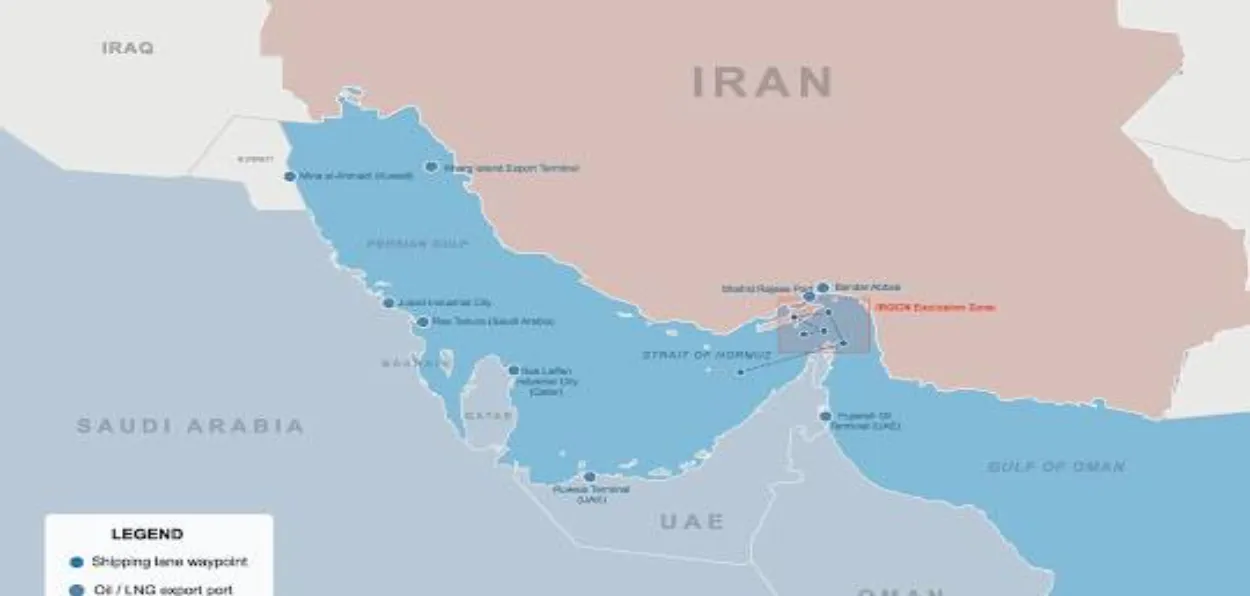
Strait of Hormuz (Map)
Beyond energy, the fallout ripples through trade and supply chains. The Gulf is a transit hub. Disruptions here extend shipping routes, inflate freight costs and delay deliveries. In a standoff, these inefficiencies become structural, eroding competitiveness for Indian exports. Industries from textiles to engineering goods face margin pressures, while imports of critical inputs such as fertilisers and petrochemicals become more expensive and less predictable. What begins as a maritime disruption evolves into an economy-wide cost escalation.
The lesson: In an interconnected world, chokepoints are not geographic; they are systemic.
Diaspora Stakes
Overlaying these economic risks is a dimension that remains unspoken. Lakhs of Indians live and work in the Gulf, one of the largest expatriate communities in the world. Their remittances sustain households, support consumption and underpin local economies across India.
In a de-escalation scenario, their lives may return to normal with minimal disruption. In a standoff, economic slowdown in host countries could affect employment and incomes. In a full-scale conflict, the risks escalate, triggering evacuations, job losses, and a reversal of migration flows. For India, this is not just a foreign policy concern; it is a domestic economic variable.
Amid this uncertainty, the Indian government’s response has been notable. By diversifying its crude sourcing, tapping into strategic reserves and maintaining calibrated communication, New Delhi has managed to avoid the panic that often accompanies such crises. Equally important is India’s diplomatic posture. By engaging with Washington, Tel Aviv, Tehran and key Gulf capitals, India has preserved its strategic space, neither aligning nor disengaging entirely. The absence of disruption within the country is a testament to this steady, understated approach.
Strategic Reset
ALSO READ: Why 7th century Buddhist monk Hiuen Tsang is celebrated in India, China
This crisis underscores the need for a strategic reset. The era of assuming stable energy flows and secure trade routes is over. The new reality is one of intermittent disruption, where resilience must be designed into the system. For India, this means accelerating energy diversification, expanding renewable capacity and strengthening strategic reserves. It also means investing in alternative trade corridors and enhancing maritime security to reduce exposure to single points of failure.
Diplomatically, it calls for a refinement of multi-alignment… not just as a balancing act, but as a proactive strategy to shape outcomes.










_(1)_(1).webp)



.webp)
.webp)

_(1).webp)