





Amir Suhail Wani
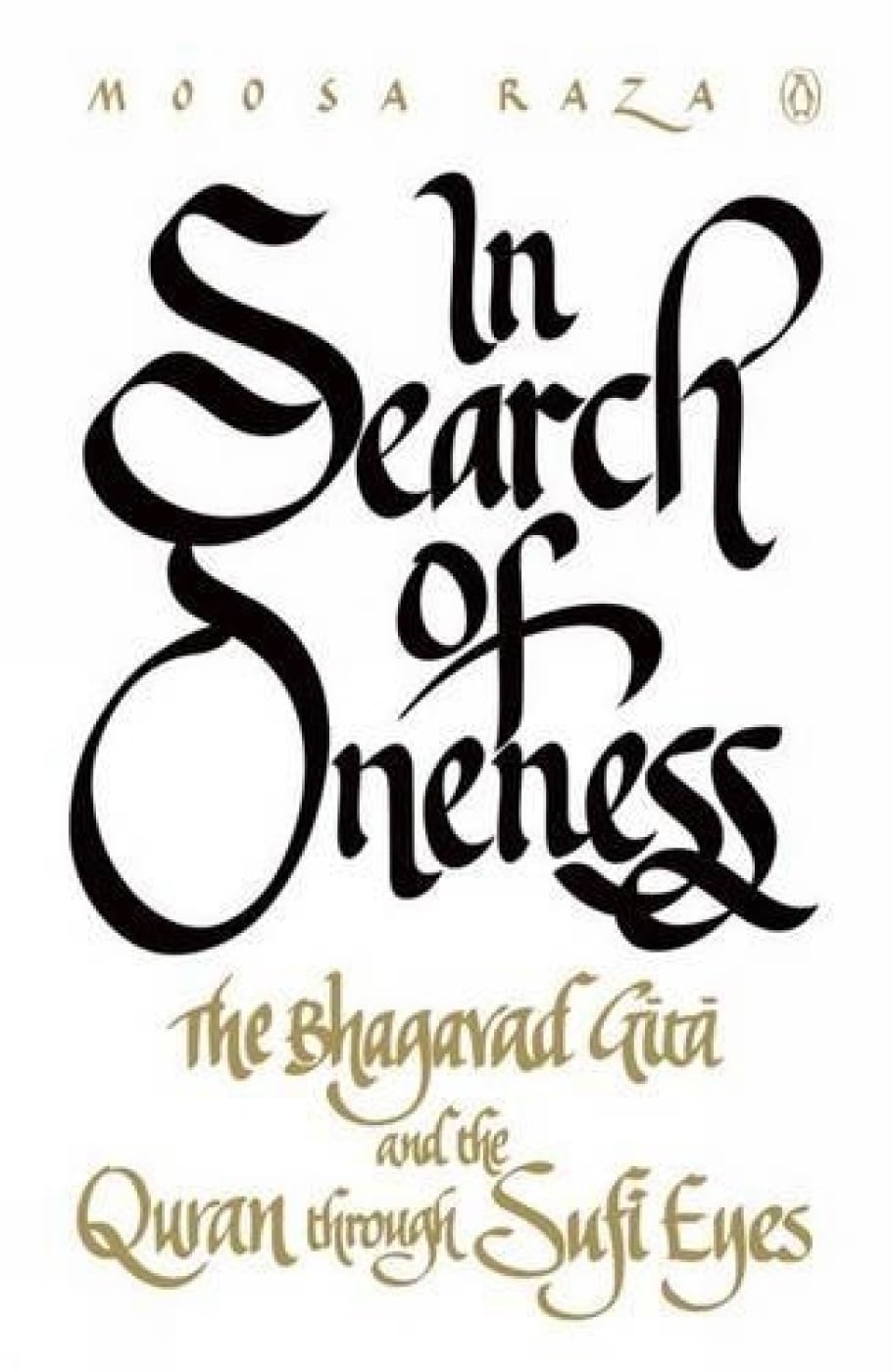
At a time when religious identities are increasingly mobilised to create distance rather than deepen understanding, In Search of Oneness: The Bhagavad Gita and the Quran through Sufi Eyes by Moosa Raza emerges as a deeply contemplative and much-needed intervention.
The book is not merely a comparative reading of two sacred texts—the Bhagavad Gita and the Quran – but a sincere and introspective journey into the heart of spiritual unity. Raza offers a voice that is neither polemical nor apologetic, but quietly transformative. His work seeks to remind readers that religion, at its deepest level, is not about boundaries but dissolving them in the search for ultimate truth.
Raza’s work can be considered a spiritual memoir that gradually unfolds into a work of comparative theology. The author's engagement with other traditions, particularly Hindu philosophy, is marked by humility and curiosity rather than judgment or superiority. This shift—from a religiosity defined by boundaries to a spirituality defined by experience—is one of the book’s most powerful movements. It reflects a journey many seekers grapple with: how to remain faithful to one’s tradition while remaining open to truth wherever it may be found.
 As Raza immerses himself in the teachings of the Bhagavad Gita, he begins to uncover echoes of the ethical and spiritual principles he already knows from the Quran. These resonances are not presented as forced equivalences or simplistic parallels, but as organic insights that arise through contemplation. Importantly, this engagement is filtered through the lens of Sufism, which allows him to move beyond literalism and into the symbolic, experiential dimension of religion. In doing so, Raza demonstrates that universality is not achieved by diluting identity, but by deepening it to the point where it naturally connects with others.
The core of the book rests on the Sufi doctrine of Wahdat al-Wujud, most famously articulated by the great mystic Ibn Arabi. This idea—that all existence is a manifestation of a single, unified Reality—serves as the interpretive key through which Raza reads both the Bhagavad Gita and the Quran. Under this lens, doctrinal differences begin to recede, and a shared spiritual grammar comes into focus, revealing a deeper layer of harmony beneath apparent diversity.
For instance, the Gita’s teaching of nishkama karma, or selfless action performed without attachment to results, is akin to the Quranic emphasis on righteous deeds carried out with sincerity and without ostentation.
Similarly, the Islamic practice of dhikr—the constant remembrance of God—mirrors the Hindu disciplines of sadhana and bhakti, both of which aim to cultivate an unbroken awareness of the Divine presence. Perhaps most striking is the shared emphasis on surrender: the very word “Islam” signifies submission to the Divine will, while the Gita culminates in the call for sharanagati, or complete surrender to God. Through such parallels, Raza does not attempt to collapse differences but rather to illuminate a shared orientation toward transcendence.
The book delves into the history of Hindu–Muslim relations in India. Rather than entering the terrain of political argument or historical grievance, Raza offers an alternative rooted in spirituality. He suggests that the path to unity does not lie in debates over identity or power, but in a deeper understanding of the shared metaphysical and ethical aspirations.
Like Kabir and Guru Nanak, who challenged rigid religious boundaries and emphasised a direct, personal relationship with the Divine, Raza focuses on the inner essence of religions.
The book does not advocate for a superficial or forced unity. Instead, it proposes a more nuanced and mature vision: that true unity lies not in sameness, but in recognising that diverse paths can lead to the same ultimate reality. This insight allows for a pluralistic framework in which traditions retain their distinctiveness while participating in a shared spiritual horizon. It is a vision that is both inclusive and respectful—one that acknowledges difference without turning it into division.
Raza avoids dense jargon and technical language, opting instead for clarity and accessibility. This makes the book approachable to a wide range of readers, including those who may not have a formal background in theology or philosophy. His prose invites contemplation rather than argument, encouraging the reader to engage with the material at a personal level.
The author’s encounters with spiritual teachers, moments of doubt and questioning, and flashes of insight add a layer of intimacy to the narrative. These personal reflections serve as a bridge between abstract philosophy and lived experience.
However, this approach leads to the book’s limitations. Readers looking for rigorous textual criticism or detailed scholarly analysis may find the treatment somewhat selective, as Raza tends to emphasise points of convergence over areas of tension. Yet, this selectivity is not necessarily a weakness; it is a conscious choice aligned with the book’s purpose, which is not to debate but to illuminate
In the contemporary socio-political landscape, where religious polarisation often shapes public discourse, In Search of Oneness performs a subtle yet vital cultural role. It serves as a reminder that the spiritual history of the Indian subcontinent is not solely defined by conflict, but also by centuries of dialogue, mutual influence, and shared seeking.
ALSO READ: RJ Saima's Purani Jeans revived love of golden era music among youth
By placing the Bhagavad Gita and the Quran in conversation, Raza invites readers to step beyond inherited prejudices and to encounter the “other” not as an adversary, but as a fellow traveller on the path toward truth.


_(1)_(1).webp "Khanqah Emadia Qalandaria, Patna, Bihar")










.webp)


.webp)