 Aditi Bhaduri
As large parts of the world celebrate Buddha Purnima, tradition reminds us that over 2,500 years ago, Prince Siddhartha Gautama—who would become Gautama Buddha, the Enlightened One—was born on this day. It is also believed that on this very day, he attained enlightenment under the Bodhi tree at Bodh Gaya in present-day Bihar, and years later, at the age of 84, entered Mahaparinirvana—the final release from the cycle of life and death.
On this occasion, one is drawn back to the Buddha’s simple yet profound message: “Be your own light. Nothing is permanent.” This timeless teaching recently found renewed resonance for me while watching a film on the great seventh-century Chinese monk and scholar, Xuanzang—known in India as Hiuen Tsang.
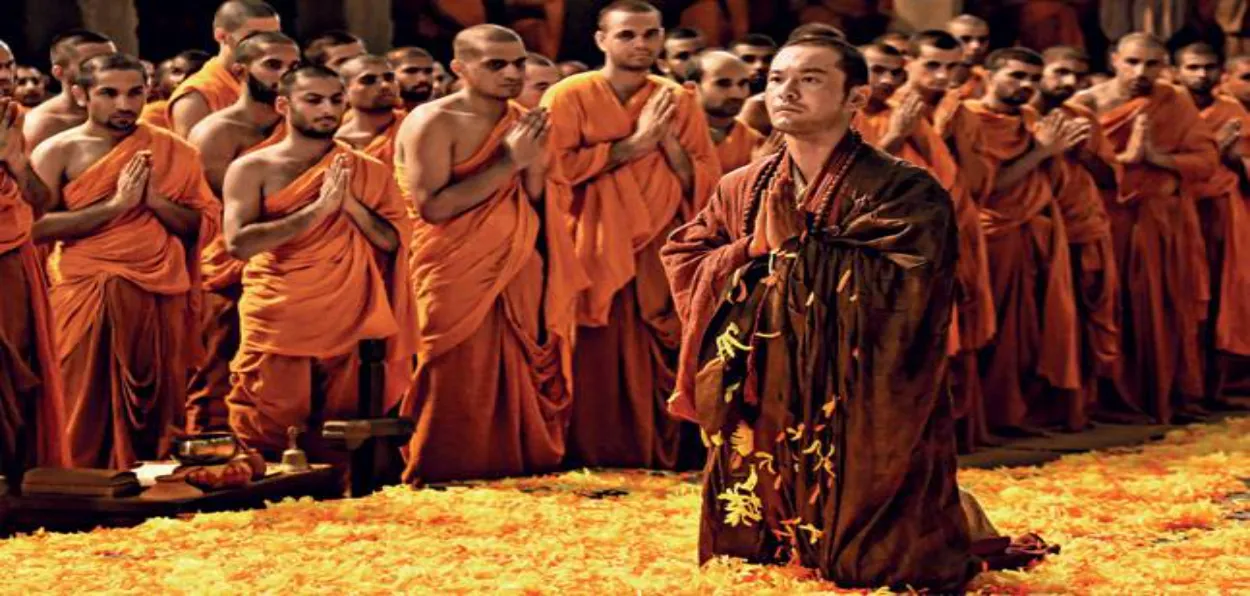
The film, Xuanzang: Journey to the West, traces the extraordinary travels of this young monk from China to Nalanda in India. Jointly produced by India and China, it opened the Kolkata China Film Festival, held after a decade-long hiatus with the support of the Chinese Consulate in Kolkata. It was a fitting choice, for Xuanzang remains one of the most enduring symbols of the deep civilisational and spiritual ties between the two countries.
In many ways, Xuanzang stands as a remarkable cultural bridge—not just between China and India, but across time itself. His life exemplifies the Buddha’s teachings on impermanence, detachment, and the pursuit of higher truths. He did not merely preach these ideals; he lived them, allowing his journey to become a testament to faith, resilience, and purpose.
Born during the Tang dynasty, a period marked by political turbulence, Xuanzang was drawn early to the monastic life. As he travelled across China, he realised that the Buddha’s teachings had often been distorted or diluted. Determined to access the original scriptures, he resolved to journey to India—to Nalanda, the great seat of Buddhist learning—in search of texts in their original Sanskrit and Pali.
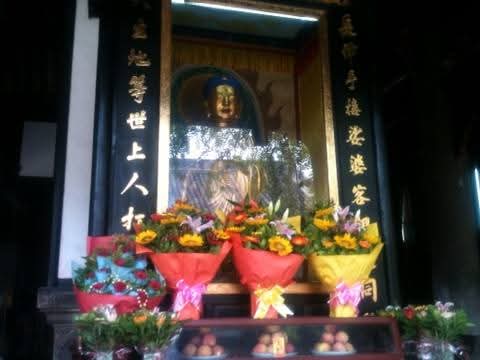 Manjushree Monastery, Chengdu where the skull of Huien Tsang is preserved as a relic
There were moments of temptation. In one region, a local ruler, impressed by his wisdom, urged him to stay back as the head monk, offering him comfort and luxury. But Xuanzang declined. Material pleasures, he believed, were fleeting. His purpose lay elsewhere—in the pursuit of knowledge and truth.
After 17 arduous years, he reached Nalanda. There, he immersed himself in study, engaging in scholarly debates and travelling to sacred sites associated with the Buddha. His intellect, humility, and sincerity earned him deep respect. He also participated in intellectual discourses held by King Harshavardhana, further establishing his reputation as a scholar of great insight.
Xuanzang’s message echoed the Buddha’s teachings: nobility lies not in birth but in action; compassion and non-violence are the highest virtues. After years of study and exploration, he returned to China carrying with him 657 manuscripts. Though he translated only a portion of the texts, his work helped understanding of Mahayana Buddhism in China.
His writings on India remain among the most valuable historical records of the subcontinent in the seventh century. They offer insights into a time when intellectual exchange flourished, and when rulers of different faiths supported diverse religious traditions, including Buddhism.
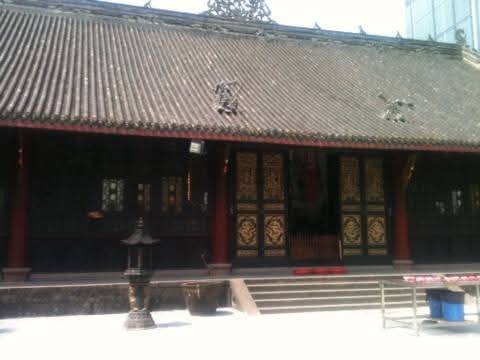 Daci Monastery in Chengdu (Pics by Aditi Bhaduri)
Centuries later, when I visited the Daci Monastery in Chengdu—where Xuanzang once lived and worked—the sense of continuity was striking. Despite the upheavals of history, the monastery remains serene and vibrant. As I walked through its quiet pathways, I could almost imagine the young monk, centuries ago, absorbed in thought, memorising sutras under the same open sky.
Xuanzang’s legacy is not confined to history. It continues to resonate in today’s world, marked as it is by divisions and discord. His life reminds us of a time when India and China were bound not by rivalry, but by shared intellectual and spiritual pursuits. Indeed, there is little historical evidence of conflict between the two civilizations until the mid-20th century. Instead, theirs was a relationship of mutual enrichment—India offering spiritual thought, and China preserving and expanding it.
The film captures this spirit beautifully. Anchored by a powerful performance by Huang Xiaoming—who won the Best Actor award at the 13th Changchun Film Festival in 2016—it is more than a biographical account.
More importantly, the film symbolises the deep cultural ties and collaborative spirit between Indian and Chinese civilisations. Huien Tsang/Xuanzang remains the most shining example of age-old cultural, spiritual, and civilizational ties between India and China. Throughout history, there have been no records of any conflict between India and China till towards the mid-20th century.
.jpg)
Poster of the film Xuanzang: Journey to the West
On the contrary, India contributed to the development of Chinese traditions, customs and spirituality through Buddhism. In turn, those like Huien Tsang helped in contributing and enriching us about facets of our own history and identity. India and China have complemented each other's histories and societies.
The film serves as a reminder that this can be possible once again. India and China are not destined to be rivals, and faith and compassion can still show us a peaceful path ahead.
In a world increasingly defined by polarisation, Xuanzang’s journey offers a different narrative—one of curiosity, humility, and connection. It reminds us that nations, like individuals, need not be adversaries. With compassion and understanding, they can instead become collaborators in a shared human journey.
ALSO READ: Ancient Russian festival of Maslenitsa is akin to Holi, Lohri
Perhaps that is why a seventh-century monk continues to matter today.
This is how Nalanda appeared to the Chinese travelers. The colour picture is a grab from 2016 Chinese movie "Xuanzang". The B/W pictures show the site as it was in 1915 when the ASI undertook first proper excavation. pic.twitter.com/fhnb2OKCrr
— Anuj Dhar (@anujdhar) June 19, 2024
.webp "Union Home Minister Amit Shah")







_(1).webp)