




Nitin Sawant Parbhanikar
The historic Panhalgad in Kolhapur district is not just a fort commemorating the sagas of valour, but also a symbol of 'Ganga-Jamuni' tehzeeb and an amalgam of Hindu-Muslim spiritual traditions.
Hazrat Peer Shahaduddin Khattalwali is treated as the village deity of Panhala, where his Urs is currently being celebrated with great enthusiasm by people of all religions.
This festival, which preserves the legacy of social harmony for over 900 years, also showcases the deep roots of the Sufi tradition in Maharashtra.
Shahaduddin Khattalwali came to Panhala from Iran, and his unique shrine is inside the fort.
"All things in this world perish; God alone remains eternal." is the Inscription on the grave inside the Dargah of Hazrat Peer Shahaduddin Khattalwali alias Sadoba.
India, endowed with a rich heritage of nature, myriad religions and philosophy, has fascinated everyone from Buddhist-Chinese travellers like Huien Tsang and Fahian to Sufis from Arabia.
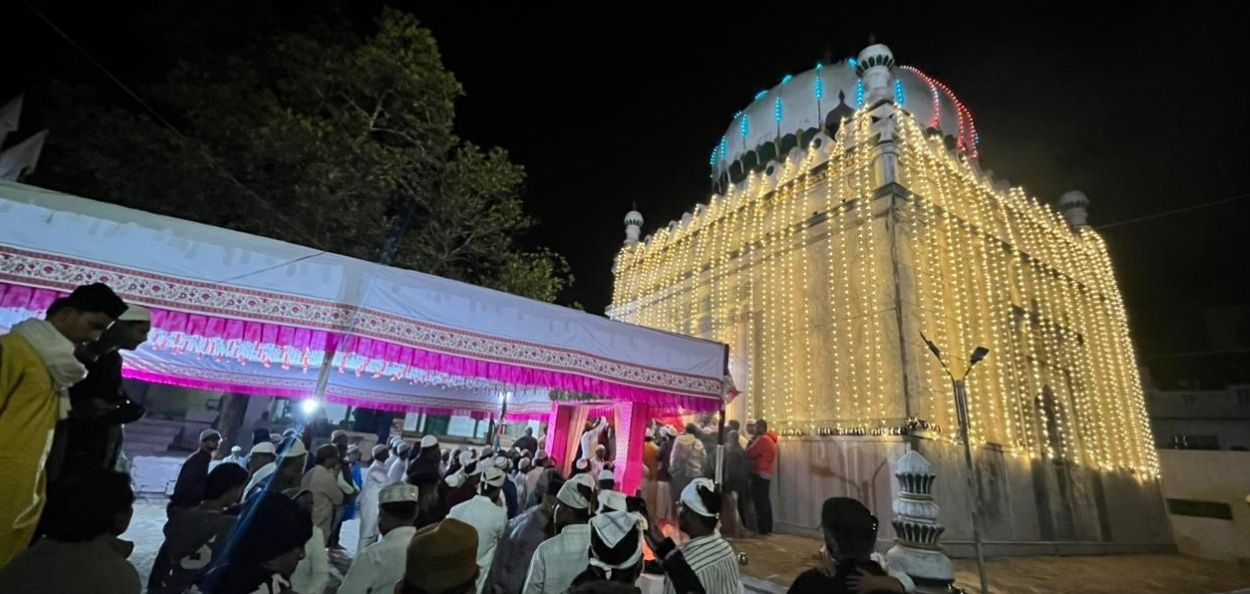
The shrine of Sadoiba Peer illuminated on the occasion of Urs
About this land, Amir Khusrau says: "Ast mera maulid wa mava vatan, Kishware Hind bahishte bar zamin" (Hind is my birthplace and my country, and it is a paradise on earth.)
The fact that Sufi saints named a city settled by them as the 'City of Paradise' (Khuldabad) not only tells of the greatness of this land but also the magnanimity of the Sufis. They possessed a generous, broad, and all-encompassing vision.
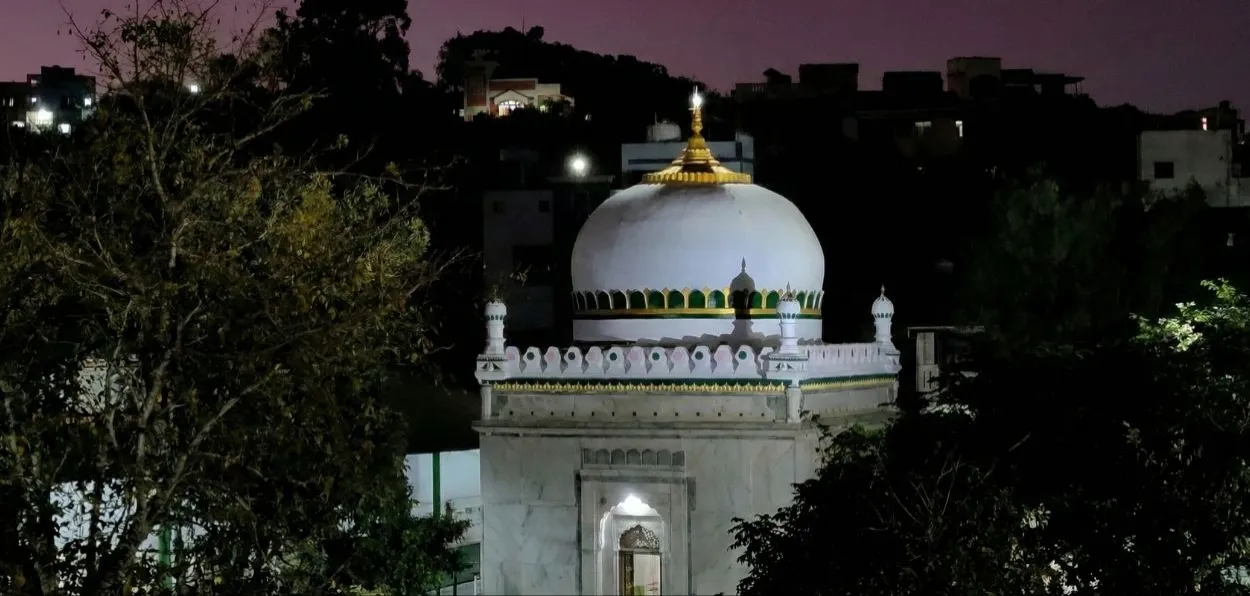
The Beauty of Sadoba Dargah on Panhalgad
The shrines (Mazars), Dargahs, and many Sufis who traveled thousands of kilometers to serve the poor of this land and are resting in this soil till eternity, show us the footprints of history. In the world of shrines and Dargahs in Kolhapur, the 'Sadoba' Dargah on Panhala Fort inevitably catches one's attention.
Situated about 20 km from Kolhapur city, it’s located near the entrance gate of Panhalgad (Fort). It stands as a beautiful and enchanting Dargah. This shrine spread over15 gunthas is located between two lakes. It was built by Khizr Khan, the chief minister during the reign of ruler Ibrahim Adil Shah.
The Parashar Lake in front of the Dargah's entrance is ancient. It was constructed during the Bahmani and Shilahar regimes.
The name "Hazrat Peer Shahaduddin Khattalwali Dargah Panhala" is written in bold letters on the arch of the Dargah, and it grabs the attention of visitors.
As one enters through this small gate-like arch, numerous shrines with enchanting stone carvings become visible. One notices that the carving and structure on the stones of these shrines are quite different from those of other shrines in Maharashtra.
Local Muslims said that these arts in 'Turkish' style and such ornate shrines are found nowhere else in Maharashtra. T
These shrines stand in a row in the front part of the main Dargah. Upon entering the main Dargah, one can see three shrines inside. The main large shrine on the left belongs to Hazrat Shahaduddin Khattalwali.
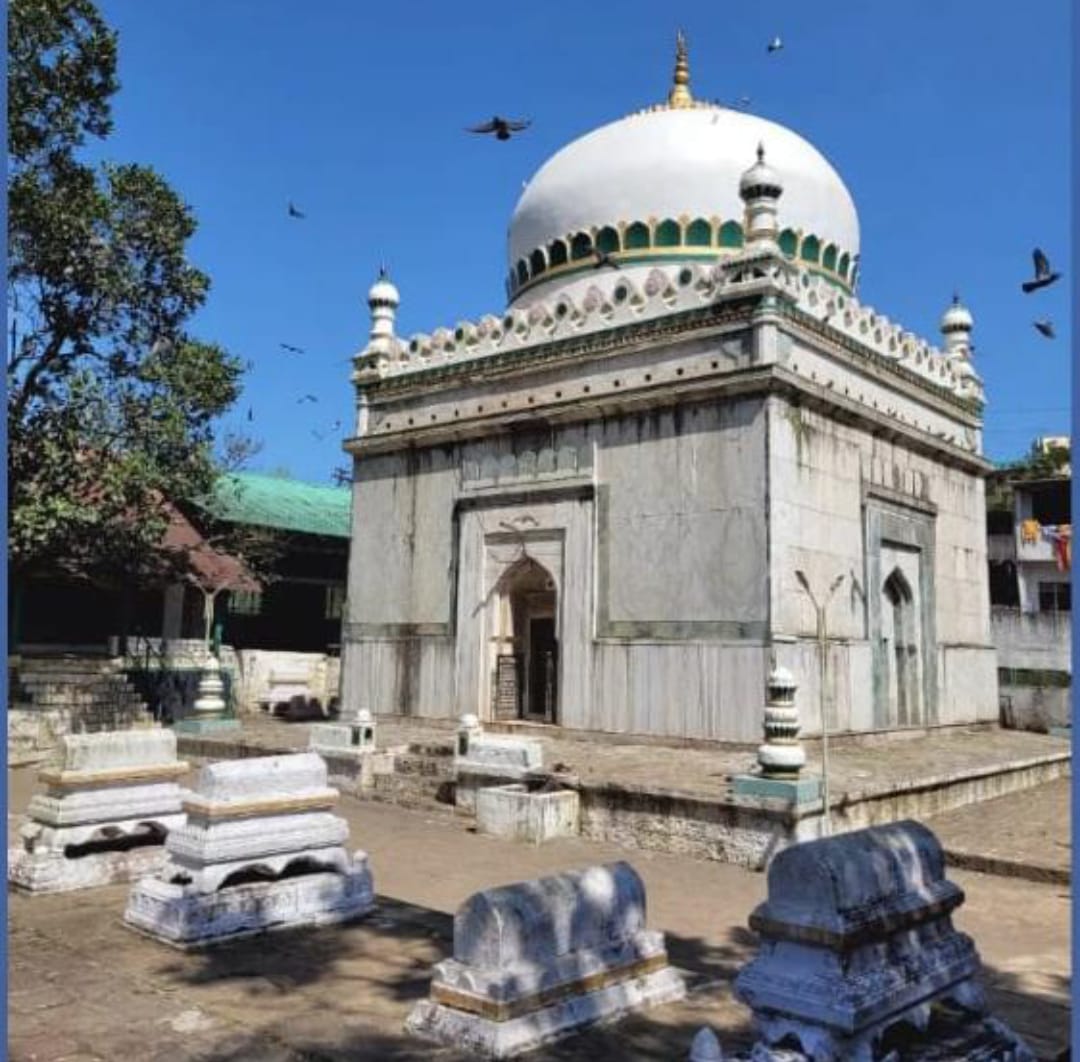
The shrine of Hazrat Sahauddin Khattalwali and grave of his sons inside the fort
The small shrine in the middle belongs to his son, Masoom Saheb. Hazrat Shahaduddin Khattalwali was blessed with a son after many years, but Masoom Saheb passed away at a young age.
On Masoom Saheb's shrine, the Sufi saint Shahaduddin Khattalwali has carved very heart-touching poems in the Persian language out of love for his son. The third shrine belongs to his wife, Ma-Saheb.
This Sufi saint, known as 'Sadoba' (Sadhu Baba) in the local dialect, came to Panhalgad with his entire family from the Janjan province of Iran in the 12th century, approximately 900 years ago. His era is from 1376 to 1397 AD. During this period, Shahaduddin Baba received royal protection from the Bahmani kings.
Although this fort was under the Bahmani Muslim rule during the period 1347-1527 AD, the local fort keepers were Marathas (Shirke). When Sadoba Baba first came to Panhala, he established the first Muslim settlement in that area named 'Nabipur' (Nebapur). Sadoba's father was the King of Iran. He renounced royal luxury for the propagation of monotheism and came to Maharashtra.
There are several inscriptions in Persian on and around Sadoba's grave on Panhalgad. The construction of this Dargah was carried out under the supervision of Khizr Khan, the vizier of Bijapur's King Ibrahim Adil Shah II. Later, after Panhala went to the Mughals, there are records of Aurangzeb visiting the Dargah.
During the Maratha rule, this Dargah became the 'Village Deity' of the Panhala region, and the Urus festival received public patronage. There is a tradition of offering a 'Galeffa' (ceremonial sheet) to the Sadoba Dargah every year during the Urus from the temple of Chhatrapati Sambhaji Maharaj (II), the grandson of Chhatrapati Shivaji Maharaj.
This tradition continues today as the 'Government Galeffa' through the Panhala Tehsildar. Rajarshi Chhatrapati Shahu Maharaj had gifted land as 'Inam' for the maintenance of this Dargah and had also donated a golden coconut.
This Urus is held on the 24th of the month of Rajab according to the Muslim Hijri calendar. On the previous day, women of all religions perform the ritual of 'Oti Bharne' for Ma-Saheb. From the Adil Shahi and Shiva eras to today, this Dargah is revered in people's minds as a symbol of social unity. From Kolhapur's Ambabai to Rajarshi Shahu Maharaj, many great figures have demonstrated equality here.
ALSO READ: First documentary on Kayamkhanis will make you feel proud of this Rajashthan community
The Sufi tradition has also implanted the thoughts of humanity and equality in this city. Sufis never observed discrimination; they gave everyone a place in the same row and alleviated people's suffering. That is why people still say that once you go to Baba's court, a solution to problems is bound to be found. As per the verses of Hazrat Peer Shahaduddin Khattalwali—even though this world is mortal, the divine principle and this legacy of humanity remain eternal.
(The author is a scholar of Bhakti and Sufi literature.)










.webp)