Farhan Israeli/Jaipur
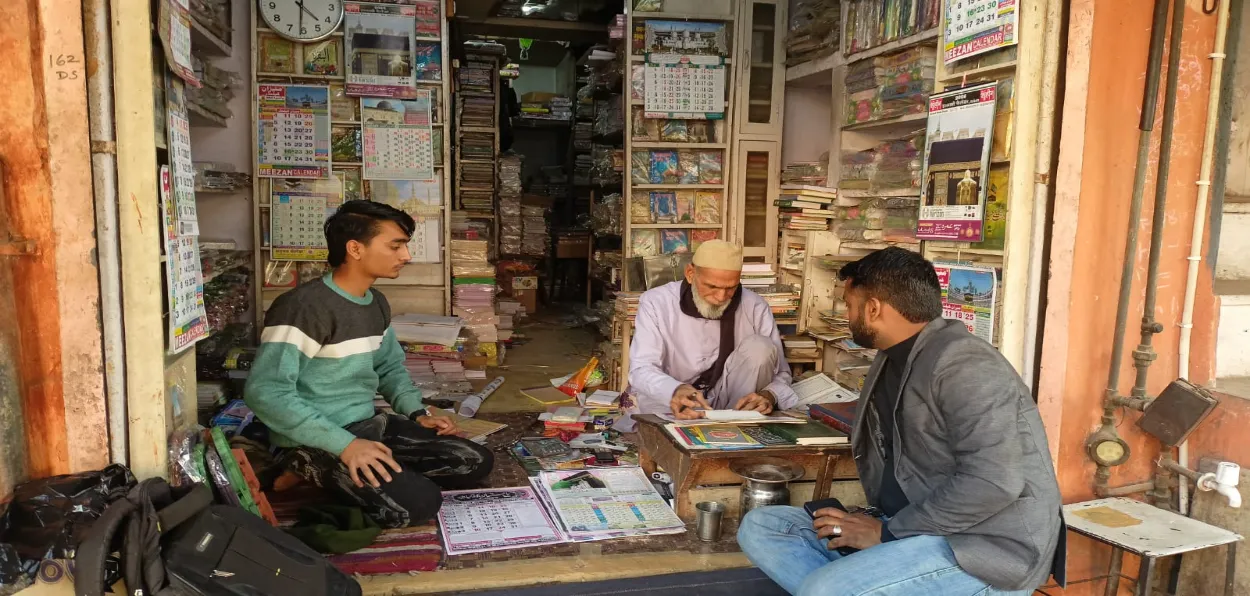
Ever heard of a handwritten calendar in this digital era? A small shop located in the narrow and bustling streets of Ramganj Bazaar of Jaipur, prints calendars which are handwritten and not formatted by computers.
The shop number 130, 'Quran Ghar' and 'Naeem Book Depot' has maintained this unique tradition for about a century. The shop is the sole seller of the famous Kota Calendar of Rajasthan, which is not just about dates, but a living example of time, faith, tradition, and trust.
.jpeg) The author with Haji Azimuddin at his shop
The author with Haji Azimuddin at his shop
The man behind this idea is 75-year-old Haji Azimuddin, and he been scripting the calendar with his hands for the past 15 years.
This simple-looking lunar calendar, printed in pink and white, still holds a special place in people's hearts because of the unwavering trust they have in its makers.
The Kota Calendar was started by Qazi Salauddin, who wanted to provide ordinary people with accurate dates based on the Islamic lunar calendar.
In those days, neither modern technology nor significant resources were available. The calendar was handwritten and reached only a limited number of people, approximately 100-150.
About 15 years ago, Qazi Salauddin entrusted the responsibility of the calendar to Naeem Book Depot in Ramganj Bazaar, Jaipur. It was there that Haji Azimuddin learned the intricacies of writing the calendar. The business association saw the Kota Calendar's transformation as a business proposition.
Initially, it printed only 10-12 calendars, but gradually, as people found its information accurate and reliable for their religious and daily activities. Today, 30,000 Kota calendars are printed each year and distributed to every district in Rajasthan.Moreover, this calendar has now crossed the boundaries of Jaipur and Kota and reached cities like Ratlam and Indore in Madhya Pradesh. People from Jaipur and Rajasthan living abroad take it with them to Hong Kong, the USA, and other countries, thus giving the Kota calendar a gradually growing global recognition.
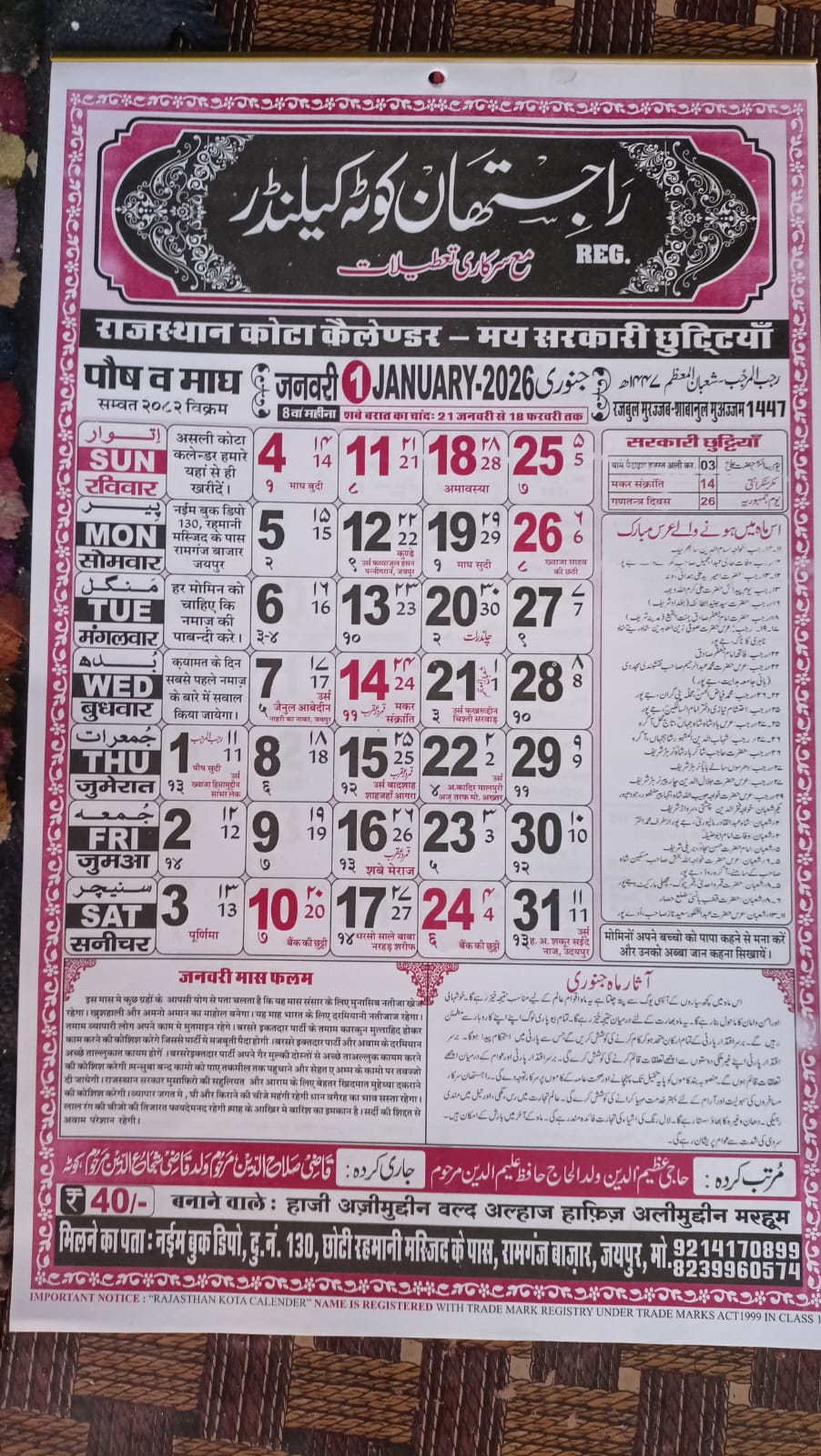
The most significant aspect of the Kota calendar is the information it provides. It includes three types of dates simultaneously—the Hindi Panchang date, the English Gregorian date, and the Islamic lunar date.
In addition, it explains Urs religious festivals), important Islamic dates, the lunar cycle (whether the month will be 29 or 30 days), and lunar calculations in simple language for the common people. Small, insightful messages written throughout the calendar make it far more meaningful than a simple date sheet. This is why people rely on this calendar throughout the year and keep it carefully in their homes and shops.
Haji Azimuddin explains that preparing the Kota calendar is not an easy task. Preparation begins about six months before the start of the year. First, the entire layout is written out by hand on paper. After that, each date, day of the week, and lunar date is set with care. Determining the lunar dates is the most challenging part, as it has to be decided each month whether the month will have 29 or 30 days.
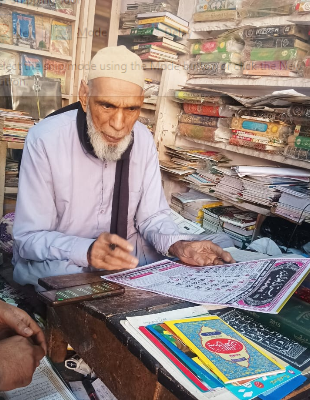
This requires calculations as well as years of experience. Once the entire calendar is prepared, it is given to a designer for computer layout, from which a proof is generated. Each page is then checked multiple times to ensure there are no errors. Haji Azimuddin says that people rely on this calendar throughout the year, so even a small mistake can cause significant problems.
He believes that lunar dates are determined not only by mathematics but also by experience and understanding of life. So far, no major mistakes have occurred in it. Haji Azimuddin, 75, sits at his shop every day and personally oversees every aspect of the calendar's production. For him, it is not just a means of livelihood, but a responsibility and an act of devotion.
Naeem Book Depot is not just a shop, but a legacy. It was started by Haji Azimuddin's father, Hafiz Alimuddin, in the name of his eldest son. The shop bears the sign "Quran Ghar" (House of the Quran) because it handles all necessary work related to the Holy Quran and Islamic literature.
At this shop, the Holy Quran is available in more than 15 languages. Additionally, Haji Azimuddin has written several books. He especially creates new books for children every day, which are still in high demand.
Haji Azimuddin has been managing this shop for the past 42 years. Today, his son, Moinuddin, and grandson Fazluddin are also helping him, ensuring that this tradition continues.
ALSO READ: Kabir Khan's film on the Taj Mahal turns into India's soft power
While the price of the Kota calendar has changed over time—it initially cost around five rupees, then 8-10 rupees 15 years ago, and now it costs 40 rupees—people's trust in it has not diminished at all.
पुराने जयपुर की तंग गलियों और रामगंज बाजार की हमेशा चहल-पहल से भरी सड़कों के बीच एक ऐसी दुकान आज भी मौजूद है, जहाँ वक्त को मशीनों या डिजिटल स्क्रीन पर नहीं, बल्कि इंसान के हाथों से लिखा जाता है। दुकान नंबर 130 पर स्थित यह जगह ‘कुरान घर’ और ‘नईम बुक डिपो’ के नाम से जानी जाती है और… pic.twitter.com/AhQtCuWKwl
— Awaz -The Voice हिन्दी (@AwazTheVoiceHin) January 19, 2026










_(1).webp)



_(1).webp)

.webp)