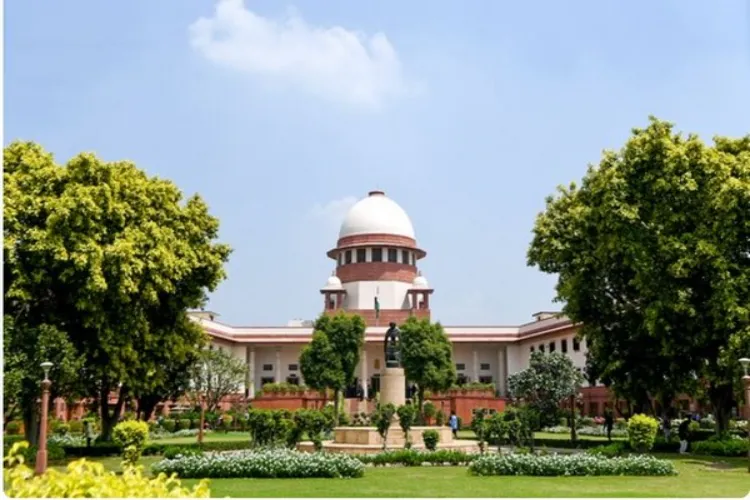
New Delhi
Additions and deletions are an integral part of the electoral roll revision process, the Supreme Court said on Wednesday while resuming final hearings on a batch of 19 petitions challenging the Special Intensive Revision (SIR) of electoral rolls in Bihar.
Hearing the matter, a bench comprising Chief Justice Surya Kant and Justice Joymalya Bagchi clarified that routine inclusion and exclusion of names cannot, by itself, be construed as arbitrary.
When senior advocate Kapil Sibal, appearing for one of the petitioners, alleged large-scale deletions of voters, the Chief Justice observed, “Additions and deletions are part of the electoral roll revision exercise.”
On the issue of Aadhaar being considered as one of the supporting documents, the bench held that the possibility of forgery alone cannot be a valid ground to reject the 12-digit biometric identifier.
Drawing a comparison, Justice Bagchi noted that even passports are processed through private agencies discharging public duties. “If a document is recognised by statute, it cannot be discarded merely because a private entity is involved in its issuance,” the bench said.
The court heard rejoinder submissions from senior advocates Kapil Sibal, Gopal Sankaranarayanan, Prashant Bhushan and Vijay Hansaria, along with petitioner-in-person Yogendra Yadav.
The bench recalled that while commencing final arguments in August last year, it had observed that inclusion or exclusion of names from electoral rolls falls within the constitutional domain of the Election Commission of India (ECI).
Defending the SIR exercise, the Election Commission has maintained that Aadhaar and voter identity cards cannot be treated as conclusive proof of citizenship.
Senior advocate Vijay Hansaria, supporting the ECI’s stand, argued that Aadhaar cannot determine citizenship, pointing out that under the Aadhaar Act, even foreign nationals residing in India for 182 days are eligible for enrolment and that the law explicitly states Aadhaar does not confer citizenship or domicile.
Justice Bagchi, however, reiterated that the risk of forgery cannot be a standalone reason to reject Aadhaar as a document.
Hansaria also submitted that none of the petitioners had sought Aadhaar’s inclusion as proof of citizenship and contended that a mandamus could not be issued in the absence of such a specific prayer.
Sibal argued that while the Election Commission enjoys plenary powers under Article 324 to conduct elections, the authority to determine citizenship rests solely with the Union government under the Citizenship Act.
“Who decides whether I am a citizen of India? It is the Government of India, not the Election Commission,” Sibal said, relying on Articles 325 and 326 of the Constitution.
He further contended that electoral registration officers cannot adjudicate questions of citizenship while dealing with objections or deletions under Form 7.
Justice Bagchi observed that deletion from the electoral roll does not automatically result in loss of citizenship. Sibal countered that such exclusions effectively disenfranchise voters without adjudication by a competent authority.
Emphasising the scale of the exercise, Sibal said nearly 1.82 crore voters were scrutinised without any data indicating large-scale illegal migration in Bihar.
“How many illegal migrants were actually found? Not one,” he said, warning that mass deletions close to elections could undermine democratic participation.
Senior advocate Gopal Sankaranarayanan, appearing for the NGO Association for Democratic Reforms (ADR), argued that once included in electoral rolls, citizens acquire valuable constitutional rights, including the right to vote.
He said the SIR effectively imposed a 2003 cut-off, shifting the burden of proof onto voters added later, many of whom had already participated in multiple elections.
“A constitutional right has been taken away without amending the Constitution or the Representation of the People Acts, and without framing rules or issuing orders under Article 324,” he submitted.
Petitioner Yogendra Yadav argued that international standards for electoral rolls emphasise completeness, equity and accuracy, and claimed the Bihar exercise resulted in a sharp fall in the electoral population ratio due to structural design flaws.
The Election Commission has consistently denied political motivation, stating that deletions occurred across party lines, and reiterated that Aadhaar can only be used to prevent duplication, not to establish citizenship.
ALSO READ: India’s-EU landmark FTA to spur growth, jobs, increase New Delhi's relevance
The hearing is expected to conclude on Thursday.










.webp "Andhra Pradesh Chief Minister N Chandrababu Naidu")

_(1).webp)