 Rajeev Narayan
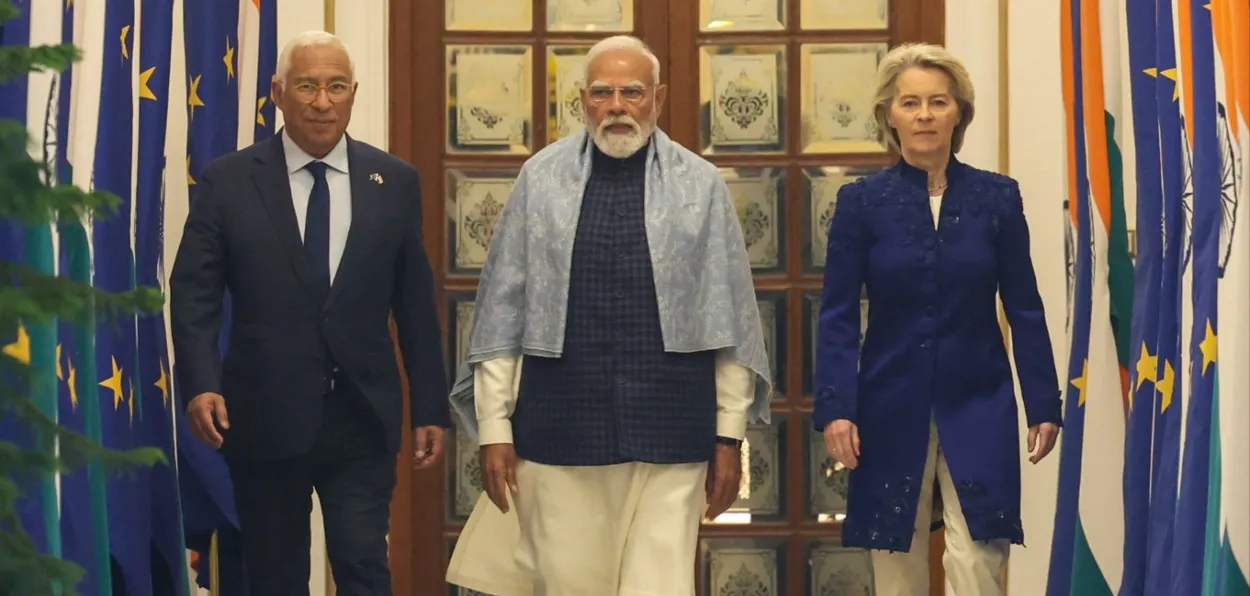
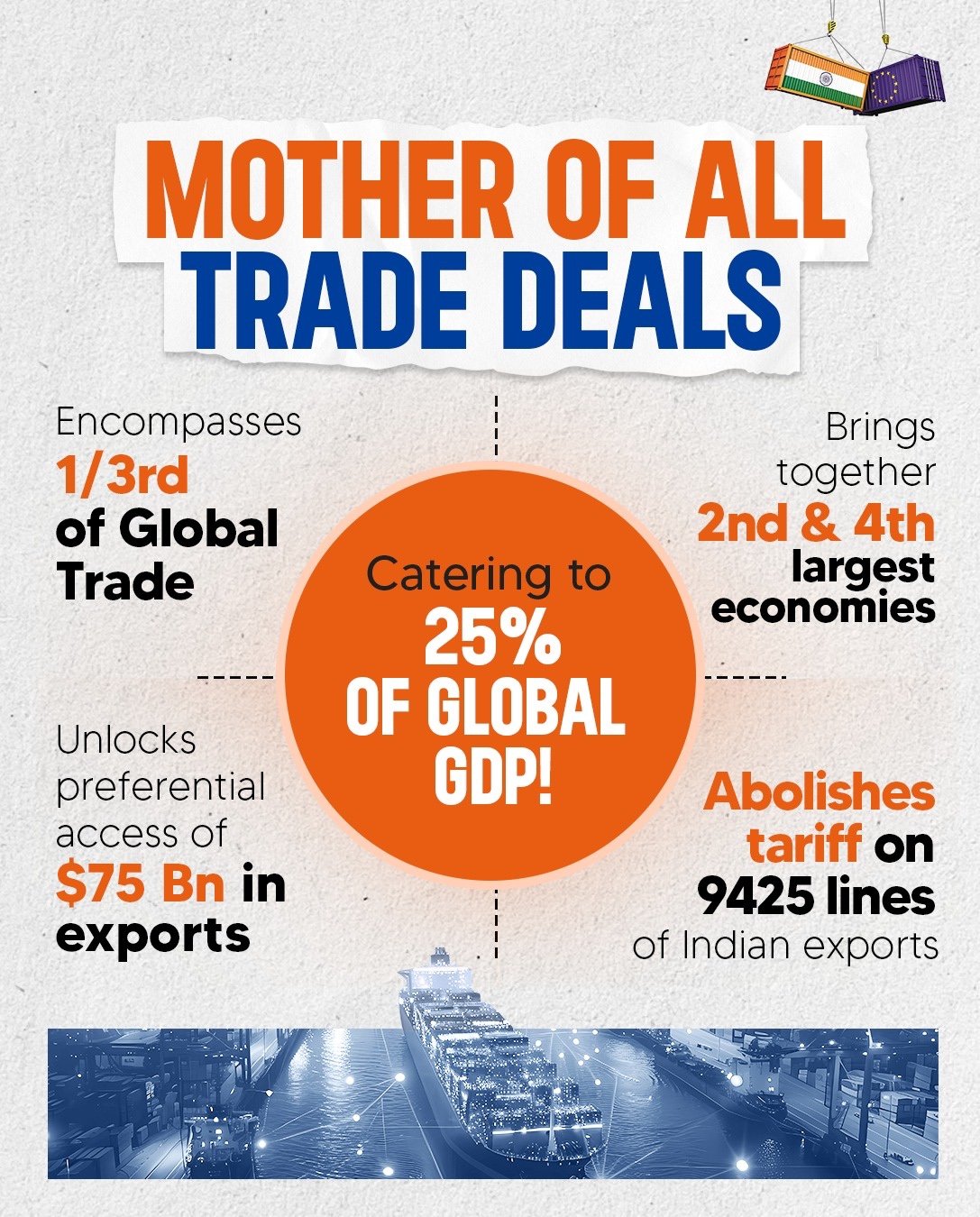
Typically, history announces itself quietly, but January 27 will be remembered as the day when India decisively altered its economic trajectory. For, on this date in 2026, India and the European Union sealed what Prime Minister Narendra Modi described as the “Mother of All Deals”, the single-largest Free Trade Agreement (FTA) India has ever concluded. Spanning 27 European nations and valued at US $213 billion, the deal binds together the world’s largest democratic trading blocs in a sweeping pact that goes well beyond tariffs and trade balances.
Prime Minister Modi’s words captured the relevance of the moment: “This is not merely a trade deal, but a blueprint for shared prosperity, one that will benefit all of India, its industry and its highly-skilled workers. It will also greatly help the 8 lakh Indians living in the EU. Today is January 27 and it is a happy coincidence that on this day, India is signing this FTA with 27 European countries.” European Council President Antonio Costa, who co-signed the deal with Modi, endorsed the outcome of the agreement.
The symbolism is deliberate. Announced just after India’s Republic Day celebrations which mark the nation’s constitutional journey, the deal reinforces a sense of economic statecraft, not transactional diplomacy. And coming after years of stalled negotiations, shifting geopolitical realities and global supply chain disruptions, India and Europe have clearly chosen partnership over fragmentation. At a time when globalisation is being questioned and economic borders are hardening, the trade agreement stands out as a confident affirmation of openness and long-term cooperation.
Ursula von der Leyen also called it mother of all deals on her post on X:
Europe and India are making history today.
— Ursula von der Leyen (@vonderleyen) January 27, 2026
We have concluded the mother of all deals.
We have created a free trade zone of two billion people, with both sides set to benefit.
This is only the beginning.
We will grow our strategic relationship to be even stronger. pic.twitter.com/C7L1kQQEtr
The strategic value of the India-EU agreement becomes clear when viewed against the turbulence of recent global trade politics. In an era marked by tariff shocks and protectionist surges, particularly from the United States, Indian exporters have faced uncertainty and shrinking margins. Abrupt tariff increases on a range of goods had begun to undermine India’s access to one of its most important markets, exposing the risks of over-reliance on any single trading partner.
The EU trade deal turns that equation on its head. By granting preferential, zero-duty access to India’s exports, the FTA provides a powerful hedge against unilateral trade actions elsewhere. It anchors India’s external trade to a growing, stable and rules-based market, reducing vulnerability to policy whims and geopolitical disruption. Further, it rebalances India’s global trade architecture and restores predictability to exporters who had been navigating an increasingly volatile terrain.
The pact signals India’s intent to de-risk its economy through diversification, not isolation. It positions the country as a reliable partner in a multipolar trading world, one willing to engage deeply, but only if the terms protect its long-term interests.
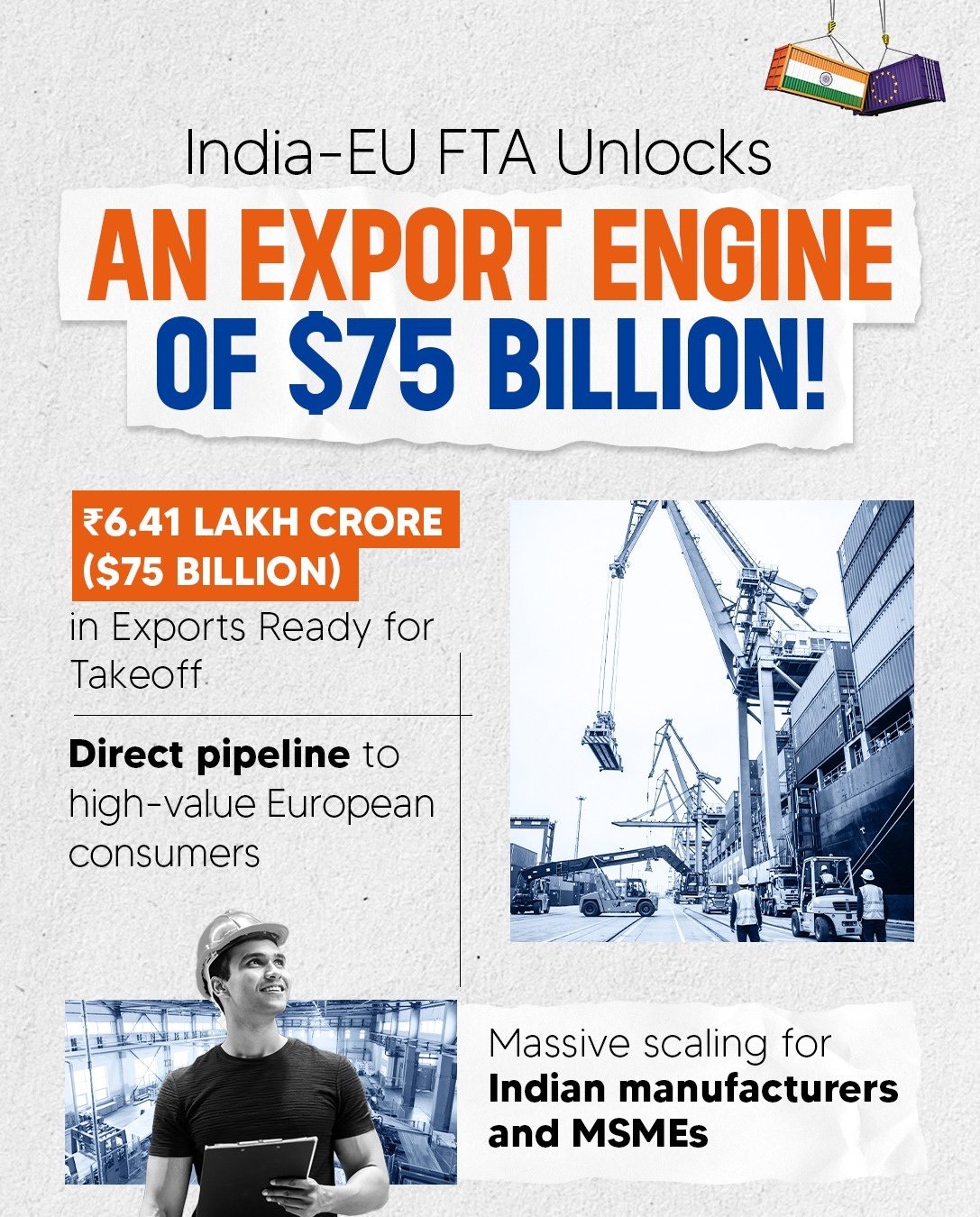
Perhaps the most transformative impact of the agreement will be felt not in macroeconomic charts, but on factory floors, artisan clusters and across India’s vast landscape of small enterprises. Labour-intensive sectors such as textiles, footwear, leather goods, gems & jewellery, marine products, handicrafts, pottery and metal-works stand to gain enormously from improved access to Europe’s affluent consumer markets.
The Joint Press conference:
Today marks a historic moment as we open a new chapter in EU-India relations - on trade, security, and people-to-people ties.
— António Costa (@eucopresident) January 27, 2026
Our Summit sends a clear message: in a reshaping global order, the EU and India stand together as strategic, reliable partners. https://t.co/Dvn3yggfHn
For decades, many of these sectors were constrained by tariff reversals and complex compliance norms, losing ground to competitors from other export-oriented economies. The new trade regime will change that calculus. In one swift move, weavers in Tirupur, shoemakers in Agra, brass artisans in Moradabad and jewellery manufacturers in Surat now gain access to an expanded market, pricing power restored and volumes certain to grow.
The implications for employment are profound. These sectors are labour-intensive and geographically-dispersed, and the benefits of export growth will extend beyond metropolitan centres. As orders rise, so will the demand for skilled and semi-skilled labour, logistics services, packaging, transport and allied sectors. The FTA will generate crores of jobs and strengthen India’s manufacturing base from the bottom up.
Beyond goods, the EU FTA reinforces one of India’s strongest global advantages: services. As economies increasingly become digital, interconnected and knowledge-driven, it is the services trade that is shaping competitiveness. The trade deal opens up new avenues for Indian professionals, technology firms and service providers to operate freely across European markets.
Information technology, engineering, financial services, consulting and other knowledge-based sectors will benefit from improved market access and regulatory cooperation. For a young country with a deep talent pool and an expanding digital economy, the agreement could prove just as consequential as tariff liberalisation in goods. It supports India’s transition from a cost-based exporter to a value-driven global services hub. At the same time, enhanced services engagement will strengthen people-to-people ties. For the lakhs of Indians living and working in Europe, the pact promises smoother economic integration and expanded professional opportunities, reinforcing India’s soft power and diaspora influence.
No trade deal of such scale is without its challenges and the India-EU pact is no exception. Gradual tariff reductions on select European goods, including automobiles and high-end machinery, will expose Indian manufacturers to intensified competition. Compliance with Europe’s exacting standards on sustainability, quality, data protection and labour practices will demand adjustment and investment.
Yet, these very pressures can be productive. Competition often acts as a catalyst for reform, inspiring industries to modernise, adopt cleaner technologies and raise productivity. By aligning with global-best practices, Indian firms can become more resilient and better-positioned across multiple export markets, not just Europe. The agreement offers an external push to the reforms that India has long acknowledged as necessary, but unevenly implemented. Success of the pact will eventually depend on domestic follow-through, such as improving logistics, easing regulatory bottlenecks, supporting MSMEs in meeting standards and ensuring that trade facilitation matches ambition.
Beyond bilateral gains, the India-EU trade deal sends a powerful message to the world. It demonstrates that large, diverse economies can still negotiate comprehensive, balanced trade arrangements rooted in mutual respect. At a time when global trade risks fragmenting into rival blocs, the pact reaffirms faith in cooperation, rules and shared growth. For developing economies watching closely, the agreement offers a template – engagement without capitulation, openness paired with strategic safeguards. It underscores that trade, when designed thoughtfully, can be an instrument of resilience, rather than dependency.
The ‘Mother of All Deals’ is just the beginning. For India, the opportunity lies in execution. It means translating tariff schedules and market access into humming factories, gainfully-employed workers and expanding workshops. It requires aligning industrial policy, skilling initiatives and export promotion with the scale of the opportunity on offer.
ALSO READ: Women's rights in Quran must be seen in the context of pre-Islamic Arab
With India rising to this moment, the trade deal can redefine its place in the global economy; not as a peripheral manufacturing base, but as a confident, diversified and reliable trading power. In a fractured world, the new deal offers India both insulation and influence. The real test is in whether the promise of shared prosperity becomes a lived reality… at home first and then across the global marketplace.
The writer is a veteran journalist and communications specialist.


.webp "Union Home Minister Amit Shah")







_(1).webp)