Ghulam Rasool Dehlvi
At the Festival of Holi, colours are meant to dissolve social boundaries. Yet in Delhi’s Uttam Nagar, a trivial incident turned into a tragedy that shocked the nation. A dispute began with a child accidentally splashing colour on a passing woman, leading to a quarrel between two neighbouring families, which led to the lynching of a 26-year-old man named Tarun.
Subsequent investigations suggested that the clash was not simply a spontaneous communal confrontation but also connected to a long-standing dispute between the families involved. Police officials have also stated that the incident should not be viewed purely through a communal lens. Yet, as happens in today’s polarised climate, the tragedy quickly travelled across social media as a communal narrative. Within hours, it was framed by many as a Hindu–Muslim confrontation.
For Indian Muslims, such moments raise a question. How should they respond to such incidents involving an individual whose actions are interpreted as a reflection of Islam? One answer lies in revisiting the ethical tradition of Imam Abu Hanifa — the founder of the Hanafi school of Islamic thought that most Indian Muslims historically followed.
The Uttam Nagar episode is not merely a law-and-order issue; it is also a moral reminder. When violence erupts in the name of personal anger, communal pride or religious sensitivity, it contradicts the spirit of Islam
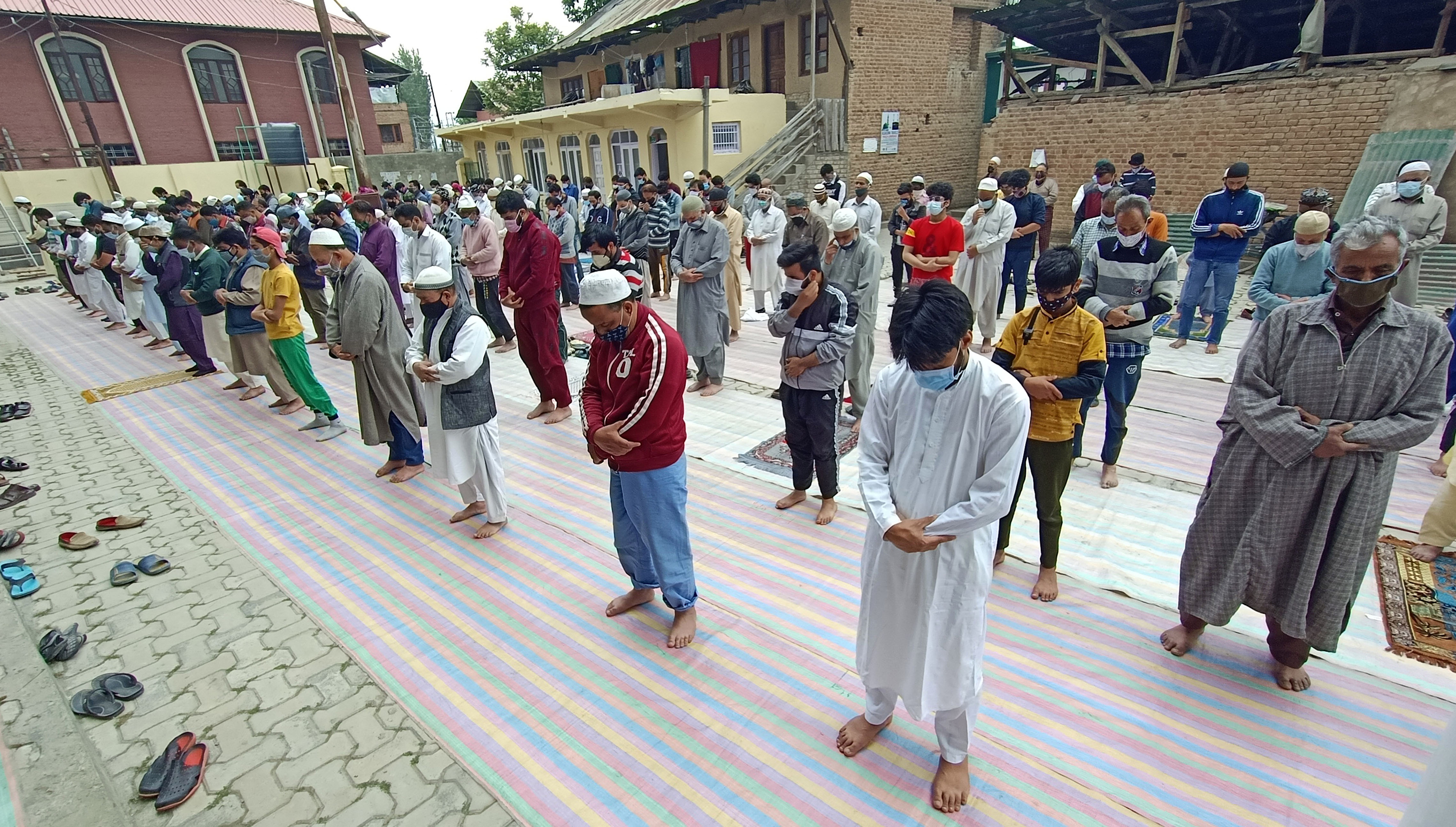 Muslims praying
Festivals such as Holi represent moments of shared cultural interaction in India’s plural society. For centuries, Muslims and Hindus have lived as neighbours, often participating in each other’s social spaces with mutual understanding. A splash of colour, even when unwelcome, should ideally be met with patience, not fury.
The Uttam Nagar tragedy illustrates how easily everyday tensions—personal grievances, neighbourhood disputes or emotional reactions—can acquire communal overtones in today’s atmosphere of mistrust. This is precisely why Muslim communities must revisit the intellectual tradition that historically shaped their ethical outlook: the tradition of Imam Abu Hanifa.
Vision of Imam Abu Hanifa
Imam Abu Hanifa (699–767) lived in a time of intense political and sectarian conflict in the early Muslim world. Different groups were declaring each other unbelievers, and political violence had deeply fractured the Muslim community. In this turbulent environment, Abu Hanifa articulated a theological outlook rooted in restraint, humility and moral responsibility.
At the centre of his thought was a simple but profound principle: faith should not be judged hastily by human beings. According to Abu Hanifa, faith (iman) consists primarily of belief in the heart and affirmation by the tongue. Actions are important, but they do not automatically determine whether a person remains a believer.
This distinction helped prevent religion from being reduced to outward behaviour or emotional reactions. A Muslim may commit wrong actions, yet the final judgment of his faith belongs only to God.
Abu Hanifa’s theological position is often associated with the doctrine known as Irja, which literally means “postponement.” In simple terms, Irja teaches that the final judgment of a person’s faith should be postponed until the Day of Judgment, when God alone will evaluate human actions.
This idea emerged as a response to extremist tendencies in early Islamic history. Some groups, particularly the Kharijites, declared Muslims guilty of major sins to be unbelievers. Abu Hanifa strongly rejected this harsh approach.
Instead, he argued that human beings should exercise humility in matters of faith. People may disagree, commit errors or even behave unjustly—but declaring them outside the fold of Islam is not the role of ordinary believers.
This approach created what may be called a “theology of restraint.” It discouraged Muslims from weaponising religion against others and emphasised patience, reflection and moral self-discipline.
.jpg)
Another important contribution of the Hanafi tradition is its broader understanding of religion (deen). Classical Sunni-Hanafi scholars did not view religion merely as a set of rituals or legal rules. Rather, deen represented a moral framework designed to guide human behaviour toward justice, compassion and social harmony.
In this sense, the purpose of religion is not to inflame anger but to discipline it. Faith should cultivate humility rather than arrogance, patience rather than aggression.
If such an ethical understanding had guided the individuals involved in the Uttam Nagar incident, the outcome might have been very different. A moment of irritation could have been defused by patience; a misunderstanding could have been resolved through dialogue.
The majority of Muslims in South Asia historically follow the Hanafi school of law. Through centuries of scholarship, Sufi influence and social interaction, this tradition shaped a distinctive form of Indian Islam characterised by moderation and coexistence.
Hanafi jurisprudence emphasises reasoning, social welfare and adaptation to local conditions. It allowed Muslim scholars in the subcontinent to engage constructively with a diverse society while maintaining their religious identity.
This intellectual heritage encouraged Muslims to live peacefully with neighbours of other faiths and to resolve disputes through dialogue rather than confrontation. It also fostered the Sufi ethos of compassion and humility that became deeply embedded in the cultural life of the region.
Lessons from the tragedy
The tragedy in Uttam Nagar should therefore be seen not only as a criminal incident but also as an opportunity for moral introspection. It reminds Muslims that individual actions can shape public perceptions of an entire community.
Islam does not permit violence driven by anger, pride or impulsive reaction. The Qur’an repeatedly emphasises restraint and patience in moments of conflict. Similarly, the Hanafi tradition teaches that faith must manifest itself through ethical conduct and social responsibility.
In a plural society like India, where religious communities live side by side, such values become even more essential. A moment of intolerance can deepen mistrust; an act of patience can strengthen harmony.
Today, when social media often amplifies conflict and turns isolated incidents into communal controversies, the ethical vision of Imam Abu Hanifa becomes even more relevant.
His theology reminds Muslims that the essence of faith lies in humility before God, not in aggression toward fellow human beings. It encourages believers to avoid quick judgments, control their anger and prioritise social harmony.
For Indian Muslims, reconnecting with this intellectual heritage is not merely an intellectual exercise. It is a practical necessity for navigating life in a diverse and often polarised society. Viewed from this perspective, the Uttam Nagar incident is a painful reminder of how quickly everyday disputes can spiral into tragedy. But it also offers an opportunity to revisit the moral teachings that lie at the heart of Islamic tradition.
ALSO READ: Islamic scholar Syed Muhammad Naquib al-Attas linked knowledge to godliness
Imam Abu Hanifa’s theology of restraint teaches that religion should cultivate patience, humility and respect for others. In times of tension, these virtues become not only religious ideals but social necessities. If Indian Muslims draw upon this legacy, they can reaffirm a form of Islam that promotes coexistence rather than confrontation—a tradition that has long been part of the country’s civilizational fabric.
Ghulam Rasool Dehlvi is an author and a student of Sufism

.webp "Union Home Minister Amit Shah")