 Shankar Kumar
In a few days, Nepal will get a new Prime Minister. The four-year-old centrist party, the Rashtriya Swatantra Party, with close to a two-third majority in parliament, is poised to form the next government in the Himalayan country.
Balendra Shah is expected to become Prime Minister of Nepal if the RSP leadership led by Rabi Lamichhane and his deputy in the party, D P Aryal, stick to the seven-point agreement that they signed with the 35-year-old rapper-turned politician. The agreement envisaged Shah as Prime Minister of the country in the event the party secures a majority in the elections.
Hailing from Nepal’s Mahottari district in Madhesh region, Balendra Shah has a good command over several languages, including Maithili--spoken widely in Bihar and Jharkhand.
As per Deccan Herald, Shah completed his MTech at Nitte Meenakshi Institute of Technology, Yelahanka, Bengaluru in 2018. Despite his connections with India, his mayoral stint with Kathmandu from 2022 to January 2026 had not been without controversies.
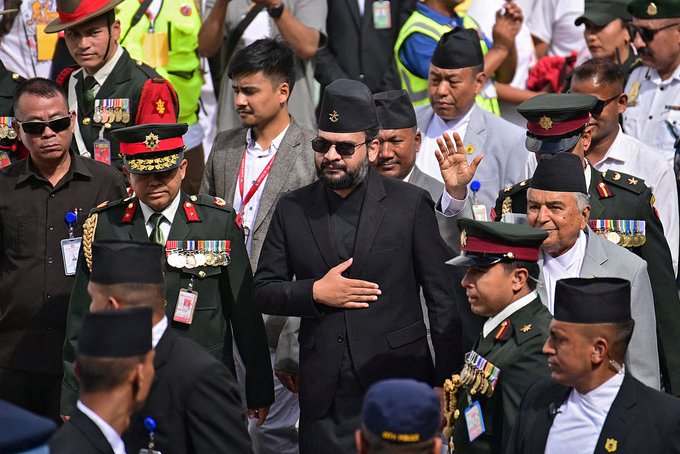 Balendra Shah after his victory
He sparked diplomatic tensions with New Delhi after displaying a map of “Greater Nepal” in his office. In June 2023, he ordered a ban on Indian movies’ screening in Kathmandu, and this order was passed after the Bollywood film ‘Adipurush,’ based on the epic Ramayan, included a line claiming that ‘Janaki (Goddess Sita) is a daughter of India.”
Although this order was stayed by a court in Kathmandu a few days later, asking authorities not to intervene in the screening of any movie passed by Nepal’s censor board.
However, his impulsive behaviour was again on display in November 2025, when weeks after the ‘Gen Z’ protest, he took to Facebook to post derogatory words against India, the US, China and Nepal’s political parties, including the RSP that he later joined. “You guys all combined can do nothing,” Shah wrote in his post, triggering a massive political storm across Nepal. This forced Balendra Shah to delete this post. But the incident renewed debate over his outspoken style and unconventional approach to politics.
With this, it is also true that Balendra Shah is a product of Nepal’s Gen Z uprising, which led to the ouster of highly seasoned politicians from power last year. It impacted them electorally during the recently concluded polls too. Except for Maoist leader and three-time Prime Minister of Nepal, Pushpa Kamal Dahal alias Prachanda, all prominent political leaders belonging to the Nepali Congress and the Communist Party of Nepal-Unified Marxist and Leninist (CPN-UML) lost the parliamentary election.
Even CPN-UML stalwart and ex-Nepal Prime Minister K P Oli lost the election. This evidently showed continuing public dissent towards old guards who failed to deliver on promises of eradicating corruption from the polity, addressing rising youth unemployment, and bringing political stability in the country.
For decades, the Nepali Congress and the CPN-UML dominated the political landscape of the Himalayan nation. However, it is a fact that both the Nepali Congress and the CPN-UML had lost elections under the pro-Communist Party of Nepal (Maoist) wave in April 2008. The CPN (Maoist) had secured 220 out of 575 elected seats, and its leader, Pushpa Kamal Dahal alias Prachanda, became the Prime Minister.
#WATCH | Kathmandu, Nepal: Celebration visuals coming from Nepal, where Balen Shah’s Rastriya Swatantra Party (RSP) is inches away from victory in the General Election 2026. pic.twitter.com/lzbO5lx3V8
— ANI (@ANI) March 6, 2026
However, even this electoral setback did not result in the kind of comprehensive humiliation that the Nepali Congress and the CPN-UML leaders have witnessed in the just-concluded polls. Pro-Balendra Shah wave during the election took a massive toll on their political fate, and it benefited the RSP, whose landslide victory is all set to change the course of politics in Nepal.
For the first time in many years, the RSP will be able to provide a much-needed political stability in the country. That means once the RSP’s Balendra Shah is sworn in as Prime Minister, he will have enough space on the governance issues, particularly, keeping in mind the aspirations of youth who have reposed faith in him. But then, will he be able to reset Nepal’s relations with India, which faced several ups and downs during KP Oli’s government?
Strong fundamentals of India-Nepal relations
The fundamentals of the New Delhi-Kathmandu relationship remain strong. This is evident from India’s continued developmental support to Nepal. New Delhi provided a grant of Rs 12.8 billion to Kathmandu for the fiscal year 2026-27, an increase of Rs 1.6 billion in comparison to 2025-26.
A look at India’s assistance to Nepal shows that New Delhi has been generous towards its northern neighbour right from the 1950s, when the two countries deepened their relations through the India-Nepal treaty of peace and friendship, signed by the two countries on July 31, 1950.
There is hardly any sector in Nepal, from airports and highways to dams, health, education, energy, and railways, where India has not extended help in construction and development. Sharing centuries-old social, cultural, ethnic and religious ties, India and Nepal's bond has overridden the stress and strain of politics.
From 2003 to 2023, India completed 573 projects related to drinking water, sanitation, drainage, education, health, rural electrification, hydropower, embankment and river training.
#WATCH | Kathmandu, Nepal: Residents in Kathmandu broke into spontaneous singing and dancing in the streets to celebrate the campaign of former mayor and rapper Balendra 'Balen' Shah. (02.03) pic.twitter.com/iDbxKe9GZV
— ANI (@ANI) March 3, 2026
As a first responder to Nepal’s crisis, India immediately provided, under ‘Operation Maitri’ more than $1 billion to the Himalayan country after a massive earthquake hit it in 2015. When an earthquake measuring 6.4 on the Richter scale rocked Jajarkot on November 3, 2023, India swiftly rushed 5 tranches of relief material and offered an assistance package of $75 million to support Nepal in its reconstruction efforts.
During the COVID-19 pandemic, New Delhi extended all the necessary support it needed. Whether they be ventilators, ICU beds, RT PCR kits, Personal Protective Equipment (PPE), ambulances, oxygen plants, vital medicines and vaccines.
On the trade front, India is already helping Nepal in transiting its trade through roads and ports. To add further momentum to the Himalayan nation’s trade with India, New Delhi and Kathmandu agreed to facilitate the movement of rail-based freight between Jogbani (India) and Biratnagar (Nepal) in November 2025.
More importantly, New Delhi has recently decided to extend key transit corridors such as Kolkata-Jogbani, Kolkata-Nautanwa and Visakhapatnam-Nautanwa to Nepal, thereby significantly enhancing the Himalayan country’s trade connectivity with India and third countries.
India's Concerns
Prime Minister Narendra Modi congratulated Balendra Shah as well as Rabi Lamichhane for RSP’s massive victory in the election. Yet there is cautious optimism in India about Shah, who, like K P Oli, maintains that Kalapani, Limpiyadhura and Lipulekh belong to his country’s territory, whereas India claims that all these areas are inalienable parts of India.
READ MORE: DySP Santosh Kumar's emotional reunion with Habib Mastar Sir
Last year, Nepal, under the Oli government, had objected to the India-China agreement to restart border trade through the Lipulekh Pass. In this background, what approach Nepal’s new leader takes towards India will be a keenly watched affair in New Delhi, which is highly concerned about the growing footprint of China in the Himalayan country.

.jpg "Gujarat’s women entrepreneurs bring their craftsmanship to life during Navratri")