Madhukar Pandey/Lucknow
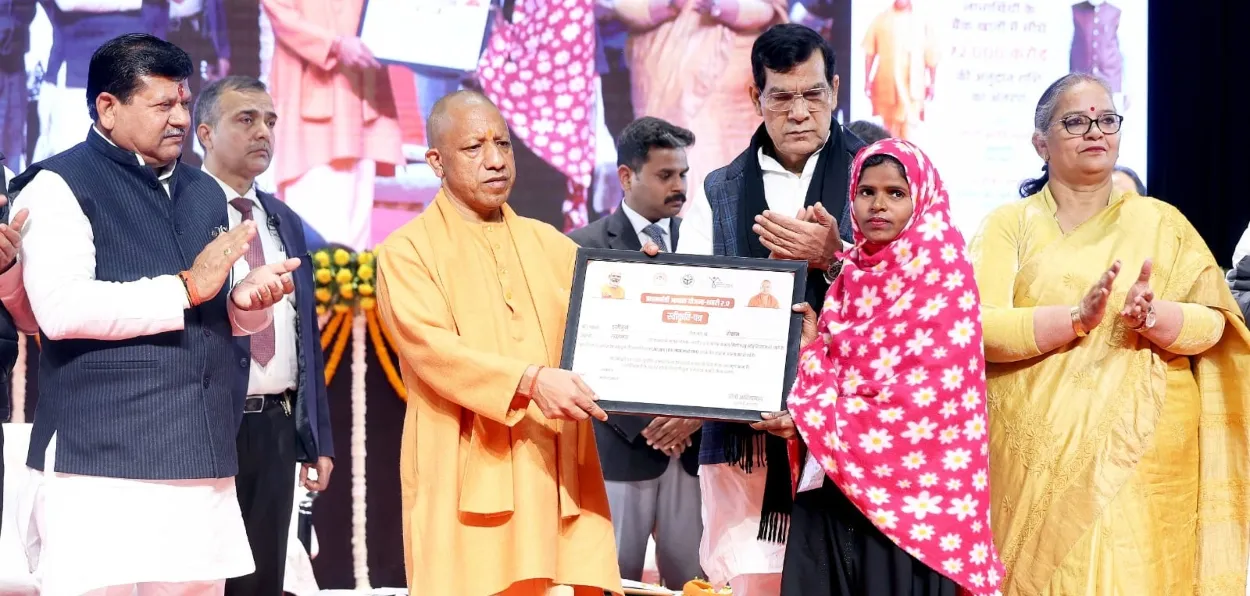
Shama Parveen of Ferozabad, Uttar Pradesh had lived in rental houses all her life. When Prime Minister Narendra Modi handed her the keys to her new house at a public event, tears of joy welled up in her eyes.
She said that she never had a roof of her own, but thanks to Prime Minister Modi, she was finally seeing her dream come true. She received the house under Pradhan Mantri Awas Yojna (PMAY), which seeks to end slums by allocating houses to urban poor in cities and to houseless people in rural areas of India.
Shamma Parveen blessed the Prime Minister, wishing him a long life and praised his government’s welfare schemes, especially the free food grain distribution, and requested a reduction in the price of cooking gas, reflecting the real needs of ordinary poor families.
Contrary to the engineered perception that Muslims are discriminated against in Uttar Pradesh by the government, statistics show that the community has received more than its proportionate share of subsidised houses under the Pradhan Mantri Awas Yojana (Prime Minister's Housing Scheme).
Under Chief Minister Yogi Adityanath, the UP government has allocated subsidised houses to thousands of Muslim families, giving them a life of dignity.
According to government data, between March 2017 and January 2026, about 60 to 62 lakh families have been provided with permanent housing under the PMAY.
Yogi Adityanath has publicly claimed that approximately 21 lakh houses under the PMAY have been allocated to Muslims.
Although an official religion-based breakdown is not available, an analysis based on the Chief Minister's statement suggests that the share of Muslim beneficiaries in the scheme is between 30 and 35 per cent. This is a good picture given that the Muslims constitute about 18 per cent of UP’s population.
If viewed as a data map, the socio-economic landscape of Uttar Pradesh clearly indicates that the districts with higher rates of poverty, homelessness, and mud houses received proportionate benefits under the PMAY.
This selection process was not based on religion but based on poverty alleviation and eligibility criteria.
Rough estimates suggest the number of Muslim beneficiaries under the PMAY falls between 1.86 million and 2.17 million.
The rural-urban divide further clarifies the scheme's reach. Under the scheme, 3.5 million houses have been constructed in the rural areas of Uttar Pradesh, while 1.7 to 1.9 million houses in urban areas have either been completed or sanctioned.
According to a MagicBricks report, under the PMAY (Urban) 2.0 scheme, the first instalment of funds was directly transferred to the accounts of beneficiaries in several districts.
In Ghaziabad, 8,937 families received the first instalment, followed by 8,693 in Bareilly and 8,568 in Lucknow. Pratapgarh saw 7,214 families benefit from the scheme, while Gorakhpur and Kushinagar had 7,142 and 6,231 beneficiaries, respectively.
Similarly, thousands of families also benefited in districts like Bijnor (5,581), Aligarh (5,382), Lakhimpur Kheri (5,100), and Prayagraj (5,023). Figures from Ayodhya, Mathura, Deoria, Maharajganj, Budaun, Moradabad, Agra, Bulandshahr, Mau, Unnao, Farrukhabad, Varanasi, and Mirzapur indicate that the scheme has reached all parts of the state equally.
When these districts are placed on a socio-demographic map, it becomes clear that in districts like Aligarh, Moradabad, Budaun, Lucknow, Bulandshahr, and Agra, where the Muslim population is relatively higher, Muslim families have received government housing in large numbers.
A man from Bijnore who sells roasted peanuts in Delhi NCR in winter said the BJP members took care to contact all the Muslims and help them fill out the forms for free houses.
In Lucknow, the Scheme has brought about a significant change in the lives of Muslim families.
Shabina Bi (45), a poor Muslim widow residing in Husainabad, had been living with her sons in dilapidated, rented houses for years. When she was selected as a beneficiary under the PMAY and the first instalment was credited to her account, it felt like the beginning of a new life for her.
Shabina Bi says that, thanks to the blessings of Yogi Ji and Modi Ji, her permanent house is now being built, and for the first time, she sees the hope of a secure future in her own home.
Similarly, the four-member family of Mohammad Iqbal, 38, a labourer from the Chinhat area, also benefited from the scheme. After years of living under a leaky roof and enduring the monsoon rains, his family is now moving into their permanent house.
The emotional reactions of beneficiaries Neha and Shaheen Khatun from Charkhari also testify that this scheme is not just about bricks and mortar, but a symbol of dignity and self-respect.
Under the Pradhan Mantri Awas Yojana Urban 2.0 scheme, each beneficiary receives a grant of ₹2.50 lakh. This amount is transferred directly to the bank accounts of the women heads in three instalments: the first instalment of ₹1 lakh, the second instalment of ₹1 lakh upon completion of 75% of the construction, and the final instalment of ₹50,000 upon completion of the house.
This system has ensured transparency and significantly reduced the possibilities of corruption.
ALSO READ: Haq is tale of Muslim women's fight for dignity and justice
Overall, if the data from the PMAY in Uttar Pradesh is viewed as a social, geographical, and demographic map, it becomes clear that the participation of the Muslim community has not only been significant but, in many districts, their share has even exceeded their population proportion.
.webp "Rocks bearing inscription in ancient Arabic excavated in Saudi Arabia's Madina region")










.webp)
.webp)