

New Delhi
National Security Advisor Ajit Doval on Saturday described Swami Vivekananda’s spiritual philosophy as a powerful instrument for awakening Indian society, building self-confidence and mobilising people towards national transformation, saying the spiritual leader sought to instil a sense of strength, dignity and collective purpose among Indians.
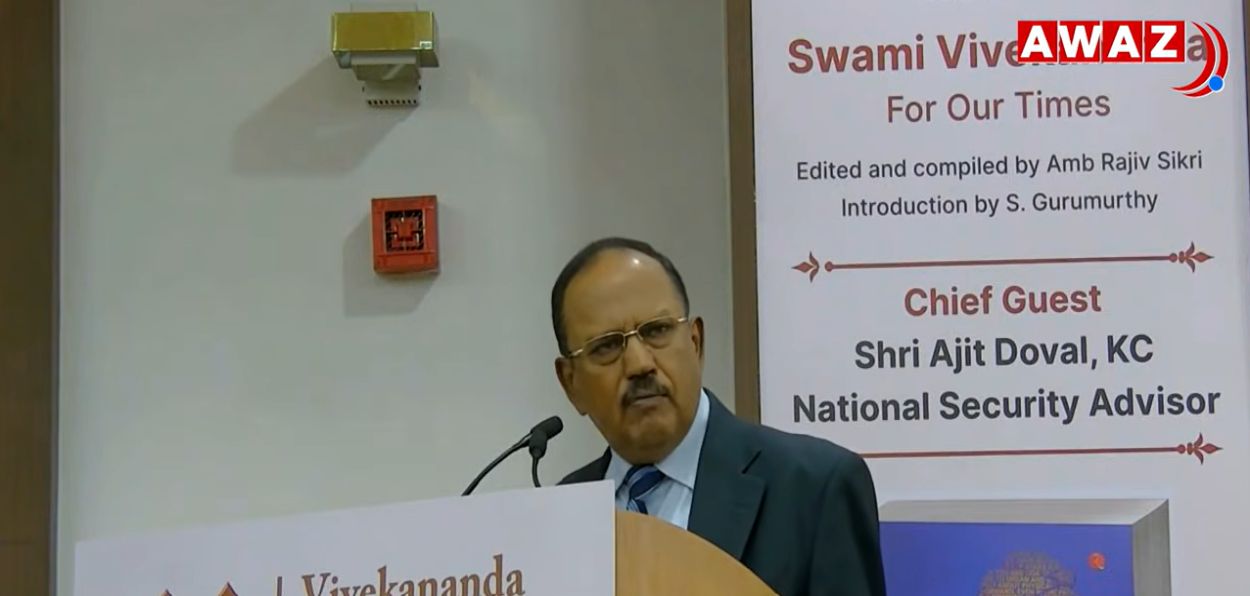
Speaking at the Vivekananda International Foundation (VIF) in New Delhi at a book discussion, Doval said Vivekananda’s philosophy went beyond spiritual teachings and rituals, offering a framework for social awakening, organisation and the empowerment of the masses.
Doval said Vivekananda understood the importance of India’s civilisational values, spirituality and culture in shaping the country’s identity, arguing that these elements had helped unite India across centuries beyond the conventional understanding of nationhood.
Referring to the book discussed at the event, Doval said it offered readers access to Vivekananda’s original ideas and teachings, rather than relying solely on interpretations by others. He praised the author for drawing from Vivekananda’s extensive writings and organising his ideas under relevant themes, making them easier to understand and absorb.
Doval said Vivekananda’s understanding of religion centred on the pursuit of truth rather than merely rituals or customary practices. The spiritual tradition, he said, represented an evolving quest for truth and wisdom that had existed long before it was formally expressed through the Vedas.
He said the book also addressed the need for Indians to rediscover their cultural roots at a time when sections of society had lost confidence in their history, ancestors and civilisational heritage.
Describing Vivekananda as a spiritual thinker who strategically used spirituality to awaken society, Doval said his approach was aimed at transforming the mental state of Indians and enabling them to overcome a sense of helplessness and self-doubt.
"He was a great spiritual strategist who weaponised spiritualism to build the Indian society and bring it to that mental state of strength and self-awareness," Doval said, emphasising that Vivekananda's ideas were linked to a broader transformation of society.
According to Doval, Vivekananda recognised that Indians had increasingly lost confidence in themselves and were attempting to imitate Western values and lifestyles. Yet, he believed that a deeply rooted spiritual consciousness remained within Indian society and could be awakened to inspire change.
Doval referred to Vivekananda’s travels across India during his years as a wandering monk, particularly before his participation in the Parliament of the World's Religions in Chicago in 1893, saying these journeys helped him understand the condition of the Indian people.
 NSA Ajit Doval at Vivekananda International Foundation
Recounting an anecdote associated with Vivekananda’s visit to Banaras in 1888, Doval spoke about a literary work that portrayed the suffering, degradation and loss of confidence in Indian society. He said the account reflected the social and psychological challenges confronting Indians and the need to revive their inner strength.
He said Vivekananda sought to counter this condition through the message of awakening, learning and self-realisation, drawing attention to the exhortation, "Arise, awake and stop not till the goal is achieved."
Doval said the goal, as he interpreted Vivekananda’s philosophy, was not limited to individual spiritual liberation but also involved the transformation of society through self-confidence, collective organisation and the accumulation of strength.
Quoting Vivekananda’s call for a new India to emerge from the peasants, labourers, artisans, fishermen and other sections of society, Doval said the spiritual leader envisioned a transformation driven by ordinary people rather than confined to elites.
He cited Vivekananda’s words, "Let new India arise out of the peasants and cottage," referring to his broader message that India's future would be shaped by people across villages, fields, factories, markets and communities.
Doval said individual empowerment was essential but would have limited impact unless people organised themselves and coordinated their efforts. He emphasised that Vivekananda believed the strength of individuals could be brought together to generate collective power.
"The secret lies in organisation, in coordination of action," Doval said, explaining that the convergence of individual strengths could help society achieve larger goals.
Drawing parallels with India's freedom movement, Doval said the awakening fostered by such ideas helped create the confidence and mobilisation that later found expression in movements led by Mahatma Gandhi and revolutionary figures such as Bhagat Singh and Chandrashekhar Azad.
He said Vivekananda’s contribution to India's intellectual and social awakening was significant, adding that the ideas of self-awareness, confidence and organisation had a lasting influence on the country's transformation.
READ MORE: At 44, Elvis Ali Hazarika conquers the Indian West Coast in 13 days
Doval also praised the author for compiling Vivekananda's teachings in an organised and accessible manner and congratulated the publisher for bringing the book to readers, expressing hope that it would receive wider recognition.