


 Rajeev Narayan
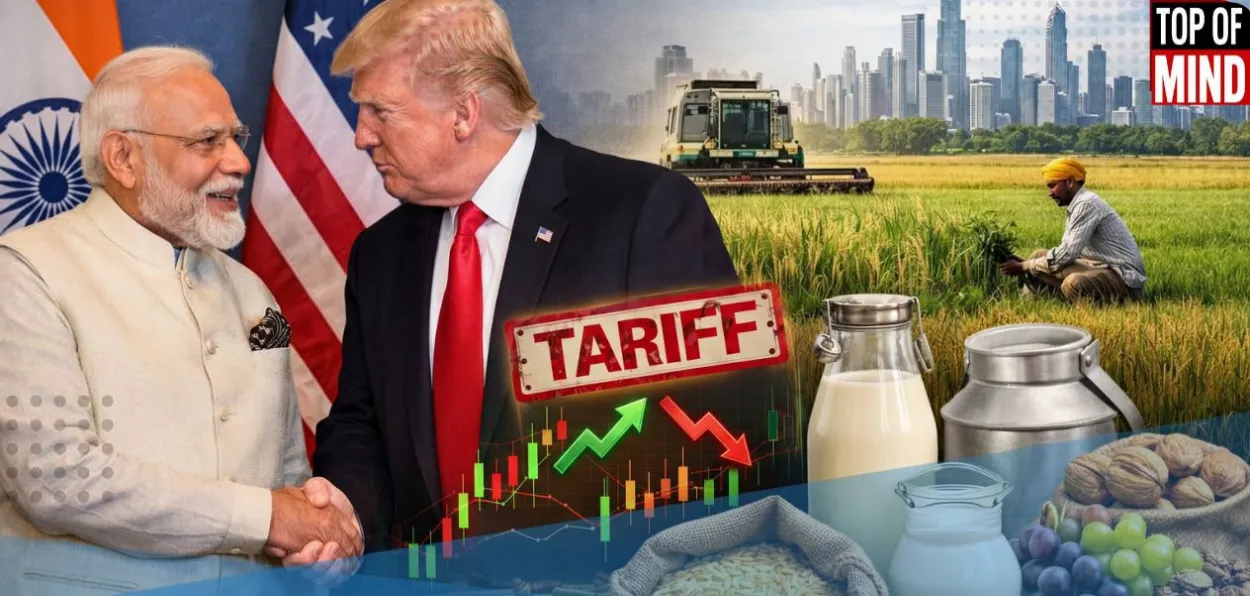
A trade deal with the United States could open doors for Indian exporters. But when Washington puts a 25 per cent tariff threat on the table and offers 17 per cent in return for a deal, New Delhi must ask one hard question: Is this a negotiation between partners, or an attempt to make market access conditional on India surrendering economic ground? A lower tariff may be welcome, but it is not proof of a good bargain.
Earlier this week, the United States proposed tariffs of up to 25 per cent on Indian goods following an investigation into what it calls “structural excess capacity in manufacturing”. The US also held out the possibility of a 17 per cent rate if India concludes a reciprocal trade agreement addressing US findings. Yesterday, Union Commerce and Industry Minister Piyush Goyal said the deal was “close to culmination”, with the pathway to finalisation taking shape.
That sounds like progress. But the 25 per cent is merely a proposal, not a duty newly imposed this week. Exemptions and existing duties also matter. The 17 per cent is not an unqualified concession. It is leverage, attached to a deal whose terms India has yet to disclose. The danger is that relief from a threat becomes the headline achievement, while the price India pays slips into the background.
The Price of Access
There is no case for dismissing the American market. The US is India’s largest export destination, with shipments touching $59.52 billion in April-October this financial year, up from $52 billion last year. The market sustains Indian jobs across textiles, gems and jewellery, engineering goods, pharmaceuticals, seafood and smaller export industries. A tariff disadvantage against competing Asian economies can quickly become a commercial disadvantage for Indian producers.
US proposes 17 per cent tariffs on goods from India. Reason : India has created excess industrial capacity that could harm American companies. https://t.co/jGiOafiIG6
— News Arena India (@NewsArenaIndia) November 25, 2026
But dependence is a knife that cuts both ways. The US wants increased access for its goods and services in India; India wants predictable access for its exports. Washington’s own figures put its 2025 goods imports from India at $103.8 billion and exports to India at $45.6 billion. The imbalance is substantial, but a trade deficit is not proof of wrongdoing, still less a licence to dictate another country’s industrial policy. Trade is not a favour bestowed by one side on the other.
The USTR has questioned India’s production-linked incentives under the PLI Scheme, manufacturing policies and use of Chinese inputs, arguing that these contribute to excess capacity. India rejects the charge, saying it has no structural excess capacity in any industry. The Indian Government maintains that ‘Make in India’ and the PLI Scheme are instruments of a development strategy to build manufacturing, attract investment and create jobs. They can be debated, improved even, but they should not be abandoned because one trading partner dislikes the competition they create.
The Real Red Lines
The acid test will be agriculture. The US market-access agenda has included demands involving dairy, food products and genetically modified crops. For America, these are commercial opportunities. For India, they touch livelihoods, food security and the survival of crores of small farmers and dairy producers. An agreement that exposes vulnerable producers to competition they cannot withstand could impose costs far beyond exporters’ balance sheets.
This does not mean Indian farming must remain insulated from competition, or every domestic industry protected indefinitely. Consumers and manufacturers can benefit from cheaper imports, technology and competition. But liberalisation must be calibrated, reciprocal and phased, based on evidence and domestic capacity; not a deadline created by a tariff threat.
The same yardstick applies to manufacturing. India wants to become a serious alternative in global supply chains, not remain a large market for other countries’ goods. If negotiations force it to dilute local manufacturing priorities, weaken legitimate standards or surrender policy space, the immediate gains in export access could undermine the longer-term ambition. An agreement should make Indian firms more competitive, not make the government hesitant about supporting them.
A Deal, Not a Deadline
There are genuine gains to pursue. A durable agreement could reduce uncertainty, improve market access, open opportunities in services and technology, attract investment and give businesses a clearer framework. It could address irritants on both sides, from tariffs and customs procedures to standards and regulatory barriers. India should bargain hard, making sensible concessions only where benefits are measurable.
But reciprocity must mean more than India lowering barriers while the US retains the power to raise tariffs whenever it is upset. Any deal needs to be transparent on sectoral concessions, safeguards, rules of origin, dispute settlement and conditions under which tariffs can be changed. It should protect public-interest regulation and provide adjustment periods for vulnerable sectors. Parliament, industry and farmers must understand what is being traded away and what is being secured.
A 17 per cent rate may give India a modest edge over Asian countries facing 18 or 20 per cent, but it would still leave exporters paying a substantial duty. Competitiveness cannot be reduced to one tariff number—because logistics, productivity, quality, scale and policy stability matter too. Nor can India assume that today’s preferential rate will be immune from tomorrow’s political pressures.
India’s optimism may be justified. If the two sides are close to a fair and balanced agreement, India should seize the opportunity. But India must not confuse speed with success, or relief with victory. The real measure will be whether the deal expands India’s trade without shrinking its choices.
ALSO READ: After prayers, the mosque premises must be used for society
India needs the American market. America needs Indian goods, services and a reliable economic partner. That is the basis for negotiation between equals. New Delhi should compromise on details, not capitulate on direction. A tariff threat is not a trade strategy. And 17 per cent is no bargain if the price is India’s economic autonomy.
The writer is a veteran journalist and communications specialist