


Amir Suhail Wani
The history of the Indian subcontinent is also about conversations between faiths, cultures and spiritual traditions. Some of the most beautiful chapters of this history were written not in royal courts, but in the company of saints, mystics, poets and ordinary people searching for a deeper meaning of life.
The relationship between Sikhism and Sufism is one such fascinating chapter. Although Sikhism and Sufism emerged from different religious traditions, they developed in a shared cultural environment. They came to express several remarkable similarities in their understanding of God, love, equality and human dignity.
Sikhism emerged in the fifteenth century in Punjab through the teachings of Guru Nanak Dev Ji (1469–1539). This was a period when the region was witnessing considerable religious and cultural interaction between Hindu and Muslim communities.
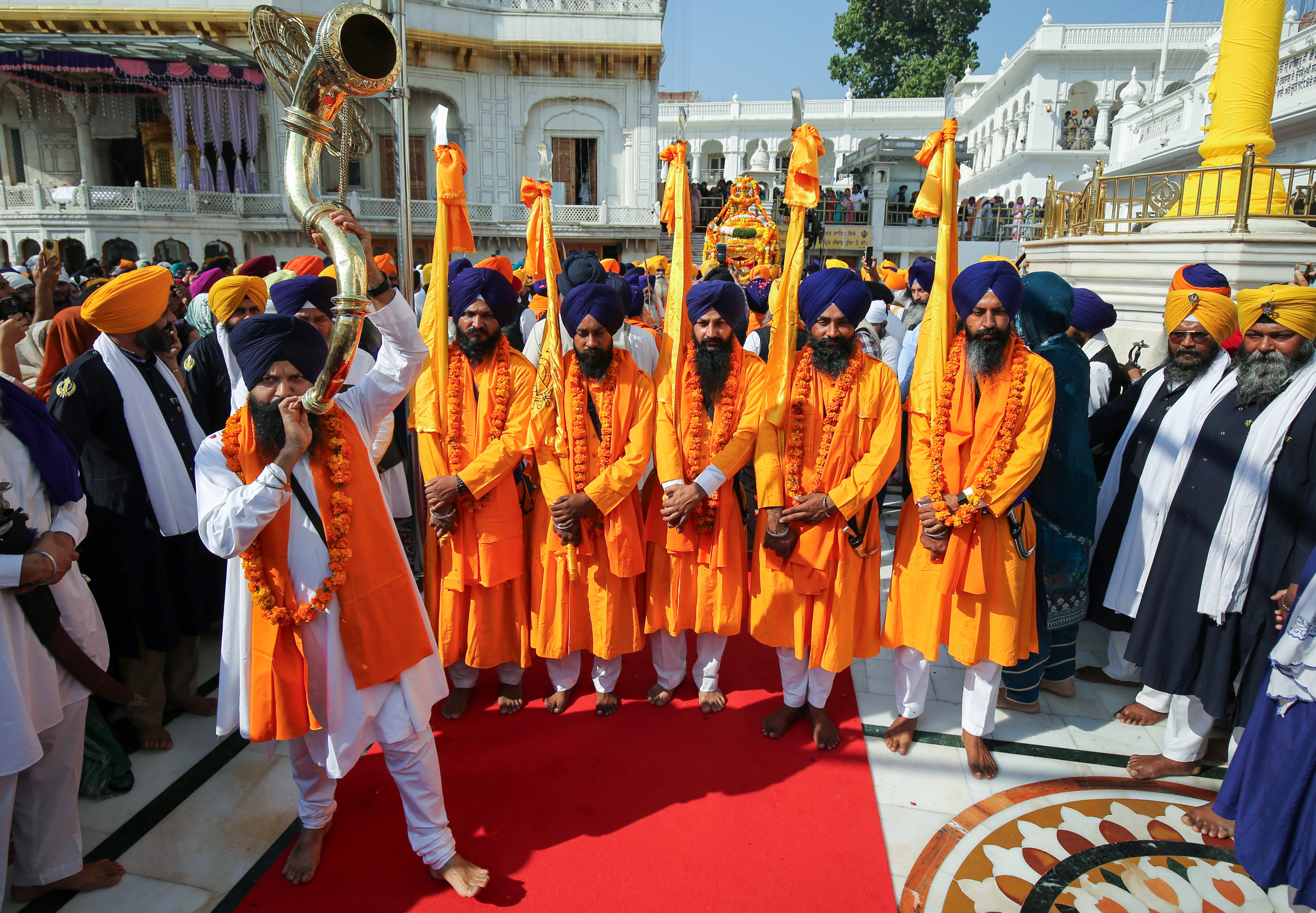 Sikh Religious procession on the eve of Prakash Parv in Patna
Sufism, which had already established a significant presence in the subcontinent, offered a spiritual language centred on divine love, inner purification, compassion and the unity of existence.
Sufi saints, particularly those belonging to the Chishti tradition, had become influential figures in the region's religious and social life. Their hospices, known as khanqahs, welcomed people across social and religious boundaries. It was in this atmosphere of spiritual interaction that Guru Nanak’s message found expression.
One must, however, make an important distinction. Sikhism was not simply an extension of Sufism, nor was it created by borrowing ideas from Islam. Guru Nanak established an independent spiritual path with its own understanding of revelation, devotion, religious discipline and the relationship between humanity and the Divine.
Nevertheless, the intellectual and spiritual atmosphere of medieval Punjab was deeply interconnected, and the similarities between Sikh and Sufi thought cannot be understood without recognising this shared environment.
Perhaps the most striking meeting point between Sikhism and Sufism is their understanding of the oneness of God. Guru Nanak began the Mul Mantar, the foundational declaration of Sikh belief, with the words Ik Onkar, meaning that there is One Supreme Reality. The idea is not merely that there is one God instead of many gods; it also points towards the unity and all-pervading nature of the Divine. Sufi mystics, similarly, placed the oneness of God at the centre of their spiritual understanding.
The Islamic declaration of divine unity, Tawhid, became, in Sufi experience, a journey towards recognising that all existence depends upon the One. For both traditions, the Divine cannot be confined to a particular building, community or outward religious identity. God is beyond human divisions and is approached through sincerity, love and spiritual awareness.
The language of divine love provides another important connection. Sufism has traditionally understood love (Ishq) as one of the most powerful means of approaching God. For the Sufi, the human heart must be purified of selfishness, pride and attachment before it can become receptive to divine love. Sikh devotional thought also places profound importance on love, remembrance and surrender to God’s will.
The repeated chanting of the Divine Name, known as Naam Simran, has a central place in Sikh spiritual practice. In both traditions, religion is not simply a matter of performing external rituals. It must transform the human personality and cultivate humility, compassion and an intimate relationship with the Divine.
A particularly important example of the Sikh-Sufi relationship is the inclusion of the poetry of Sheikh Farid in the Guru Granth Sahib, the sacred scripture of the Sikhs. Sheikh Farid, popularly known as Baba Farid (1173–1266), was one of the earliest and most celebrated Sufi poets of the Punjab.
Associated with the Chishti Sufi tradition, he composed poetry in the Punjabi language, using everyday images of nature, human suffering, mortality and love to communicate profound spiritual truths. His verses speak of the temporary nature of worldly existence, the importance of remembering God and the need to overcome pride and selfishness.
What makes this relationship significant is that his poetry was not merely admired by the Sikh Gurus; it was preserved as part of their sacred scripture. The inclusion of his compositions represents an extraordinary recognition of spiritual wisdom beyond the boundaries of religious identity.
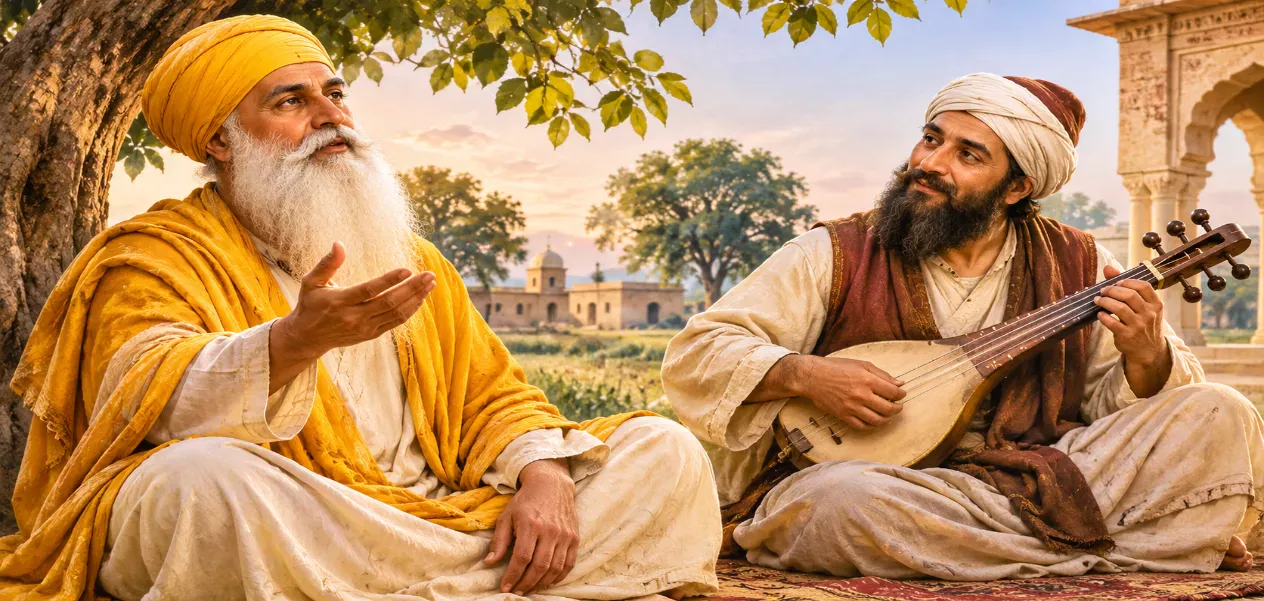 AI-Generated picture of baba nanak and his follower Baba Farid
There is another fascinating aspect to this relationship. Guru Nanak’s successors did not simply preserve the verses of Baba Farid without engaging with them. Some of the Gurus responded to his compositions, sometimes extending their spiritual message and sometimes offering a different perspective.
This exchange demonstrates that the relationship between Sikhism and Sufism was not one of passive borrowing but of active dialogue. The Sikh Gurus recognised the spiritual value of the Sufi tradition while articulating their own distinctive understanding of religious truth.
The life of Bhai Mardana offers another beautiful illustration of this shared spiritual world. Mardana was a Muslim musician and a close companion of Guru Nanak. He accompanied the Guru on his travels and played the rabab, a traditional string instrument, while Guru Nanak sang his hymns.
Their relationship was not merely that of a religious teacher and a musician. It represented a friendship that transcended the religious divisions of their time. A Muslim accompanying a Sikh spiritual teacher across regions, participating in the expression of his devotional message, offers a powerful image of the possibilities of interfaith friendship. Their association reminds us that spiritual companionship can sometimes communicate more than formal religious debates.
The similarities between the two traditions also extend to their criticism of religious formalism. Sufi masters repeatedly warned against reducing religion to outward appearances while neglecting the condition of the heart. A person might perform religious rituals and yet remain full of arrogance, greed and hatred.
Guru Nanak expressed a similar concern. He questioned the value of religious practices when they failed to produce compassion, honesty and humility. For him, a person could not become spiritually elevated merely by wearing particular clothes, visiting sacred places or displaying religious symbols. What mattered was the transformation of one’s inner life.
This concern was closely connected with their shared emphasis on human equality. Sufi hospices frequently welcomed people of all backgrounds, while Guru Nanak challenged the caste system and the discrimination based on it.
His teachings emphasised that all human beings were equal before God. The Sikh institution of Langar, the community kitchen in which people sit together and share food without distinctions of caste, status or wealth, gave practical expression to this principle. Although the Langar developed within the Sikh community and should not simply be described as a Sufi institution, its spirit resonates with the inclusive hospitality associated with many Sufi centres. Both traditions remind us that spirituality loses its meaning when it becomes an instrument of social exclusion.
Music, too, became an important meeting ground. Sufi gatherings have traditionally used devotional music, particularly Qawwali in certain Sufi orders, to awaken love and longing for the Divine. Sikhism developed its own rich tradition of Kirtan, the devotional singing of the Gurus'devotional poetry. These are distinct musical and religious practices, but both demonstrate music's power to communicate spiritual experiences. In both traditions, poetry and music are not merely artistic activities; they are means of remembering God and transforming the human heart.
It would nevertheless be historically inaccurate to suggest that every important Sikh teaching originated in Sufism. Sikhism also developed through its engagement with the Bhakti traditions of India, the teachings of earlier poet-saints and the distinctive spiritual experience of Guru Nanak.
READ MORE: Ashim Sattar, who predicted Himalayan disaster in TIME100 Next India list
Its understanding of the Guru, the importance of an active household life, the institution of Sangat and the later development of the Khalsa give it a religious identity and institutional history of its own.