


Saquib Salim
“How many yesterdays of my youth lie buried here,” wrote Jawaharlal Nehru in the district jail at Almora in his Autobiography, a book written almost wholly in British governed jails in 1935. Three months earlier he had celebrated his forty-fifth birthday in the same prison.
Between December 1921 and 1935 he had been jailed seven times. Of course he would be arrested again and would spend years more in prisons till 1947. The freedom struggle had asked him for more than 9 years in prison.
In his autobiography Nehru writes that an only son of prosperous parents, “is apt to be spoilt.” But this son walked, again and again, through the iron gates of colonial jails. These imprisonments were his politics.
The first jail term came in December 1921. The Congress had boycotted the Prince of Wales’s visit, and mass arrests began in the United Provinces. He recalled later that prison was still “an unknown place.”
When police surrounded the Congress office at Allahabad, Nehru learnt at home that they had come to arrest both his father and him. His offence was “distributing notices for a hartal.”
At his father’s trial his four-year-old daughter, Indira Gandhi, spent the proceedings in her grandfather’s arms. Sentenced to six months, he was discharged after three, when a revising authority found him wrongly sentenced. He later wrote that he was “sorry to go out, leaving my father behind.”
This was a new kind of politics under Mahatma Gandhi. Imprisonment had been common in India for years but it had not yet been “deliberately courted.”
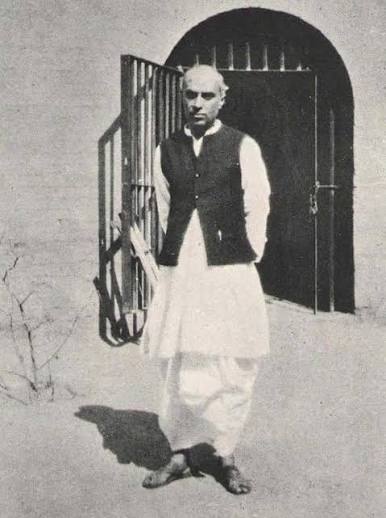
The United Provinces Gaol Manual once laid down that prison work should be “irksome and laborious and a cause of dread to evil-doers.” The volunteers arrived by the lorry-load, shouting slogans, and an estimated thirty thousand persons were sentenced in December 1921 and January 1922 alone.
Nehru wrote, “We had come to prison of our own accord”. Nehru used this as a method of politics.
About six weeks later Nehru was arrested again. He was charged with criminal intimidation after a campaign against foreign cloth and sentenced to a year and nine months. On the last day of January 1923 all political prisoners at Lucknow were discharged.
The third term came that autumn at Nabha, a state under a British administrator, which Nehru had entered to watch Sikh marchers, a trip he expected to be of single day. He was handcuffed through a night and part of a day, kept in a damp cell, and woken by a rat or a mouse running over his face. He came out with typhoid.
Then for nearly seven years Nehru remained outside. The breach of the Salt Law ended this freedom.
Nehru was arrested on April 14, 1930, as he was boarding a train for Raipur, tried inside the prison the same day, and given six months under the Salt Act. At Naini (Prayagraj) he was kept alone in a circular enclosure known throughout the jail as “the Dog House.” At night, Nehru wrote, “I felt as if I was at the bottom of a well.”
On October 11, Nehru was discharged and re-arrested after eight days. This time for two years. In those months arrests “were sought, not avoided.”
Motilal Nehru, acting Congress president, fixed Nehru’s November birthday for meetings at which the offending passages of his speech were read aloud. An estimated 5,000 arrests were made that day, which Nehru called “a unique birthday celebration.”
On New Year’s Day 1931 his wife Kamala was arrested too, and Nehru was pleased, for she had longed to follow her comrades to prison. On January 26 he was released on health reasons.
A year later, Nehru was back in jail. The Government had determined to crush the Congress, and on January 4, 1932 he was sentenced to two years’ rigorous imprisonment for trying to travel to Bombay in defiance of an order confining him to Allahabad.
His mother and both his sisters threw themselves into the movement, and both sisters were soon in jail with a year each.
Nehru was moved to Bareilly and then to Dehra Dun, where he stayed fourteen and a half months. His health suffered. He was discharged on August 30, 1933, thirteen days early, because his mother was seriously ill.
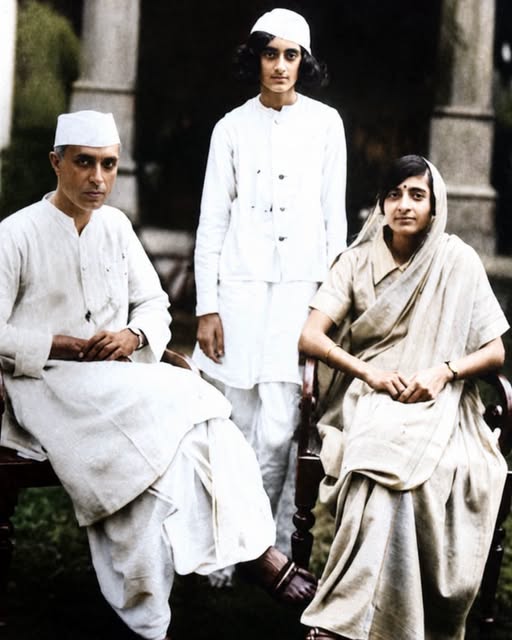 Jawaharlal Nehru, Indira Gandhi and Kamala Nehru at Anand Bhawan
After a little over five months of freedom Nehru was again in prison, and he wrote from jail that “during the last three years I have been mostly in prison.”
The seventh arrest came on February 12, 1934, the day after Nehru returned from earthquake relief work. When the police officer arrived, Nehru greeted him with the words, “I have been waiting for you for a long time.” He had been out five months and thirteen days. He writes that “the real burden was not mine,” for it fell, as always, on the women of the family, his ailing mother, his wife and his sister. Sentenced at Kolkata to two years, he said, “My seventh term of imprisonment had begun.”
In August 1934, with Kamala critically ill, he was released for eleven days. After eighteen years of marriage, Nehru asked himself “how many long years out of them had I spent in prison-cell”.
Through intermediaries Nehru was given an assurance to keep away from politics would ensure that he could attend to his wife Kamala. He called it “an impossible condition,” for giving it meant “a mortal injury on the roots of my being.”
In October, as Nehru left after a visit, Kamala, lying almost in a daze with fever, smiled bravely, beckoned him close and whispered, “Do not give it!”
The following September he was suddenly discharged, five and a half months before his term ended, because news had come that she was critical.
Nehru would remain free for more than 5 years only to get arrested for the eighth time on 31 October 1940 for more than a year. He was released on December 3, 1941.
The ninth arrest came on 9 August, 1942 with the Quit India Movement. He remained in prison for almost three years only to be released on 15 June 1945.
Nehru never claimed to be unique. At Lucknow, he shared a barrack of about 50 prisoners, beds three or four feet apart. His years in prison can “hardly be termed adventurous,” for he shared them with “tens of thousands” of his countrymen and countrywomen, and the record was, according to him, “our common record.”
READ MORE: Imam's responsibilities are beyond leading prayers
Add the dates and the nine terms come to 3,262 days. Nehru later wrote, “Was it worthwhile?” the ghosts of those dead yesterday. “There is no hesitation about the answer.” He said that if given another chance “my major decisions in public affairs would remain untouched.”