

 Saquib Salim
Maulana Abul Kalam Azad joined the interim government in January 1947 as Education Minister, writes Ian Henderson Douglas, “feeling that, in formulating educational policy, he could contribute to the future form of the country.”
Remembrance
The portfolio stayed with him until he died in 1958. Contrary to popular perception, Azad endured a hopeless syllabus as a student; he became an editor who put a colonial education policy on trial, and a writer who carried modern science to Urdu readers. These facts explain why the nation could hardly have found a better Education Minister.
Azad’s first interaction with education made him understand what education should not be. His father, Maulana Khairuddin, was “opposed to English education” and would not even entrust his sons to the Calcutta madrasa. He taught them himself, and “would allow no interruption by questions, but went on lecturing so fluently and exhaustively that no question remained to be asked.”
The syllabus was the Dars-e-Nizami, for which Azad later expressed “near contempt”, pronouncing one aspect of the course after another “worthless... worthless” and complaining that such learning gave no “insight tending to mental initiative”. Azad finished the course by 15 while the normal age to complete was 20.
Azad wrote that his childhood was “surrounded by the four walls of taqlid and veneration of the past”, where “no winds of change had any chance of passing within”. So he read in secret, books hidden under his mattress, “by candlelight, often until one or two o’clock in the morning.” When he asked why he should believe what he was taught, the only answer was “Because that is what I was told”. These denied questions later made criticism the centre of his educational thought.
In 1912 Azad founded the Urdu weekly Al-Hilal. On 4 June 1913, he examined the government’s educational circular in this journal. Azad began from faith and wrote, “There is an organic and natural connection between Islam and education. It should, therefore, be a distinctive trait of a Muslim to be educated, before everything else.”
Azad said that education was “the name for the expression of intrinsic capacities that a human is endowed with”, not “an outward development based on a superficial knowledge of composition, vocabulary and literature”. Its basis was “to develop human faculties through criticism and choice, and extension of knowledge”. “The personality of students deserves to be treated with respect”, teaching should keep “their interests and aptitude” in view, and “Primary education should be fully provided for.”
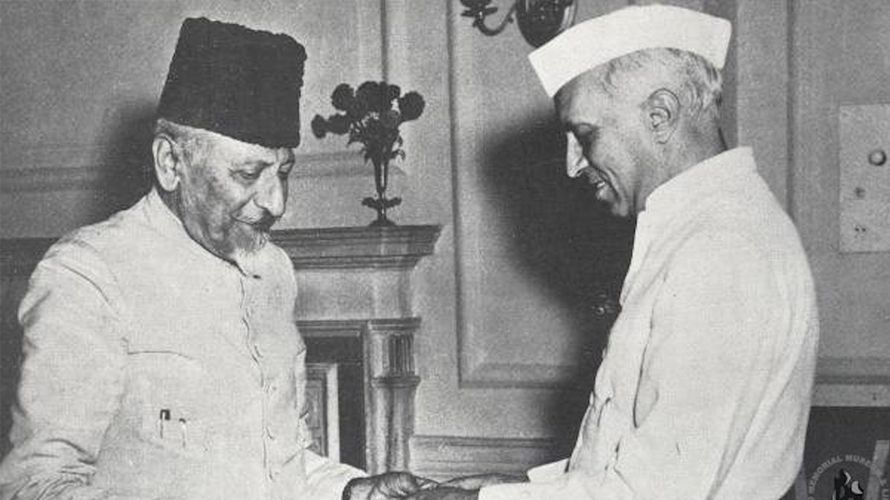 Maulana Azad with Pt Jawaharlal Nehru
So, by Azad’s judgment the British government’s school failed. Its curricula were “dominated by the element of servility”, its purpose “that educational certificates be distributed as a means of living the wretched life of servility”, and its administrators “have decided that compulsory primary education is not in the interest of India.”
The teacher was required only “to fulfil the fixed number of lectures for the day” and was “not concerned with the development of mental powers.”
Azad asked if the curriculum contained “any provision for intellectual endeavour, or for the promotion of the national language, national literature and the history of the nation to consolidate the foundation of the nationality?”
Azad was critical of Aligarh too. “We were drunk with the wine of education,” he wrote. “While our neighbours were basking in the sun of liberty, we were dampened by the dew drops of education.”
Douglas argues that Azad “could not identify with the ulama’s hostile attitude towards modern knowledge”, and that Al-Hilal “contains ample evidence of his respect for it.”
In February 1913 Azad began a column on “scientific matters”. The first article was on radium. A report on Scott’s expedition to the South Pole followed, and by 1914 he was translating articles from Scientific American, “the first of which was on Dr Maria Montessori’s educational methods.”
Professor Muhammad Habib, quoted by Douglas, insisted that Azad “at no stage of his career objected to the complete acceptance of European science in every field.”
After India gained independence, Azad said as the education minister, “Today India is free.... She can have any kind of mental mould she pleases. Will it be exclusive... or will it be all-inclusive, which has been the characteristic of Indian culture throughout the ages?”
At Shantiniketan, Azad praised Tagore for opening the school’s ceremonies with the words “The whole world here becomes one home”, which he called a “proclamation of faith in the unity of mankind”. He called education “the problem of problems for Asia”. He championed “social education”, meaning “the inculcation of a lively sense of rights and duties of citizenship”, the plain answer to the servility he had condemned in 1913.
In his view education was to produce “an educated mind in the masses, in the absence of literary education”, and to include health education, crafts, art, music, drama and “instruction in universal ethics, including tolerance and mutual appreciation.” He rebuked religious teaching that “produced the very opposite of mutual toleration.”
Azad appointed the University Education Commission in 1948 and the Secondary Education Commission in 1952, reorganised the All-India Council for Technical Education, and oversaw the establishment of the Kharagpur Institute of Higher Technology. He established the University Grants Commission and the Indian Council for Cultural Relations. Concerned that India lacked “its due place in the history of philosophy as commonly taught in colleges and universities”, he appointed a committee under Dr S. Radhakrishnan that produced a two-volume History of Philosophy, Eastern and Western.
READ MORE: A ‘Namaste’ can make a difference: Muslims must reach out and connect
Jawaharlal Nehru saw in Azad “the good qualities of the past, the graciousness, the deep learning and toleration”, joined to “a strange and unique mixture” of the “urges of today and the modern outlook”. That mixture is what a free nation’s first Education Minister needed. Azad had suffered a school that taught obedience, had argued for one that taught criticism, and was handed the power to build one that taught citizenship.