New Delhi
A Copenhagen-based digital content creator has debunked many myths and perceptions about India over its populations, women’s safety and other issues after her month long travel with his son across India.
Line Petrova wrote a long post on Facebook’s Population Discussions public group. “Just back from a month in India – and I need to push back on the narrative,” she declared.She also posted her pictures in India/
She wrote: “I've just returned home to Copenhagen after a month travelling through India with my 11-year-old son. And I want to share something, because in groups like this the view of India often tilts toward the overwhelmingly negative.
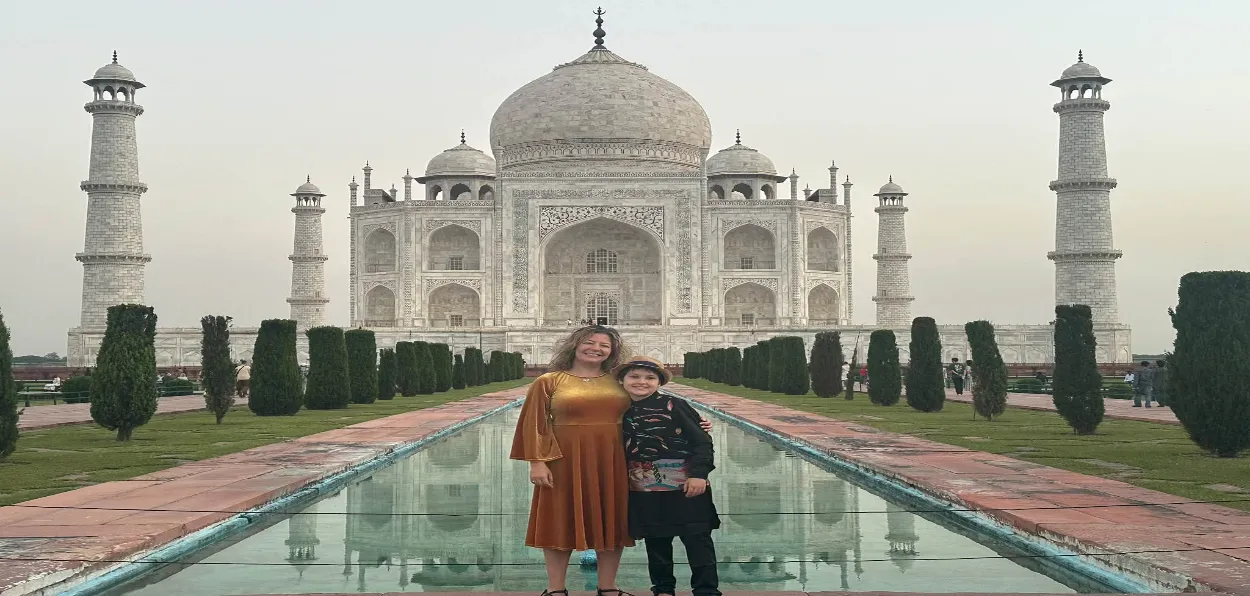
 Lina Pertova with her son ready to board a train in India
“India is a fantastic country. Full of energy, colour, innovation and warmth. The development happening there is real and visible – infrastructure, technology, education, a growing middle class and an economy that keeps transforming. It's a country on the move.
“Yes, there are serious issues with the situation for women – I won't pretend otherwise. But it's also worth mentioning women's political and economic power in India: reserved seats for women in local government, women leading major companies and banks, women in space programmes and science, and a female finance minister steering one of the world's largest economies. It's a huge, diverse country, and that diversity matters.
“I've travelled alone in India for extended periods. I've been alone on overnight trains. I've travelled there with my son. And at no point – not once – did I feel unsafe.
 Line Petrova and her son enjoying their food
“Now to the bigger picture: "they" flattens a hugely diverse country of 1.4 billion. Fertility pressure varies enormously by region, class and community – and India's fertility rate has actually dropped below replacement level nationally. The bigger overpopulation lever isn't babies born in India; it's consumption per capita in rich countries. And framing population as the core problem often shades into blaming the poor for a crisis driven mostly elsewhere.
ALSO READ: A ‘Namaste’ can make a difference: Muslims must reach out and connect
“So before we reduce 1.4 billion people to a single statistic, let's remember what gets lost in that flattening: the diversity, the progress, the women gaining ground – and the fact that the real lever often sits with those of us consuming the most.
Just back. Still processing. But glad I went – and I'll go back”