

Saquib Salim
“You learn science by keeping your eyes and ears open and looking around at this world.” C. V. Raman said on 22 December 1968, at the foundation stone laying ceremony of the Community Science Centre in Ahmedabad.
As a scientific subject to speak about, he chose a question every child asks. Why is the sky blue? It was a subject that one did not need a laboratory to see. “Just look up.”
Though the lecture was not really about the sky. Raman himself said, “The subject of my lecture is not the blue of the sky… it is the spirit of science. What is science? And how can we in this country hope to advance science? How can we try to really make ourselves worthy of our ancestors in the past?”
His speeches show how he wanted Indian science and its youth to grow.
Raman’s first idea was self-reliance for India. He said, “one of the things that has been bred in us, a very deep and ineradicable defect, is a kind of inferiority complex which makes us think that we dare not question what has come to us from abroad.” He further asked, “Bad enough to borrow money. But what about borrowing knowledge? What about borrowing experts from abroad? We must realise that we must stand on our own legs. It is better to work with the most inefficient useless equipment of ours than to shine in borrowed feathers.”
At IIT Madras in 1966, Raman said, “we in this country have no future whatsoever of any sort unless we learn firstly, secondly and lastly to rely on ourselves for everything that we need.”
Raman practised this belief of Indian self-reliance long before 1966. In 1917, Sir Ashutosh Mookerjee, the Vice Chancellor of Calcutta University, offered him a professorship. The post required foreign training, but Raman refused and the University had to amend the condition.
In 1928, he discovered the Raman effect with an apparatus he made himself for a modest 200 Rupees. After Raman brought the Physics Nobel to Asia for the first time in 1930, Nobel Laureate C. J Davisson wrote that Raman’s “formal training was received entirely in India, and, except for a single year, he has worked only in his native land.”
Raman was not against learning from other nations though. At a ceremony held at Town Hall, Kolkata, in 1931, he said, “I do not for a moment suggest that we have nothing to learn from Europe or America, but surely it is better that we learn to accomplish whatever we can within our own borders.”
Indian science, Raman believed, should have its own institutions and journals. While working as a government accountant, he revived the almost defunct Indian Association for the Cultivation of Science, set up by Mahendra Lal Sircar in 1876. He founded the Proceedings of the Indian Academy of Sciences and other journals. Leading by example, he sent much of his own research to these Indian journals and encouraged his students to do the same.
His message for the Indian youth was not complex. About the blue sky he said, “Don’t read any book about it; don’t ask your teacher… Look at it as if it is a completely new scientific problem about which nobody has troubled himself before.” A botanist, he said, when asked why leaves are green, “murmurs, ‘Chlorophyll’. Finished. You can surely pass your examinations with that kind of answer, but that is not the real answer.”
While talking about the colour of sky, Raman took his audience through clouds, dust, rain and human vision, because “the spirit of science is not finding short and quick answers, the spirit of science is to delve deeper.”
Students, in Raman's view, need not hunt through textbooks for problems, because “all round you, the whole world bristles with problems to solve.”
Raman asked the youth to work for the love of knowledge and not for a pay cheque. “The greatest thing in life is not the achievement, but it is the desire to achieve.” Without the urge to search for knowledge, one may get a job and “a nice comfortable salary, in which you don’t have to do anything except to wait for the monthly cheque.” Which, in his opinion, is not science. He actually joined as a Professor of Physics at Calcutta University for a much lower salary than his previous job.
In Raman’s view, those who worked only to advance knowledge proved to be “the greatest benefactors of humanity.”
Professor Ramseshan, a close aide of Raman during his last years, wrote that Raman often said that a scientist’s work “should not only be original but should also be relevant to India’s needs when it came to application of research.”
ALSO READ: My mission is to bring a smile to each face on Diwali
Ramseshan also wrote that Raman was opposed to Indian scientists going abroad for advanced research. “It is difficult to say whether he was right or wrong, but it is a fact that independent India is yet to produce scientists of Raman’s calibre, although the money spent on scientific research is enormous compared to the Raman days.”
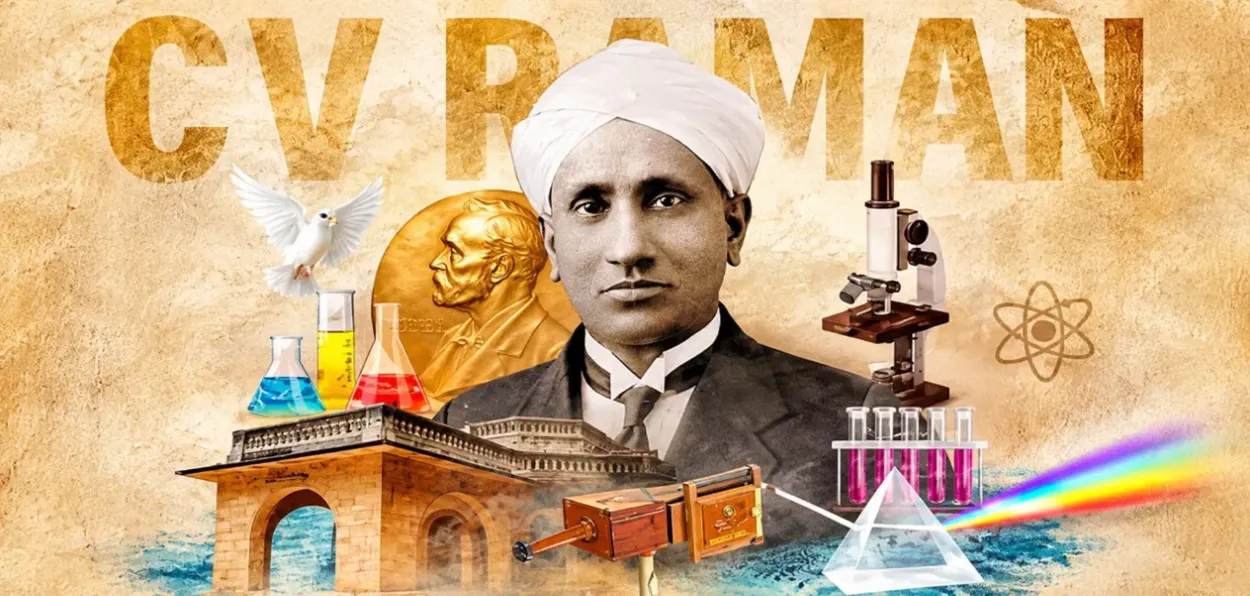
Today, 7 November, is the birthday of this great scientist and patriot.