

 Mohd Fahad
"The best of people are those who are most beneficial to others." — A widely quoted Prophetic tradition. Charity is woven into the fabric of Islamic life through zakat, sadaqah, waqf, and countless acts of private generosity.
Yet, despite this deeply embedded culture of giving, Indian Muslims continue to lag on almost every socio-economic indicator—education, healthcare, formal employment, entrepreneurship, women's workforce participation, and representation in higher education.
Every Ramadan, thousands of crores of rupees are distributed in charity across India.
Mosques collect donations effortlessly, appeals for religious causes evoke immediate responses, and whenever a calamity strikes, Muslims are often among the first to contribute. This contradiction deserves honest introspection.
The problem is not that Muslims give too little. The problem is that a significant portion of philanthropic spending is directed toward religious consumption rather than toward community building.

Increasingly, wealth is spent on repeated voluntary pilgrimages, constructing new religious institutions where adequate ones already exist, lavish religious gatherings, and ceremonial expenditures, while investments in schools, colleges, hospitals, research institutions, scholarships, skill development centres, and economic empowerment remain comparatively inadequate for any quality endeavour.
This is not an argument against Islam or against religious institutions. Nor is it a criticism of those who sincerely perform Umrah or contribute to mosques and madrasas. Rather, it is an appeal to revive an older Islamic tradition—one that viewed education, healthcare, scientific inquiry, and public welfare as acts of worship no less significant than ritual devotion.
The Sachar Committee Report (2006) painted a sobering picture of the socio-economic condition of Muslims in India. It found that Muslims were underrepresented in higher education, government employment, banking access, and organised-sector jobs.
Subsequent National Sample Survey and Periodic Labour Force Survey data have shown improvements in some areas but continue to reveal significant educational and economic gaps compared to national averages.
Walk through many Muslim localities across North India, and one often finds multiple mosques within a small radius, several madrasas serving overlapping populations, and frequent fundraising campaigns for additional religious infrastructure.
Yet the same neighbourhood may lack a quality English-medium school, a public library, a coaching centre for competitive examinations, a vocational institute, or even a reasonably equipped health clinic. The imbalance is difficult to ignore. The question then arises: have we been able to get our priorities right?
The culture of repeated Umrah
Over the past two decades, rising incomes and easier international travel have made Umrah increasingly accessible for middle- and upper-middle-class Muslims.

For someone who has never visited the holy cities, the desire to perform Umrah is deeply understandable. It is a profoundly moving spiritual experience.
However, another trend has quietly emerged.
Many financially comfortable Muslims now undertake Umrah repeatedly—every Ramadan, every few years, or even multiple times within a single year. Social media has amplified this culture, in which photographs from Makkah and Madinah often serve as markers of religious prestige.
A standard Umrah package from India today may cost several lakh rupees per person. For a family of four, the expense can easily touch around ten lakhs.
No one can question the sincerity of such journeys. But one may legitimately ask a different question:
Would Allah be less pleased if someone postponed a fourth or fifth voluntary Umrah and instead funded the university education of five deserving students? Would the moral impact of that decision not resonate far beyond the donor’s lifetime?
Islam distinguishes between obligatory acts and voluntary acts. Once compulsory duties are fulfilled, the tradition repeatedly encourages believers to consider what best serves society. Numerous contemporary scholars have argued that where urgent social needs exist, supporting education, healthcare, or relieving hardship may carry greater public benefit than repeatedly undertaking voluntary pilgrimages.
Building more madrasas, or better schools
Perhaps no issue illustrates misplaced priorities more clearly than education. Madrasas have historically preserved Islamic scholarship and continue to serve important religious functions. They educate thousands of children, particularly from economically weaker backgrounds, and many have broadened their curricula over time.
The concern is not with their existence. It is with the assumption that building another madrasa is always the most urgent educational need.
In many districts, fundraising campaigns successfully finance new religious seminaries while nearby government schools struggle with poor infrastructure, teacher shortages, and limited science education.
Imagine if even a fraction of those donations were directed toward facilities like science laboratories, digital classrooms, civil services coaching, nursing colleges, teacher training institutes, artificial intelligence and coding centres, research fellowships and more. The educational landscape of the community could change within a generation.
The first Quranic revelation was "Iqra", which means read or recite. It was an invitation not merely to literacy but to intellectual engagement with the world.
Muslim civilisation once produced mathematicians, astronomers, physicians, philosophers, engineers, jurists, linguists, and historians. Those achievements were possible because philanthropy invested in knowledge—not only in religious learning but in every branch of human inquiry.
The forgotten institution of Waqf
India possesses one of the largest collections of waqf properties in the world. According to official estimates, waqf boards collectively manage hundreds of thousands of properties spread across the country. On paper, these assets represent enormous economic potential. Yet many properties remain underutilised, poorly managed, or tied up in litigation.

Imagine if waqf institutions consistently generated income that was channelled into modern universities, hospitals, affordable housing, orphan care, disability services, etc.
Such a transformation would require returning to one of Islam's greatest civilisational inventions: charitable endowments dedicated to public welfare.
Historically, waqf institutions financed hospitals, libraries, universities, caravanserais, orphanages, fountains, and public kitchens throughout the Muslim world.
The question is not whether this model works. History has already answered that.
Sir Syed Ahmad Khan's Lesson
Perhaps no Indian Muslim understood this better than Sir Syed Ahmad Khan. After the Revolt of 1857, when many Muslim elites remained suspicious of modern education, Sir Syed argued that without scientific knowledge, English education, and institutional development, the community would remain politically and economically marginalised.
His efforts eventually led to the establishment of the Muhammadan Anglo-Oriental College, which later became Aligarh Muslim University. The resistance he faced sounds remarkably familiar today. Many considered Western education dangerous. Others felt religious education alone was sufficient. History has judged differently.
Aligarh produced generations of administrators, lawyers, scientists, teachers, writers, diplomats, and public intellectuals who shaped modern India.
Weddings and religious prestige
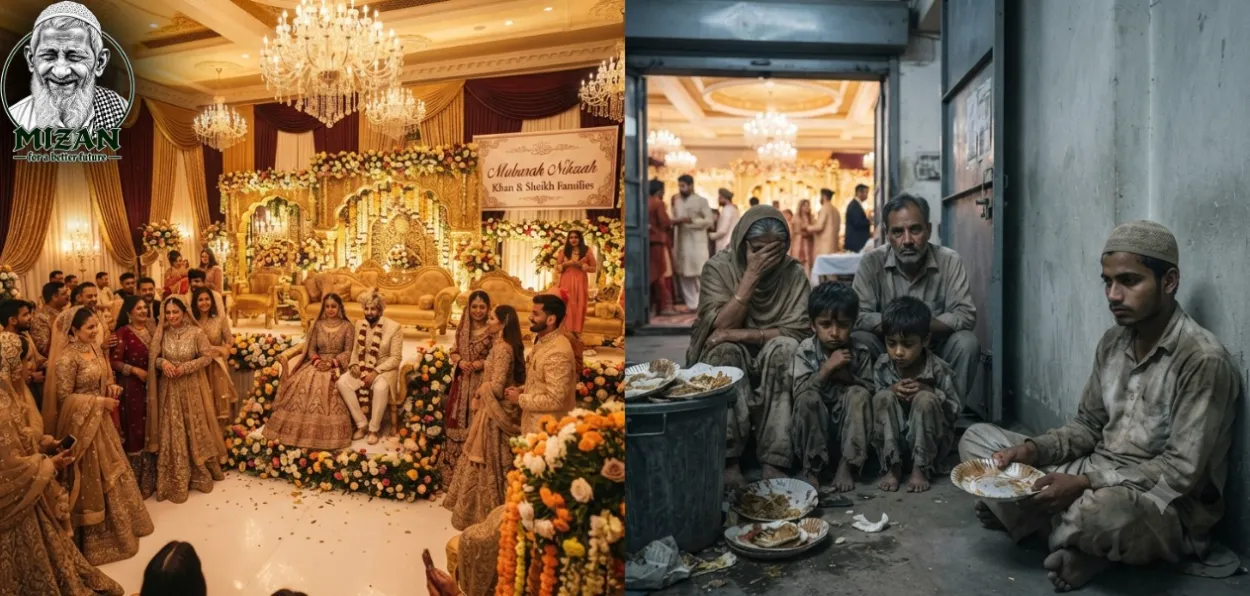
The conversation extends beyond institutional philanthropy. Across many Muslim communities, weddings have become expensive spectacles. Families spend tens of lakhs on banquet halls, designer clothing, elaborate decorations, luxury catering, photography, jewellery, and social display. Ironically, Islamic teachings consistently encourage simplicity in marriage.
Young men delay marriage because expectations have become financially overwhelming. Parents exhaust lifetime savings for ceremonies lasting a single evening. Imagine redirecting even 20 per cent of these expenses toward higher education or entrepreneurship for the newly married couple. That investment would honour both the spirit of marriage and the future of the family.
Islam's earliest civilisation became great not because it produced the largest number of religious buildings, but because it produced institutions of learning that illuminated the world.
Potential behind serious challenges
India's Muslims face serious challenges, but they also possess immense philanthropic potential. The annual flow of zakat, sadaqah, waqf income, and private donations represents one of the community's greatest untapped resources. Redirecting even a modest share of that wealth toward education, healthcare, scientific research, women's empowerment, and economic opportunity could reshape the community's future within a generation.
Perhaps the question every donor should ask before writing the next cheque is not simply, "Will this earn me reward?" but also, "Will this change someone's life?"
ALSO READ: From gyms in mosques to livelihood initiatives driven by Muslims
If the answer is yes, then that charity carries not only spiritual merit but the power to transform a community. That, too, is an act of worship.
The writer is a senior journalist based in Jaipur