Vidushi Gaur/Azamgarh
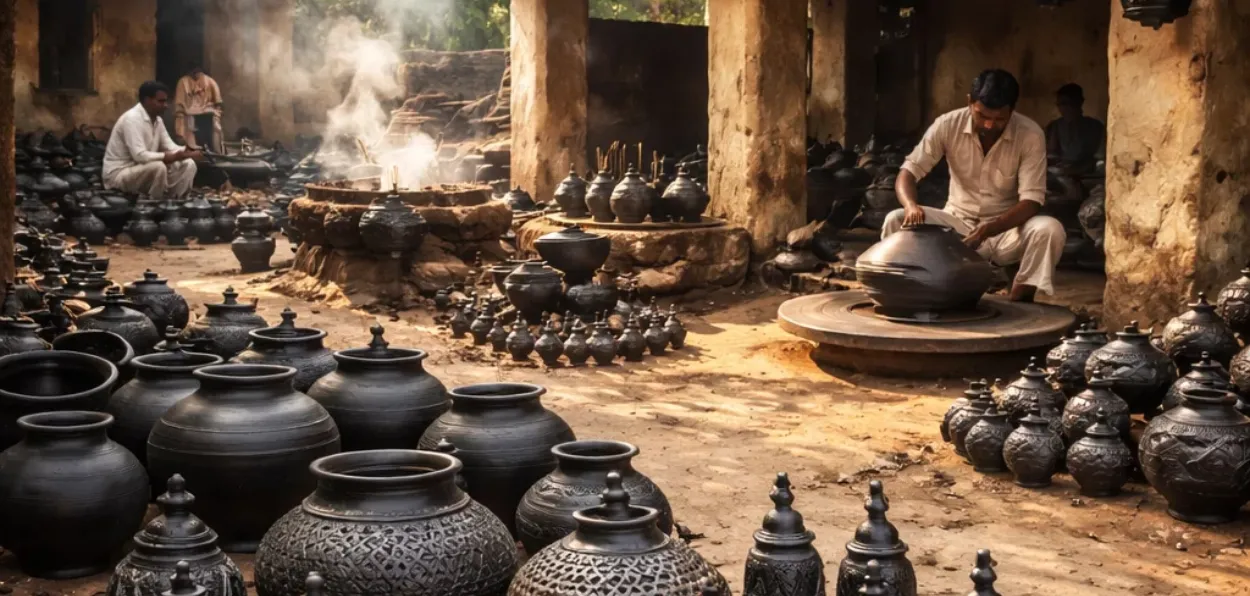
As Diwali approaches, the narrow lanes of Azamgarh, a bustling city in Uttar Pradesh, begin to acquire a festive rhythm. Artisans, a majority of whom are Muslims, are giving finishing touches to the decorative lamps, idols, and other artefacts that go into decorating homes on Diwali and are popular and classy gifts on the occasion, inside the small workshops. The black pottery of this place is much in demand and the artisans make most of the festive mood through bulk sales.
For the artisans and traders, Diwali marks peak of business but more importantly, it sustains livelihood, traditional occupation and a unique craft.
Azamgarh's artisans and its festive markets are rooted in a much older pottery tradition. The district is particularly known for Nizamabad's black pottery, a craft recognised for its distinctive dark surface and intricate silver-coloured patterns. The pottery received a Geographical Indication (GI) tag in 2015, recognising its association with the region and its traditional craftsmanship.
Black Pottery is a unique traditional craft known for its distinctive black finish and intricate silver ornamental designs. Crafted using locally sourced clay and traditional firing techniques, the pottery reflects exceptional artisan skill and cultural heritage.
 Decorative lamp in black pottery
The black potter is also the One district one product of Azamgarh district and has become all the more popular since it's official status and patronage under ODOP.
Azamgarh's artisans offer a glimpse into the everyday cultural relationships that often receive little attention. A family buying a diya may not know who made it or where the clay was sourced. Similarly, an artisan making Ganesh-Lakshmi idols may never witness the prayers offered before it.
Nevertheless, the two are connected through an exchange of skill, labour and trust. The story of Muslim artisans making Diwali products adds another dimension to this shared cultural heritage. It reminds us that India's artistic traditions have rarely developed within rigid religious boundaries. Crafts have travelled between communities, techniques have been exchanged and livelihoods have often depended on mutual trust.
 Flower vases in black pottery
And so, as Diwali approaches, the artisan's workshop becomes a place where religious identities give way to the shared language of work.
Behind the festive colours and glowing lamps lies the difficult reality of traditional artisanship. Making earthen products is a labour-intensive occupation. It requires long hours of preparation, careful handling of clay, drying, firing and finishing. A single mistake can damage an entire batch of products.
For families dependent on pottery, the weeks preceding Diwali can be particularly important. Demand for diyas, decorative lamps and religious idols offers an opportunity to supplement their regular income. The earnings are often modest, but they help sustain households and keep an inherited skill alive.
The challenges faced by Azamgarh's pottery sector are considerable. A 2022 media report documented how artisans in Nizamabad were struggling with rising raw-material costs and a shrinking market for traditional black pottery. Many had increasingly turned towards ordinary red-clay products, including diyas, to sustain their livelihoods.
The district's official export action plan also identifies the importance of traditional pottery, noting that artisans produce idols of Lakshmi, Ganesha, Shiva, Durga and Saraswati, particularly for fairs and festivals.
The most beautiful aspect of this tradition is its simplicity. A family purchasing a diya may not always know the identity of the person who made it. The religion of the artisan shaping an idol may never witness the prayers offered before it. Yet, somewhere between the workshop and the household, their lives become connected.
This is what makes India's composite culture meaningful. The significance of these artisans lies not in the fact that they belong to one religion while producing objects associated with another.
READ MORE: Ghazala Parveen uses art to challenge social stereotypes
In Azamgarh, the clay may take the shape of a diya or an idol, but the story it carries is much larger. It is a story of shared heritage, mutual respect and a country where the light of one person's festival can be shaped by the hands of another.