Ehsan Fazili/Srinagar
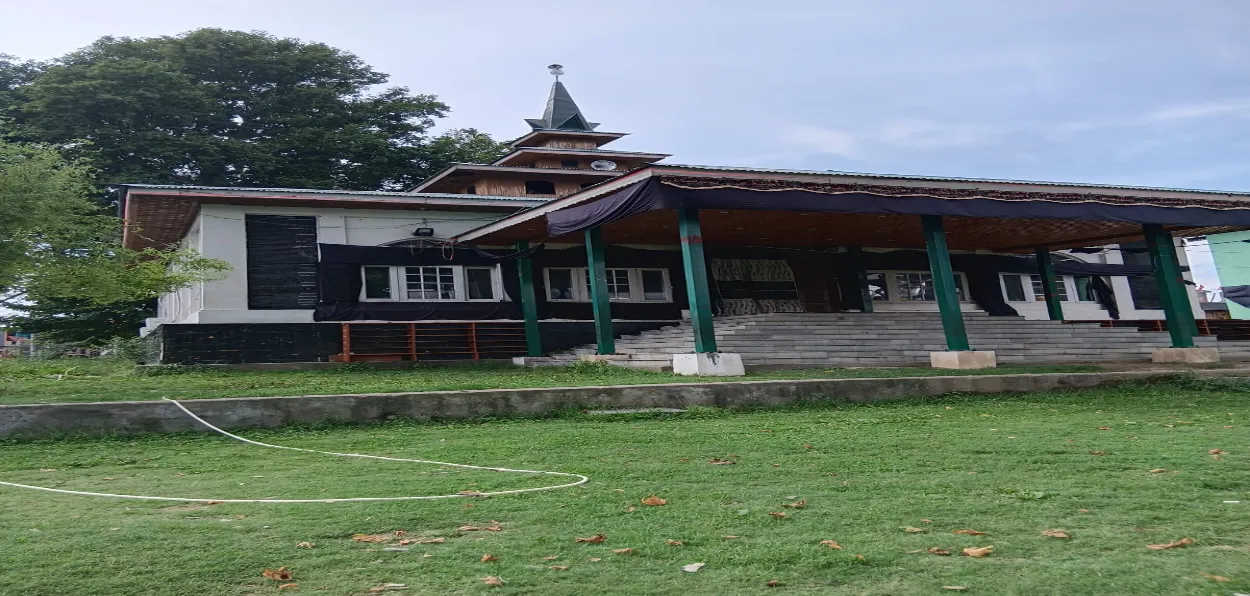
Nestled in the densely populated area of Zadibal, Srinagar, stands the centuries old Khanqah-e-Mir Shams-ud-din Araki, dedicated to the renowned theologian, who visited Kashmir first as an ambassador and, later as a preacher at the dawn of 16th century.
At a walking distance from the main Zadibal Imambara, the Khanqah is located over an elevated level looking at a horizontal line with the shrine of Sufi saint, Sheikh Hamza Makhdoom on Hari Parbat Fort to its east.
The premises comprise Khanqah, reconstructed over two decades back after several reconstructions in the past and, a mausoleum of Mir Shams-ud-Din Araki, his family members, descendents and followers around.
The new concrete structure of Khanqah, constructed more than two decades ago on modern lines, is opened for devotees on important occasions like Muharram days, according to the local caretakers. It is believed that the Khanqah, since it was established five centuries ago, had been damaged in 11 different fire incidents.
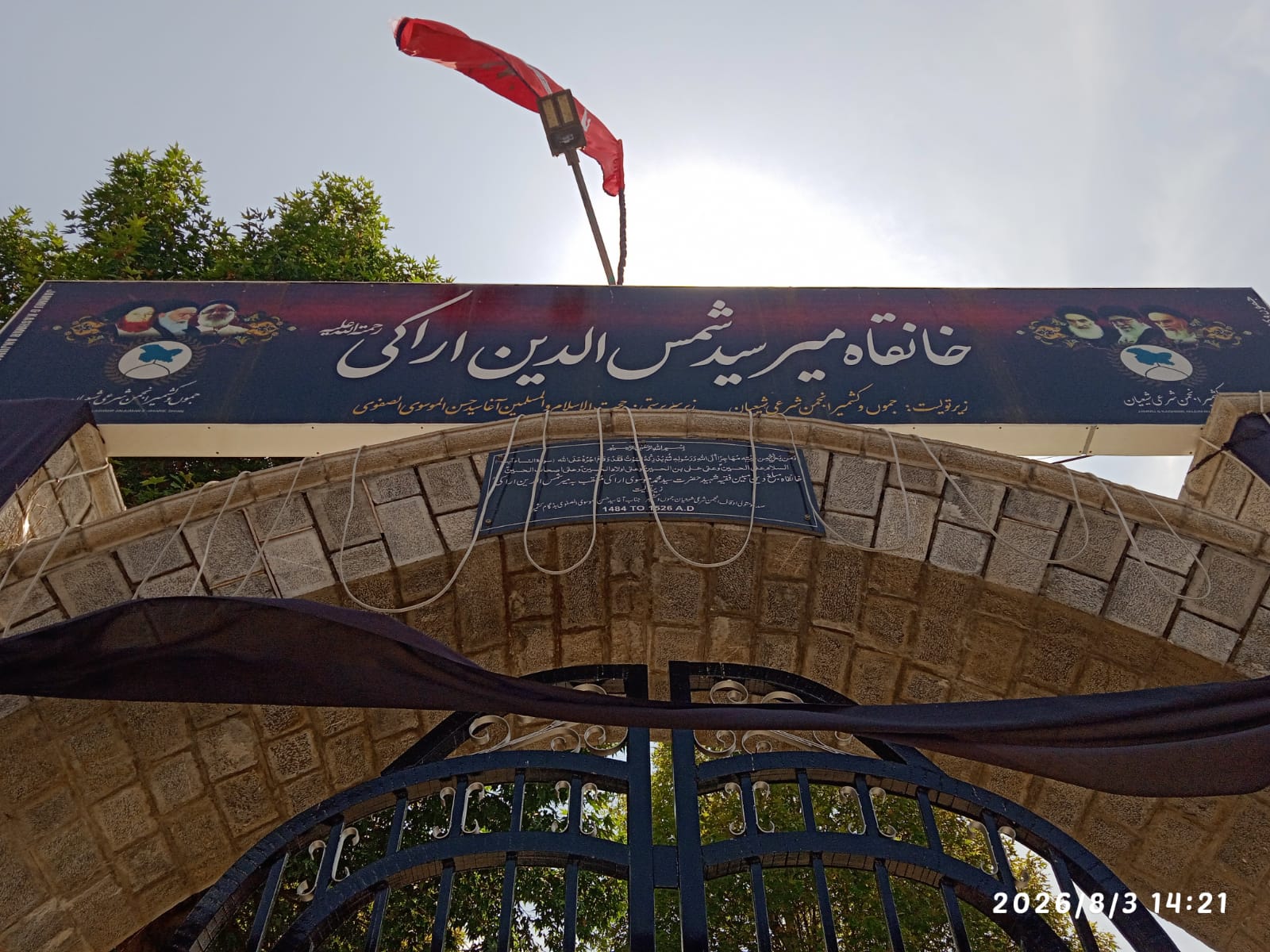 Entrance to Khanqah-e-Zadibal
The mausoleum structure is being developed by the Department of Tourism of J&K Government, for renovation, beautification and to create better facilities for the pilgrims as well as tourists, though at a low pace.
Devotees, mostly from the Shia community, continue to pour in on a daily basis offering special prayers and seeking blessings at the mausoleum. Much work on the preservation of monumental artifacts, believed to have been the tombstones on different graves or memorial plaques on which verses in Arabic are carved, are lying in disarray.
The Khanqah is looked after by the Anjuman-e-Sharie Shia, J&K.
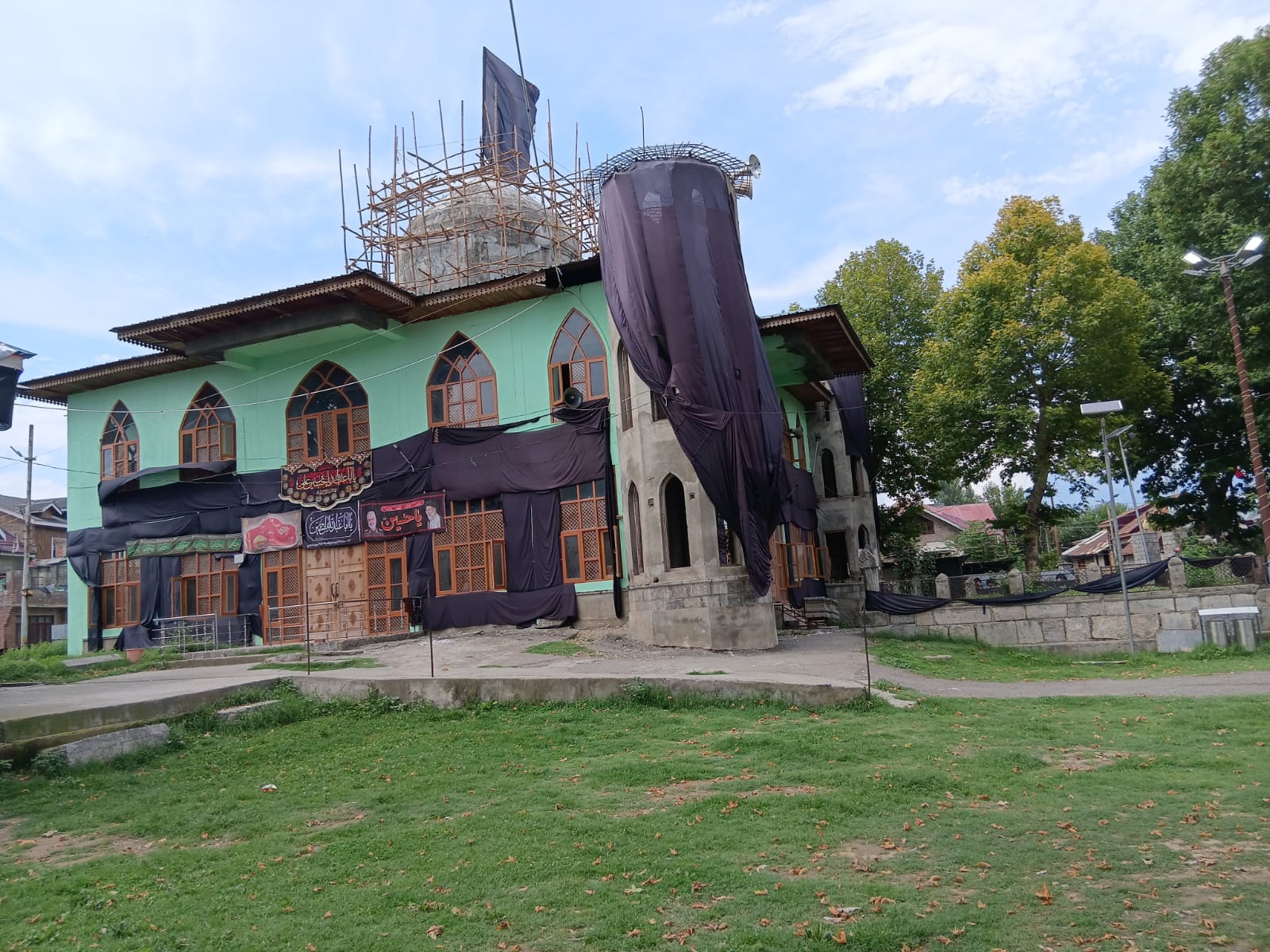 Mausoleum of Mir Shams-ud-din Araki
“Hazrat Mir Muhammad Shams al-Din ‘Iraqi (RA) was one of the most distinguished spiritual personalities of the 15th century, who occupied an eminent position in the fields of religious learning (ʿilm), spiritual knowledge (maʿrifah), and Sufi discipline (irfan)”, Justice (rtd) Hakim Imtiyaz Hussain, a former Judge of the J&K High Court and author told Awaz-The-Voice. “Through his intellectual depth, spiritual excellence, and missionary zeal, he left a lasting imprint upon the religious and cultural history of Kashmir”, he adds.
“He was born in 833 AH (1429 CE) in Kund village in the outskirts of Solqan in Iran as Muhammad, while his honorific name, Mir Shams-al-din (The Sun of Religion) was conferred upon him by his spiritual master, Hazrat Shah Qasim Faiz Bakhsh (RA), and later know as Mir Shams al Din Íraqi”, writes Justice (rtd.) Hakim Imtiyaz Hussain.
The spiritual leader is popularly known as Mir Shams-ud-Din Araki, after the name of the area of his birth place, Arak in Iran. “After the death of Hazrat Nur Bakh in 869 AH, he (Araki) resumed his pursuit of spiritual perfection and formally became one of the foremost disciples of the Nurbakhshiya order.
 Sculpted old stones at the premises of Khanqah-e-Zadibal
Mir Shams-ud-din Araki is widely regarded as the founder of the Nurbakhshiyya order, a branch of the Kubrawiya Sufi tradition, in Kashmir. During his stay in the Valley, he established the famous Khanqah-i-Nurbakhshiyya at Zadibal, Srinagar, which became one of the largest and most influential Sufi centres in Kashmir. “A widespread perception exists that Mir Shams al-Din ‘Iraqi was the founder of Shi'ism in Kashmir. Historical evidence, however, show that long before his arrival, a number of Shi'i scholars, missionaries, and religious personalities had already reached Kashmir and had introduced the teachings of Imamia sect”, comments Justice (rtd) Hakim Imtiyaz Hussain.
The visit of Mir Shams-ud-Din Araki is regarded as the arrival of third Sufi saint in Kashmir after Syed Sharf-ud-Din, commonly known as Bulbul Shah in the first quarter of 14th century and Mir Syed Ali Hamadani or Shah-e-Hamadan in later half of the 14th century.
Araki first visited Kashmir in 888 AH (1483 CE), according to Hakim Imtiyaz, adding that the visit was undertaken at the instructions of his spiritual master Shah Qasim Faiz Bakhsh in search of medicinal herbs and rare pharmaceutical plants required for the treatment of Sultan Husayn Khurasan under Shah Qasim’s medical care. On his arrival, Mir Araki found that the Valley was already an important centre of the Kubrawiyya Sufi tradition established by the followers of Mir Sayyid Ali Hamadani.

Inscriptions describing the life and works of Shams-ud-din Araki mounted inside the mausoleum
Since he himself belonged to the same broader spiritual lineage, he developed close relations with the leading Sufi scholars and spiritual guides of Kashmir. During this period, he devoted himself to the training of disciples, spiritual instruction, and the organisation of Sufi institutions. After residing in Kashmir for approximately eight years, he returned to his spiritual master in Khurasan.
After some time he returned to the valley and launched the propagation of religion. He spiritually trained a large number of people and helped them attain higher stages of spiritual perfection.
He guided those engaged in reciting the Awrad-i Fathiyyah (of Shah-e-Hamadan) in the Khanqahs and continued to train the dervishes. He also undertook significant work for the revival of Islam in Kashmir and remained devoted to the cause of upholding the true faith and proclaiming the Word of Truth. He acquainted countless people with the fundamentals of religion and the principles of the Shari‘ah. Among his other achievements was the construction of mosques and Khanqahs at various places in Kashmir.
ALSO READ: 'Khanqahs in Kashmir have been turned into pilgrimage centers'
The year of the death of Mir Shams-ud-Din Araki is generally given as 932 AH (1525 CE), according to Justice (rtd) Hakim Imtiyaz Hussain. The spiritual leader was buried at his own Khanqah in Zadibal, Srinagar, he adds. “At a later stage, however, when the foreign invader Mirza Haidar Dughlat fomented unrest, rebellion, and sectarian disturbances in the Kashmir Valley, particularly in the city of Srinagar, a tradition arose that his mortal remains were transferred from Zadibal to Chadoora, and buried there. A shrine was subsequently constructed at that site”, Hakim Imitiyaz Hussain adds.