

 Rajeev Narayan
US Secretary of State Marco Rubio’s visit offers encouraging signals on trade, energy and diplomacy. But the real test is what New Delhi negotiates, what Washington gains and whether the final agreement serves both countries.
A trade deal that has remained tantalisingly out of reach for months may be within touching distance. Rubio says the two countries are “weeks, not months” away from finalising it, with 99 per cent of the work done. That is encouraging. But beneath the optimism lies a bigger question: what will each country gain, what will it concede, and how can India ensure that the final deal serves its national interests?
India-US relations have endured tariffs, disagreements over Russian oil, tensions over immigration and the lingering consequences of President Donald Trump’s assertions about his role in ending last year’s India-Pakistan military confrontation. A trade agreement will not erase these differences, but it can give an important economic relationship greater predictability.
Rubio has also sought to soften the message on tariffs, saying they were not intended to punish India. The American administration has eased one immediate source of tension by waiving potential additional tariffs linked to purchases of Russian oil. The diplomatic weather, clearly, is improving.
India should seize the opportunity and close the deal. But speed must not come at the cost of scrutiny. A deal is valuable not because two governments announce it, but because businesses can plan around it, exporters gain meaningful access, and the obligations on each side are commercially defensible. The remaining language may be technical, but it is precisely where the substance of any agreement often lies.
Welcome Signal
Rubio offered another positive signal on an issue that could have become uncomfortable. Asked about the United Nations’ criticism of the handling of protests in India, he questioned the term “UN experts” as an “oxymoron” and declined to comment on the protests themselves, describing them as a domestic political matter for India.
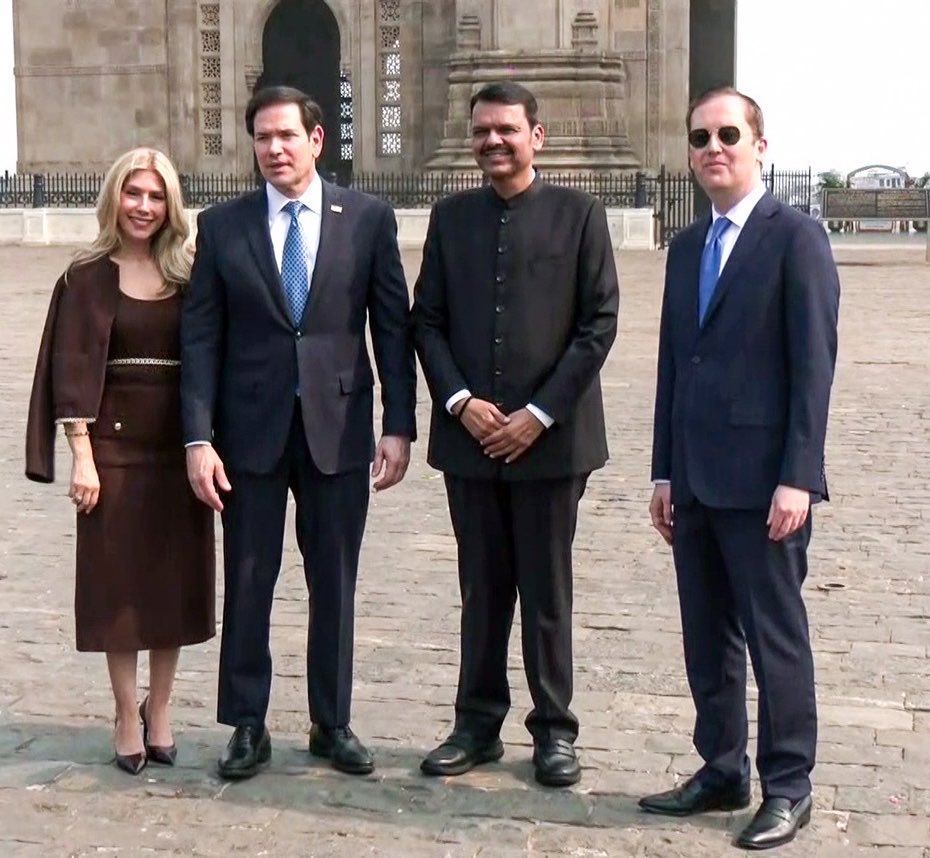 Marco Rubio, his wife , Maharashtra CM Devendera Fadnavis and US envoy Sargio Gor at the Gateway of India in Mumbai
New Delhi will welcome the refusal of a senior American official to turn a bilateral visit into a lecture on India’s internal politics. Yet the significance should not be exaggerated. Rubio was expressing his administration’s position, not certifying every action taken by Indian authorities. His distinction between questioning the UN experts and commenting on India’s domestic affairs is worth preserving.
There is a broader lesson here. Mature partnerships allow disagreement without making every difference a diplomatic confrontation. India does not need outside validation of its democracy; nor does it need to turn every supportive remark from Washington into evidence of strategic alignment. The relationship is too important for reflexive suspicion or convulsive applause.
Follow the Oil
The most revealing part of Rubio’s itinerary may be the journey to Jamnagar. At Reliance Industries’ vast refining complex, he praised India as a “refining superpower”. This was more than a flattering description of industrial capacity. It pointed to a commercial and strategic opportunity the US would like to develop.
Jamnagar can process enormous volumes of crude, including heavier grades that other refineries cannot handle as readily. The United States is interested in encouraging India to process more Venezuelan crude and expanding energy cooperation. With global fuel supplies under pressure and diesel prices a concern, India’s refining capacity has become an asset of international significance.
Rubio’s engagement with India’s leading corporate figures underlines the commercial dimension of the visit. These meetings were not open to the press and their detailed discussions have not been publicly disclosed. There is no justification for inventing motives or treating private meetings as inherently suspect. But their significance should not be overlooked either. The US is pursuing trade, energy supplies, technology purchases and investment opportunities in India. Its diplomacy is also commercial diplomacy.
India should approach these opportunities in the same way: identify where US demand meets Indian capability and negotiate arrangements that create value at home. Diversifying energy sources can improve security, but replacing one dependence with another would defeat the purpose. Price, reliability, refining economics and the freedom to choose suppliers must remain central to India’s calculations.
Protocol & Purpose
There has been commentary about Rubio’s meetings being held in Mumbai rather than Delhi. But India has hosted foreign dignitaries in different cities before. The venue alone does not establish a breach of protocol. The more useful question concerns the substance of the visit. Combining diplomatic discussions with meetings involving corporate leaders and a tour of one of the world’s largest refining complexes is hardly mysterious: energy and business are now integral to strategic relationships.
That does not mean India must accommodate every US preference. It means distinguishing between requests that are convenient to grant and demands that could compromise its interests. Flexibility over venue or scheduling is a small price to pay when it advances a serious negotiation. Concessions affecting market access, energy security or strategic autonomy are another matter altogether.
India’s Terms
The geopolitical context makes this calculation important. The US has pressed India over its purchases of Russian oil, yet Washington’s own recent decisions on Russian energy and tariffs show how commercial pressures can reshape policy. That is not necessarily hypocrisy; countries routinely reconcile competing interests. But it is a reminder that political rhetoric and economic decisions do not always travel together.
India, which imports the bulk of its crude requirements, cannot alter its energy mix overnight without considering costs, supply security and the impact on domestic fuel prices. It should diversify where sensible, including through greater energy trade with the US, without forfeiting the right to make decisions based on its own needs.
The same principle should govern the trade agreement. India needs access to the US market, investment, technology and a more predictable trading relationship. The US wants greater sales of energy and technology, investment and opportunities for its businesses. There is ample room to bargain.
Rubio’s visit has produced encouraging words and opened useful avenues. The photographs, the praise and the diplomatic courtesies are welcome, but they are not the measure of success. That will come when the agreement is signed, its terms are clear and Indian businesses and workers see tangible gains.
ALSO READ: IMF upgrade is fine, but India’s growth must shift to top gear
India must neither mistake American warmth for altruism nor American pressure for a reason to walk away. It should move quickly, negotiate firmly and remain open to cooperation. The test is simple: whether the deal delivers more than the diplomacy promises.
The writer is a veteran journalist and communications specialist