




Aasha Khosa
Azerbaijan, a predominantly Muslim country in the South Caucasus and a former constituent of the USSR, is facing resistance over its school dress-code rules which effectively bar Muslim girls and teachers from wearing the hijab in educational institutions. The government has chosen to go ahead with its policy of secularising the educational institutions.
The move has prompted protests, class boycotts and a wider debate over the place of religion in a secular state.
The controversy comes at a time when restrictions on Islamic clothing, particularly face-covering veils, have become a contentious issue in several Western countries. But Azerbaijan’s case is distinct: the latest measures concern the hijab, which covers the hair and neck but leaves the face visible, rather than merely the niqab or other face-covering garments.
The Azerbaijani government approved amendments to school uniform regulations in September 2026. The revised rules do not explicitly name or ban the hijab. Instead, they require students’ and educators’ clothing to comply with the “principle of the secular nature of education”. The authorities have invoked these provisions to restrict religious headscarves in schools.
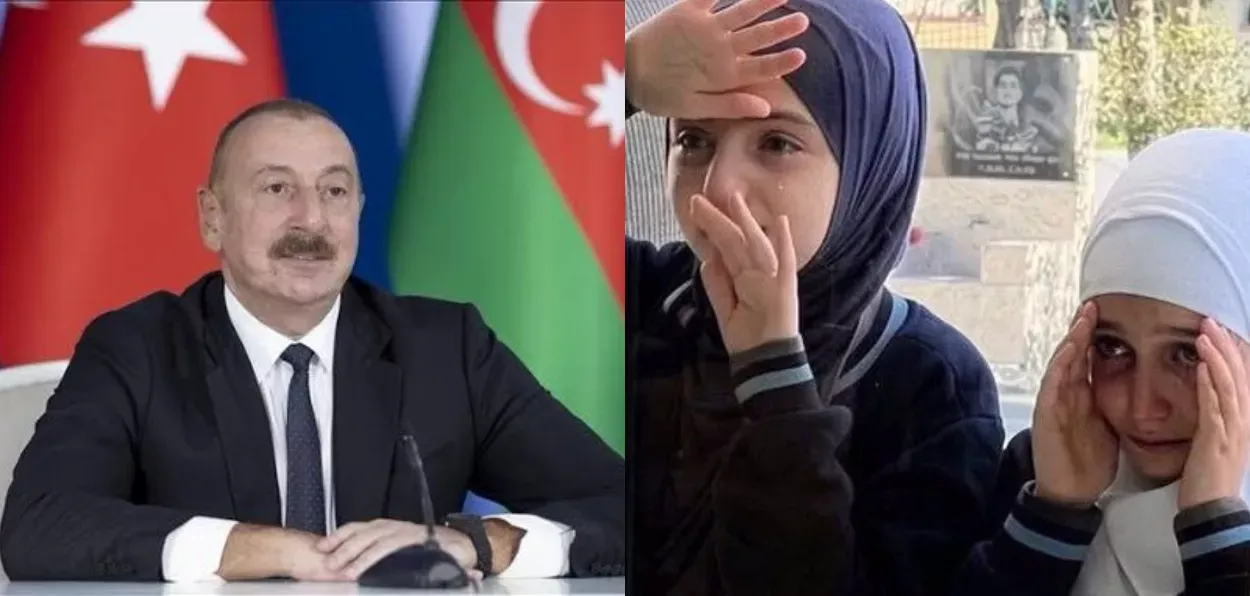
As the rules began to be enforced in October, reports emerged of students being turned away from school and teachers being prevented from entering classrooms because they wore headscarves. The restrictions have sparked emotional scenes outside schools, particularly in the capital, Baku, where students have protested against the treatment of their classmates and teachers.
Videos circulating on social media have shown pupils embracing teachers and expressing distress as the restrictions were enforced. Reports have also described class boycotts and demonstrations at several schools. Azerbaijani authorities reportedly detained dozens of people during protests, while claims of internet disruptions circulated online. However, independent monitoring cited by Al Jazeera had not confirmed reports of internet blackouts as of October 12.
The government maintains that the rules are intended to preserve the secular character of education and establish a uniform dress code. Critics, however, argue that a general requirement for uniformity should not become a means of excluding students and teachers because of their religious beliefs.
🔴 Azerbaycan’da okula alınmayan başörtülü öğrenciler, okulun kapısında derslerine çalışıyor. https://t.co/oYe1QWP7qH
— Mahfil (@mahfildijital) October 12, 2026
A secular state with a predominantly Muslim population
Azerbaijan presents a striking example of the complex relationship between religion, national identity and the modern state. Around 96 per cent of its population identifies as Muslim. The country has a predominantly Shia Muslim population, alongside a substantial Sunni minority and smaller Christian and other religious communities.
Yet Azerbaijan is constitutionally secular. It emerged as an independent country in 1991 following the dissolution of the Soviet Union, after decades in which religious institutions and public religious expression were subject to state control. Its political culture continues to reflect the legacy of Soviet secularism, although religious identification and observance have evolved since independence.
For many Azerbaijanis, Islam is an important part of their cultural and family identity, even when religious observance does not shape every aspect of daily life. Others attach considerable importance to visible religious practice, including wearing the hijab. The latest restrictions have brought these differing understandings of identity and secularism into direct conflict.
President Ilham Aliyev, who secured another term in the February 2024 presidential election with an officially reported 92.12 per cent of the vote, has repeatedly emphasised Azerbaijan’s independent national identity and its distinctive traditions. The government’s position on religious expression is closely linked to its broader insistence that the country’s public institutions and national identity should not be shaped by external religious influences.
🔴 Azerbaycan Devlet Televizyonu: “Devlet, millî kimliğimize Arap-Fars değerleri katmaya yönelik her türlü girişimin önüne geçecektir. Bizim kendi millî değerlerimiz var.” https://t.co/EmsLrbS70G
— Medya 3 (@medya3tr) October 12, 2026
The dispute, therefore, is about more than school uniforms. It raises questions about who defines national identity and whether the state can enforce secularism by restricting an individual's visible expression of faith.
What does the Constitution say?
The legal debate centres on the relationship between secular education and constitutional freedoms.
Article 18 of Azerbaijan’s Constitution explicitly separates religion from the state and stipulates that the state education system must be secular. The government can cite this provision in support of its position that schools should follow rules consistent with secular education.
This is not the first time Azerbaijan has witnessed a confrontation over the hijab in schools.
In December 2010, the government’s order for school uniforms was widely interpreted as a prohibition on Muslim girls wearing headscarves and had prompted demonstrations.
Restrictions on Islamic clothing have become a contentious political and legal issue in several parts of Europe and North America. France, Belgium, Austria, Denmark and Switzerland, among other jurisdictions, have introduced restrictions on face coverings in specified public settings or more broadly in public spaces. Rules differ considerably between countries.
The Netherlands restricts face-covering clothing in certain settings, including schools, hospitals, public transport and government buildings. Germany has imposed restrictions in particular professional and institutional contexts, rather than a single blanket ban on all religious headscarves. Quebec’s secularism law restricts certain public employees from wearing religious symbols while exercising specified public functions.
These distinctions matter. A ban on the niqab or other face-covering garments is not the same as a ban on the hijab, which leaves the face visible. Nor do all the countries mentioned prohibit headscarves in every public setting.
Azerbaijan’s controversy is significant because restrictions on the hijab are being enforced in a Muslim-majority country whose Constitution guarantees freedom of conscience. It illustrates that disputes over religious dress are not confined to Western societies or to countries where Muslims form a minority.
Azerbaijan has experienced serious acts of political violence and religious extremism. The 1994 Baku Metro bombings killed 27 people across two attacks. In August 2008, a grenade attack on Baku’s Abu Bakr Mosque killed worshippers and injured others. Azerbaijani authorities linked the mosque attack to radical militant networks, and several suspects were investigated or prosecuted.
The Azerbaijani state has pursued a firm approach towards religious organisations and movements it considers extremist, while also maintaining tight controls over religious activity.
ALSO READ: Can Pakistan defend Saudi Arabia against Houthi attacks?
For the students and teachers affected, the immediate concern is straightforward: they want to continue their education or professional lives without being compelled to abandon a personal expression of faith. For Azerbaijan, the dispute has become a broader test of how a secular republic with a predominantly Muslim population defines national identity, religious freedom and the boundaries of state authority.

.jpg "Gujarat’s women entrepreneurs bring their craftsmanship to life during Navratri")







.webp)

