




 Rajeev Narayan
India is building bigger, wider and faster roads, but something is going badly wrong on them. Lane discipline is disappearing, rules are becoming optional, and lawlessness is shameless in its exhibition. India’s roads are increasingly being governed by one rule alone: Get ahead, whatever it takes.
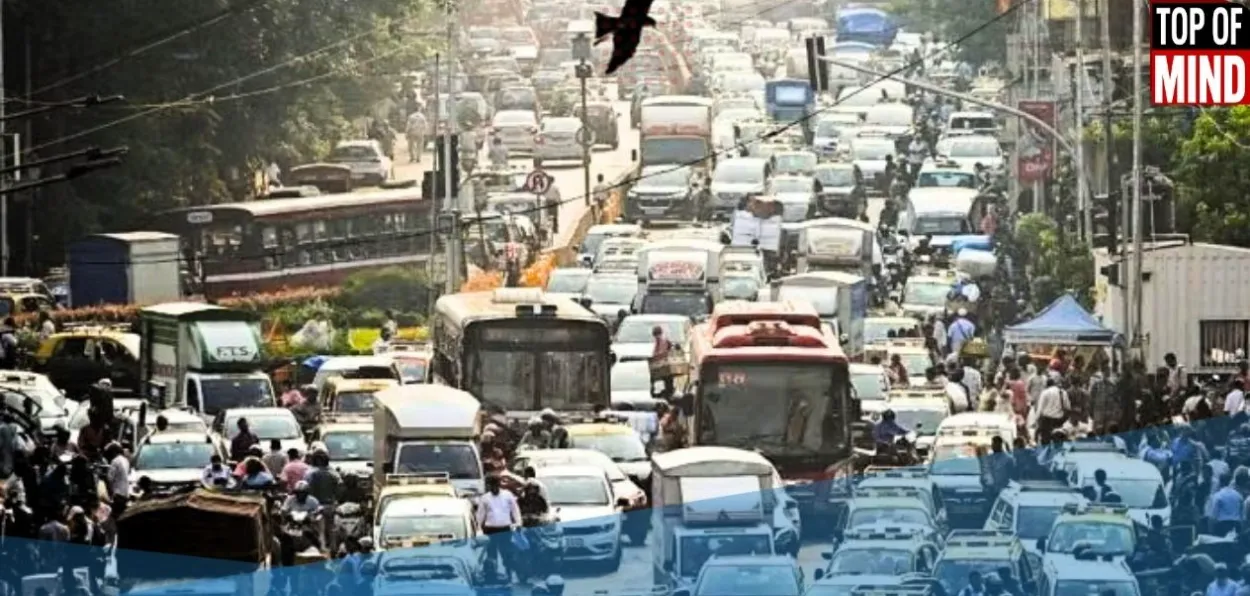
A 90-km drive should not take three hours. The return journey should certainly not take four-and-a-half. Yet that is what happened to this author last week on a journey that was mostly covered on the Delhi-Mumbai highway, with some stretches traversed in Delhi and a few others in Bhiwadi, Rajasthan.
A 20-25 km snarl around Manesar, Haryana, turned the highway into a demonstration of everything that is going wrong on Indian roads. Cars crawled bumper-to-bumper. Horns achieved nothing. Motorists invented exits from the jam. Some turned around and drove against oncoming traffic: wrong side. A few others discovered an ingenious shortcut: empty fuel stations. Cars swung into forecourts, raced through and rejoined the highway several vehicles ahead. Attendants waved, shouted and pleaded. No one cared. Twice, ambulances appeared, sirens wailing. Thankfully, drivers made way. Then vehicles began tailing the ambulance, using its hard-won passage as their own express lane.
That is not merely traffic congestion. It is India’s road culture.
Bigger Roads
India has never built roads at this pace. Expressways are stretching across the country, highways are wider, tolling is increasingly seamless, and technology now tracks traffic in ways that would have seemed fanciful a decade ago. FASTag penetration has crossed 98 per cent, while NHAI monitors queues, waiting times and vehicle speeds at toll plazas in real time.
Yet, the better the infrastructure gets, the more obvious another problem becomes: India is upgrading its roads faster than it is upgrading the behaviour of the people using them.
The Indian road-user has developed a remarkable ability to decide which rules apply to him. The biker squeezes through because a gap exists. The car crosses three lanes because the other lane is moving faster. At a signal, two-wheelers use pedestrian paths and return to the road near the turn. At toll plazas, marked lanes become competing channels as everyone manoeuvres for the one that might move faster.
Nobody believes he is causing the chaos. Everyone believes he is surviving it.
The consequences are visible. India recorded 4.73 lakh road accidents and 1.70 lakh deaths in 2024. More than 52,600 of those deaths occurred on National Highways. Those numbers are not just a measure of bad roads, excessive traffic or bad luck. They are also a measure of how people are using roads that are becoming faster, wider and more sophisticated. A bigger road does not automatically produce a better road culture. Bad behaviour at higher speeds simply makes the consequences more severe.
Might Wins
A disturbing change is that driving has become a contest of sheer nerve. Patience is for the person behind you. Courtesy is something the other driver owes you. Your lane is sacred. Until you need his. The result is a peculiar form of road Darwinism: the most aggressive driver often gets ahead.
A driver who pushes his bumper into a gap is rewarded. The person who refuses to let him in is considered an obstacle. A biker who cuts between cars has not merely changed lanes; he has won. Someone driving down the wrong side during a jam has discovered that the fastest route is sometimes the one everybody else knows is illegal.
This is not harmless cleverness. When breaking a rule gets you ahead, the rule begins to lose authority. MoRTH’s 2023 report attributed 72.4 per cent of accidents on National Highways to speeding and 5.1 per cent to driving on the wrong side; the latter accounted for 5.3 per cent of highway fatalities. The data lists drunken driving, red-light jumping and mobile-phone use among other frequent violations. These are not statistics about an abstract road-safety problem. They describe behaviour we see every day.
Technology Isn’t Enough
India has tried to make enforcement smarter. Cameras record violations. Challans arrive online. Speed displays tell motorists how fast they are travelling. The advantage is obvious when lakhs of vehicles have to be monitored. But technology can record a violation; it cannot by itself create deterrence.
Between September 2020 and December 2024, 23.92 crore e-challans were issued, involving penalties of Rs 36,703.96 crore. That is an extraordinary number. It also raises an uncomfortable question: If so, many violations are being detected, why does the road-user still consider the rules to be negotiable? It is perhaps because detection and deterrence are not the same. A camera can capture a vehicle jumping a red light. An e-challan can impose a penalty. But it is the certainty that a violation will have immediate and tough consequences that changes behaviour. Enforcement has to be credible. It has to be visible.
There is a problem on another front. On a few new empty highways, motorists are encountering absurd speed limits of 40, 50 or 60 kmph, with electronic displays announcing their current speed being used to warn offenders. There may be a valid reason for such a restriction, but when rules appear arbitrary and downright silly, motorists begin deciding which rules deserve respect. And which ones don’t. That is dangerous: Rules only work when the people expected to obey them believe the rules make sense.
The Road Culture
None of this lets governments or road agencies off the hook. Construction bottlenecks, poor diversions, confusing lane markings, uneven surfaces and badly designed junctions can create genuine chaos. They need fixing. But bad infrastructure cannot become a licence for bad behaviour.
A queue remains a queue. A red light remains a red light. An ambulance remains an ambulance. A fuel station is not a bypass. And a road user who is frustrated by everyone else’s indiscipline cannot claim an exemption when he does exactly the same thing five minutes later.
Perhaps that is the heart of the problem. We do not merely break rules. We have become remarkably good at rationalising why our particular violation is different. The other driver is reckless. The other biker is blocking the road. The other car jumped the signal. Of course, when we do it, there is a sensible reason.
ALSO READ: Why a section of Muslims opposes UCC?
India can keep building new expressways. It can install more cameras, digitise more toll plazas and issue lakhs more challans. That matters. But the biggest upgrade we need is not another lane. It is a change in the way we use the lanes. Until we learn to share the road instead of trying to conquer it, we will keep building longer, wider and faster places to behave badly. And on roads, bad behaviour does not merely waste time. It can destroy a vehicle, cripple a family or end a life.
The writer is a veteran journalist and communications specialist












.webp)