New Delhi
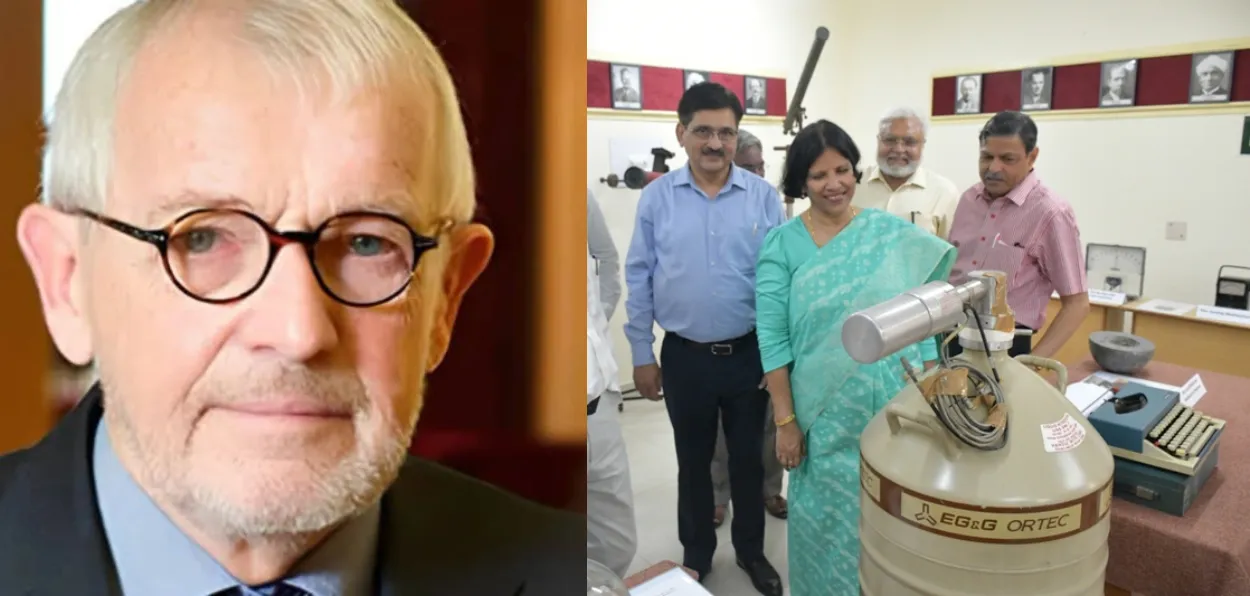
When the 2026 Nobel Prize in Physics was awarded to Belgian-American physicist Francis Halsen "for decisive contributions to the IceCube Neutrino Observatory and the discovery of high-energy neutrinos of astrophysical origin," there was jubilation in an Indian University.
The reason was that three Ph.D. scholars of the Aligarh Muslim University (AMU), Anuj Kumar Upadhyay, Gopal Garg, and Krishnamurthy Jayakumar, are members of the IceCube Collaboration, conceived, founded and led by Prof. Francis Halzen.
Prof. Mohammad Sajjad Athar, Chairman, Department of Physics, and a Neutrino Physics expert, who is the guide to the three Ph.D. scholars, congratulated them. He said, “The recognition is particularly significant for AMU’s neutrino physics program and highlights the university's sustained engagement with one of the most exciting frontiers of modern particle physics.”
Prof. Halzen’s pioneering vision laid the foundation for an entirely new branch of astronomy: neutrino astronomy. His concept to trap Neutrinos, the shyest particle in the universe, which is hard to study, led to the setting up of the IceCube Neutrino Observatory deep within the Antarctic ice at the geographic South Pole.
Francis Halzen's idea was to use glacial ice at the South Pole to capture the elusive particles called neutrinos. He set up the IceCube Neutrino Observatory, which can track neutrinos that originate in the distant cosmos.
The neutrino is the shyest particle in the universe; it has no electric charge and almost no mass. In general, it passes unnoticed through matter – seldom does a neutrino make its presence felt by colliding with an atomic nucleus. Every second, without you noticing, 65 billion neutrinos from the Sun flow through your little fingernail.
Neutrinos also come from other regions of space, carrying clues to some of the mysteries of the cosmos. Researchers who succeed in capturing these rarer cosmic neutrinos can then extract information about the extreme environments in the universe where they originated.
Back in the 1980s, Francis Halzen had realised that the Antarctic ice could be ideal for ensnaring enough of these secretive neutrinos, so researchers could learn more about their distant origins. He quickly convinced many others of his idea’s potential and, in 1992, a group of tenacious researchers and engineers made the first attempts to lower light sensors into the glacier at the South Pole.
The breakthrough came around 20 years later: the IceCube neutrino telescope registered neutrinos with properties that convinced researchers they originated in distant regions of space. The hunt for the universe’s neutrino sources had begun in earnest.
The IceCube Neutrino Observatory enables scientists to detect and investigate neutrinos arriving from the distant universe.
It has emerged as one of the world’s leading facilities for exploring the high-energy neutrino universe.
The observatory has enabled researchers to isolate a flux of high-energy neutrinos originating beyond our Galaxy, with an energy flux comparable to the extragalactic high-energy photon flux observed by NASA’s Fermi satellite.
Analysis of more than a decade of observations has also helped identify potential sources of these high-energy neutrinos, pointing towards the dense, obscured regions surrounding supermassive black holes in certain active galaxies as powerful cosmic accelerators.











.jpg "Representational Image")

.webp)