

 Aditi Bhaduri
The events over the past few days across Bangladesh show a disturbing trend. People are rampaging on the streets; looting and arson have become the order of the day. As if it was not enough that Nobel peace laureate and the former interim chief executive Mohammad Yunus' house was set on fire,; a day ago, miscreants even set on fire the home of deputy foreign minister Humayun Kobir. Few could be as close to power as he is.
Is Bangladesh staring at a civil war?
The violence has spread. If early it was places like Chittagong, where Hindus form a sizeable community, then now it has spread to places like Sylhet, where the ruling Bangladesh National Party (BNP) holds formidable sway.
At least four people have already lost their lives, and many more have been injured. So what exactly in happening in n Bangladesh?
For one, Bangladeshis will now find that getting rid of a leader, no matter how unpopular, is the easiest part of a "revolution". Nation building and continuing the path of democratisation and development are inevitably much more difficult. And the last two years since then Prime Minister Sheikh Hasina was so unceremoniously deposed and chased out of Bangladesh prove just that.
No matter how tyrannical or authoritarian Hasina had been, she had taken the country along the path of development, with GDP growing and indices improving. In fact, on many counts like infant mortality, women's health and workforce participation, and waste management, Bangladesh’s indices were better than giant neighbour India.
🔥 The Beauty of Gopalganj. Thousands take to the streets in a powerful show of resistance against alleged BNP Jamaat persecution, illegal arrests, and persecution of Hindu minorities. Gopalganj stands firm. The Awami League vows to stand against extremism and fight for democracy, justice, and the rights of every citizen. #Gopalganj #AwamiLeague #Bangladesh
— A.A.FAISAL (@AL88FAISAL) November 22, 2026
Yet, the "revolution" that should have hastened development and progress manifold did just the opposite. Per capita income has gone down, the economic situation has worsened, women's rights have been trampled upon, and the security situation has deteriorated. Add to that the global economic downturn, which has also negatively affected Bangladesh. The IMF has projected Bangladesh's inflation at 8. 7 per cent.
Since Awami League leader Sheikh Hasina fled Bangladesh, the security situation swiftly and sharply deteriorated. While the current round of violence, which includes arson and vandalism, has been blamed on Awami League activists, the truth is that since the August uprising the violence has actually increased. Neither the interim leader Yunus nor the BNP, which came to power earlier this year in February after general elections, where the Awami League was banned, have been able to control, leave alone stop, the violence. It has actually worsened. The rights organisation Ain o Salish Kendra has documented that 171 people were killed in mob violence between January and October this year while 198 were killed in 2025 and 128 in 2024.
The worst offenders have been the Jamaat-e-Islami Bangladesh (JIB). Their activists and front activists not only targeted members of the Hindu and Buddhist minority communities, but also women - primarily Muslim women to enforce Shariah and other Islamist codes for women, as well as, of course, the members of their historical enemy - the Awami League.
Petrol bomb attack at Bangladesh State Minister for Foreign Affairs Humayun Kabir's house in Sylhet early on Friday. Prashant Bhushan must have got orgasam seeing this & Neha Bora's inspiration must have reached next level now. https://t.co/6pZxQ0tUDA
— BhikuMhatre (@MumbaichaDon) November 20, 2026
Their strict interpretation of Islam also meant that they targeted many Sufi shrines and worshippers who visited these places. A gruesome recent example was where they dug up the "pie's" body and set it on fire, so that no one could visit the tomb anymore.
This continued right through the reign of Yunus and now the BNP. The BNP is alleged by many to be a partner with Jamaat. At the least, they turned a blind eye as they have sought political support from the JIB.
The current bout of violence did indeed get a fillip from Awami League activists who have gone on a rampage because Bangladesh’s current dispensation has refused to facilitate the return of Sheikh Hasina, now in self-imposed exile in Delhi, to Bangladesh. Even the ancestral home of Yunus was set ablaze as if the circle has come full round, as Yunus had similarly presided over arson against Hindu homes and the house of the founder of the nation, Sheikh Mujibur Rahman’s house.
Protesters have also been calling for the government to lift the ban on the Awami League, and for the release of those party leaders and supporters who are currently in prison.
Despite Hasina's escape and the ban on her party in the current elections, at least one third of the population still owes allegiance to the Awami League. After reticence in the initial days of the August uprising, they are no longer willing to remain silent.
The government has not only refused to facilitate Hasina's return, rejecting her request for a passport and documents, but also said it prefers an extradition route with India. Last year, an international crime tribunal in Dhaka had given Hasina the death sentence.
But while the current violence may to a great extent be between the supporters of two rival parties, they are by no means the only ones involved.
Anger has been boiling over as people see livelihoods destroyed, but the corruption expands. There are numerous allegations against both the Jamaat and the BNP that their workers are usurping land, properties and coercing people to pay "chanda" or donation, as cut money. This is particularly in reference to daily-wage earners and those who don't pay taxes.
Furthermore, Bangladesh's textile industry, almost the backbone of its economy, is also under extreme duress. In large part, this is due to the negotiations and agreement the Nobel laureate Yunus entered into with the USA, the prime instigator and supporter of the August uprising. Under the agreement, Bangladesh would have to buy US cotton, rather expensive for Bangladesh, in return for favourable export conditions.
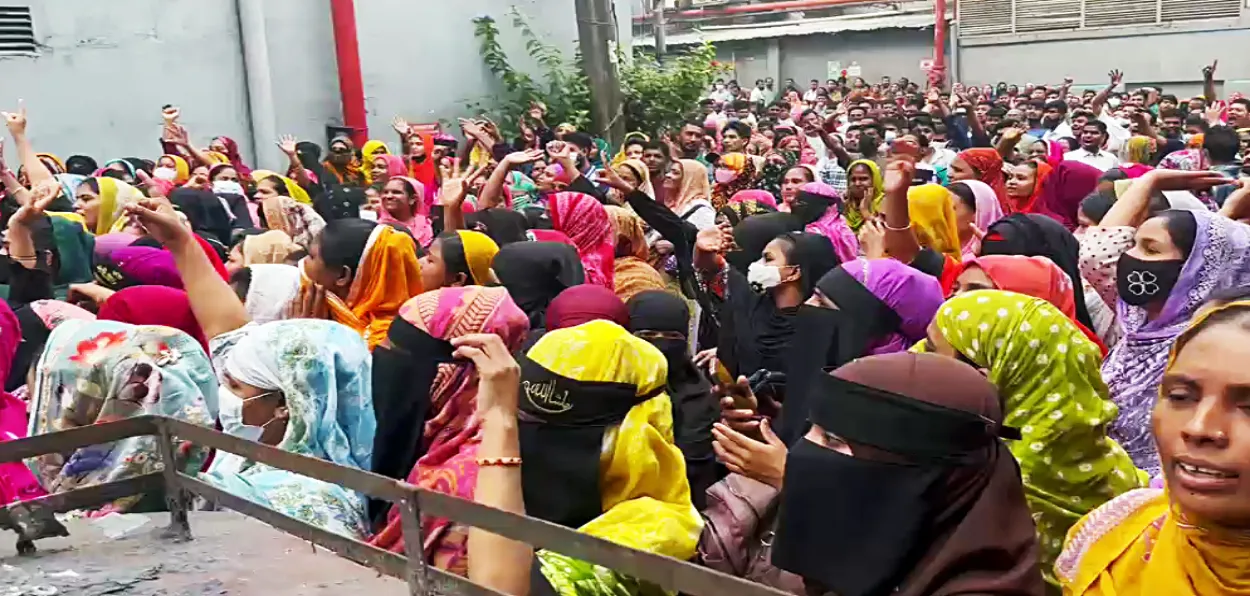
They have been staging their own protests and violence, torching vehicles and blocking highways in Dhaka since last Tuesday, when a key wage board meeting was cancelled.
According to AFP, almost 500 of Bangladesh's 4,500 garment factories are shut. Bangladesh's textile industry employs almost four million workers who have been demanding a wage rise and a minimum wage.
This, different constituencies are brimming with different grievances, and the government of Tarique Rahman seems unable or inept to cope with them.
ALSO READ: A year after 'revolution' can Bangladesh do a Tahrir Square?
With continuing reprisals and violence engulfing more districts, increasingly it seems that now that the genie of "students revolution" has escaped from the bottle, no one knows how to put it back. Bangladesh may well be headed towards a civil war.
India should watch out!
The author is an award-winning columnist, specialising in Eurasian affairs.