 Muhammad Razi-ul-Islam Nadwi
It is ironic that Indian Muslims, whose faith teaches hygiene as a basic obligation, have not lived up to the image of a community whose half faith is defined by cleanliness.
Muslims, especially in North India, have created for themselves the perception of being people who are not interested in keeping their surroundings clean.
Islam emphasises not only the spiritual development of human beings but also their physical, social, and environmental cleanliness. Cleanliness is among the fundamental teachings of Islam.
A Muslim’s life is recognised not only through worship, morals, and dealings, but also through the purity of his lifestyle, body, clothing, home, and surroundings. This is why Islam has declared cleanliness to be a part of faith and has instructed people to maintain purity in every aspect of life.

On one side, for Muslims the faith requires ablution as a prerequisite for prayers; on the other side, there is a tendency within the community to be careless as far as the cleanliness of their surroundings is concerned.
Islam encourages human beings to adopt both outward and inward cleanliness. The Messenger of Allah, peace and blessings be upon him, said: “Purity is half of faith.” (Sahih Muslim: 223)
Similarly, in another hadith, the Prophet said: “Indeed Allah is pure and loves purity. He is clean and loves cleanliness.” (Jami‘al-Tirmidhi: 2799)
These teachings clearly show that cleanliness is not merely a social necessity, but rather a religious obligation and an important part of Islamic civilisation.
Allah Almighty says in the Holy Qur’an: “Indeed, Allah loves those who repent and loves those who purify themselves.” (Surah Al-Baqarah: 222)
In another place, Allah says: “And purify your garments.” (Surah Al-Muddaththir: 4)
Purification also holds a fundamental place in Islamic acts of worship. Ablution before prayer, ritual bath on certain occasions, and the cleanliness of clothes and places of worship all prove that Islam wants to make cleanliness an essential part of human life. Even removing a harmful object from the road has been declared an act of charity. The Messenger of Allah, peace be upon him, said:
“Removing something harmful from the path is charity.” (Sahih al-Bukhari: 2472, Sahih Muslim: 1009)

On the one hand, these are the teachings of Islam regarding hygiene and cleanliness. On the other hand, it is extremely unfortunate that many Muslims today have become negligent regarding these teachings.
They take care of hygiene in performing acts of worship, but often ignore cleanliness, discipline, and environmental purity in their surroundings.
They may maintain cleanliness inside their homes to a great extent, yet pay little attention to the cleanliness of streets, roads, and public places.
Such behaviour is not only against Islamic teachings, but it also hurts the collective image of Muslims. A Muslim is expected to become a model of cleanliness, order, and a pleasant environment wherever he lives.This issue becomes especially prominent during Eid al-Adha. Sacrifice is a great act of worship and a Sunnah of Prophet Ibrahim. Muslims perform this practice with great enthusiasm. However, at times proper attention is not given to cleanliness during this occasion.
In some Muslim neighbourhoods, animal waste, blood, and remains are abandoned in streets for days after the sacrifice, causing severe filth, foul odour, and the spread of disease. These images are completely contrary to the beautiful teachings of Islam. Non-Muslims too feel discomfort after observing such behaviour.
Therefore, Muslims should be conscious about the sensitivities of fellow citizens and ensure that cleanliness and proper disposal accompany the act of sacrifice. Disposing of animal remains appropriately by burying them or handing them over to municipal authorities, cleaning blood and filth immediately, and protecting the environment from pollution are responsibilities of every Muslim.
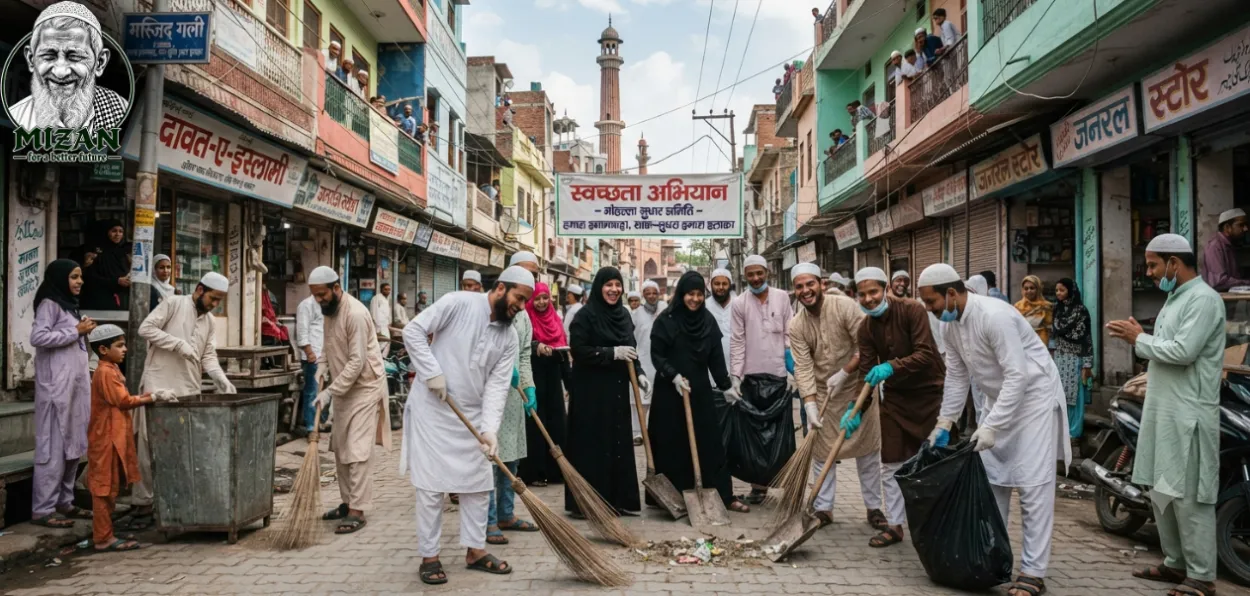
There is a strong need to create awareness about cleanliness among Muslims. This is a prerequisite for changing the negative image of Muslims as a community. We must understand that cleanliness is not limited only to the inside of our homes. Maintaining cleanliness in the streets, roads, and neighbourhoods outside our homes is also our responsibility.
While there is awareness regarding environmental cleanliness in South India and some other parts of the country, areas in North India are lagging far behind. A good Muslim is one from whom others do not suffer harm and whose environment becomes a source of comfort for others.

Imams of mosques, scholars, social organisations, and educational institutions should create awareness regarding this issue among the public. They must carry out campaigns in this regard.
At an early age, children should be made aware of the benefits of a clean environment. Citizens should volunteer to take care of their surroundings so that their locality becomes an example for others.Especially before Eid al-Adha, awareness campaigns should be organised concerning cleanliness, hygiene, and the etiquette of sacrifice. Children too should be taught habits of cleanliness from an early age so that society may become pure and civilised.
The teachings of the Qur’an and Hadith guide us toward purity, discipline, and a beautiful environment. The need of the hour is that we make these teachings a practical part of our daily lives, especially during collective occasions where a large number of people participate.
If we keep our homes and neighbourhoods clean as per Islamic teachings, not only will our society remain healthy, but this conduct will also show the high morals of Islam among fellow human beings. May Allah grant us the ability to act upon these teachings.
ALSO READ: Zakat is the Quranic commandment for social responsibility
Muhammad Razi-ul-Islam Nadwi is Secretary, Shariah Council, Jamaat-e-Islami Hind