

Aasha Khosa/New Delhi
Imran Khan is not the first Pakistani leader to face imprisonment, humiliation and threats to his life. The persecution of former rulers has been an enduring feature of Pakistan’s political culture ever since the country was carved out of India, one of the world’s most enduring democracies.
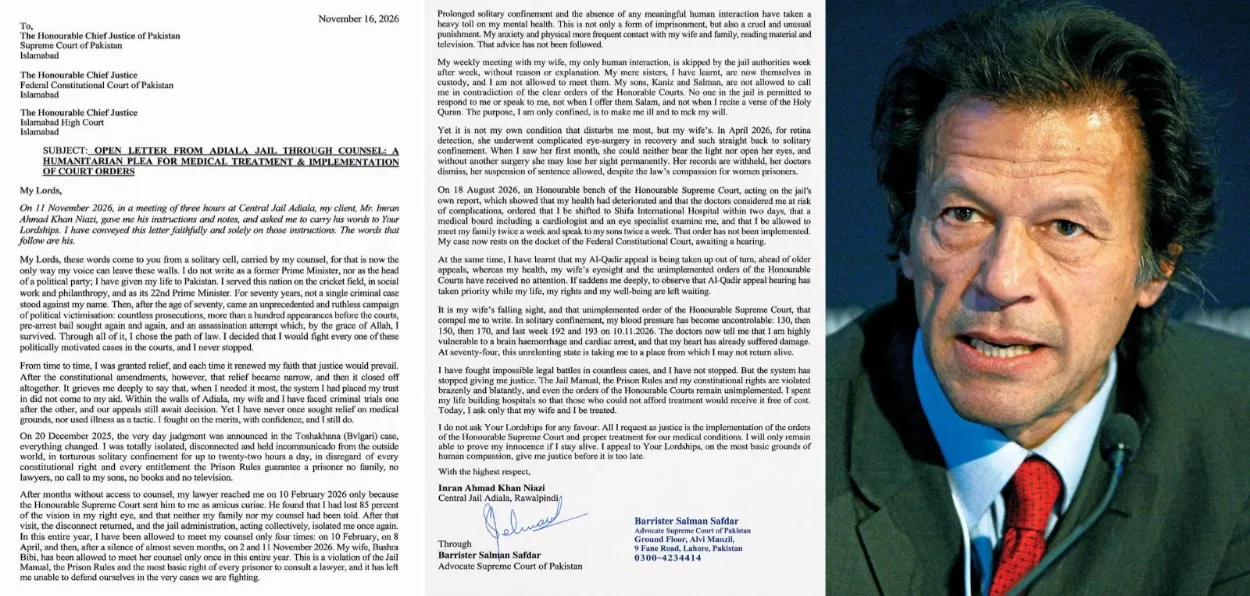
Khan, who is imprisoned in Adiala Jail in Rawalpindi, has written an open letter through his lawyer, Salman Safdar, to the chief justices of the Supreme Court, the Federal Constitutional Court and the Islamabad High Court, urging their urgent intervention over the medical conditions of himself and his wife, Bushra Bibi.
He has expressed particular concern about his wife's deteriorating eyesight, warning that she may even lose her vision.
Interestingly, much like former Prime Minister Benazir Bhutto, Khan had also pledged to cleanse the political system and end the cycle of retribution against political leaders after they lose power. That promise, too, remains unfulfilled.
An episode recounted by Benazir Bhutto in her autobiography, Daughter of the East, offers a glimpse into the deepening tensions between elected governments and Pakistan's powerful military establishment.
Benazir believed that her victory in 1988, when she became Prime Minister for the second time, had established the supremacy of civilian political leadership over the military. However, she soon discovered the limits of that authority.
Pervez Musharraf, then Director General of Military Operations (DGMO), proposed that she immediately order the Pakistan Army to march into Srinagar.
Benazir was appalled by the suggestion and questioned him. “..And then what will happen?” she asked.
Musharraf persisted with his extraordinary proposition, arguing that “Kashmiris will welcome the Pakistan Army and after taking control then Pakistan will go to the United Nations to get an order for a ceasefire.”
Benazir writes that she was furious at the audacity of the General. She had earlier admonished the Army Chief for suggesting that she take over Afghanistan, dismissing such military adventures as dangerously unrealistic.
She told Musharraf: “And you know what the United Nations will tell me? They will pass a resolution in the Security Council condemning us and demanding that we unilaterally withdraw from Srinagar and we will have nothing for our efforts but humiliation and isolation.”
Benazir believed she had managed to rein in Generals intoxicated by what they perceived as the "victory of Mujahideen in Afghanistan.” Little did she know that Musharraf would eventually overthrow her political successor, Nawaz Sharif, and later preside over a political climate in which her own return to Pakistan would prove fatal.
Benazir was assassinated in December 2007 after returning from exile. She was killed by terrorists amid serious allegations of security failures and deliberate lapses by the state machinery during Musharraf's rule.
Imran Khan's sisters speaking to the media after visiting Adiala Jail:
Allowing Imran Khan to meet his lawyers is not a relief, it is his fundamental right. Today is family meeting day, and his sisters have every right to meet their brother. You cannot label the fulfilment of someone’s basic rights as a relief. https://t.co/3hTGuNfltm
— Mubarak khan (@theageof804) November 17, 2026
Pakistan's history of political violence dates back to the assassination of its first Prime Minister, Liaquat Ali Khan, in 1951, barely four years after the country's creation.
Thereafter, Pakistan experienced prolonged periods of military rule, giving rise to the popular quip: “Countries have armies, Pakistan’s army has a country.” The military gradually emerged as the country's most powerful institution, exercising influence far beyond matters of national security.
After a prolonged period of political uncertainty, Zulfikar Ali Bhutto became Prime Minister in 1971. His tenure coincided with the country's dismemberment, as East Pakistan broke away to emerge as independent Bangladesh. The debacle severely damaged the Army's reputation and challenged its image of invincibility.
Bhutto was subsequently imprisoned, tried in a controversial judicial process and hanged in 1979 by the regime of military ruler General Zia-ul-Haq.
The Generals, too, were not entirely immune to Pakistan's culture of political intrigue and retribution. Zia, who was the longest military ruler and introduced Islamic fundamentalism into its institutions and political system, died in a mysterious plane crash in 1988.
The crash triggered widespread speculation about possible foreign involvement.
After the Bhuttos, Nawaz Sharif emerged as one of Pakistan's most popular political leaders. Elected Prime Minister twice, he experienced the country's recurring cycle of political upheaval firsthand.
During his second tenure, General Musharraf overthrew his government in a coup in 1999, forcing him into exile in Saudi Arabia.
Sharif eventually returned to Pakistan and secured a landslide electoral victory. He subsequently moved to remove Musharraf from the political equation, forcing the former military ruler into exile. Musharraf later died in Dubai.
In yet another turn of Pakistan's political revenge cycle, Nawaz Sharif himself was forced into exile in London during Imran Khan's rise to power.
ALSO READ: Zakat is the Quranic commandment for social responsibility
Khan, once regarded as a political lightweight, allegedly benefited from the Army's active support and the manipulation of the electoral process to secure power.