 Aditi Bhaduri
I was introduced to Hazrat Nizamuddin Auliya by my late mother, a devout and practising Hindu. She, in turn, had been introduced to the saint and first guided to his dargah by a friend, a follower of the Saint, on her first visit to Delhi.
She was then an 18-year-old student and budding singer representing her university, the University of Jabalpur, at the National Youth Festival in Delhi. Obviously, as it was her first visit to the national capital, every monument she visited and every person she met fascinated her. She had met both Prime Minister Jawaharlal Nehru and Yuri Gagarin, the first man to travel into space, who was visiting Delhi at the time.
She had not sought out the visit and knew nothing about Nizamuddin, yet found herself at his shrine, listening to stories about his life and times.
Decades later, when I was travelling to Delhi for the first time on official work, she casually mentioned the dargah. Always eager to visit and learn something new, I made a note of it.
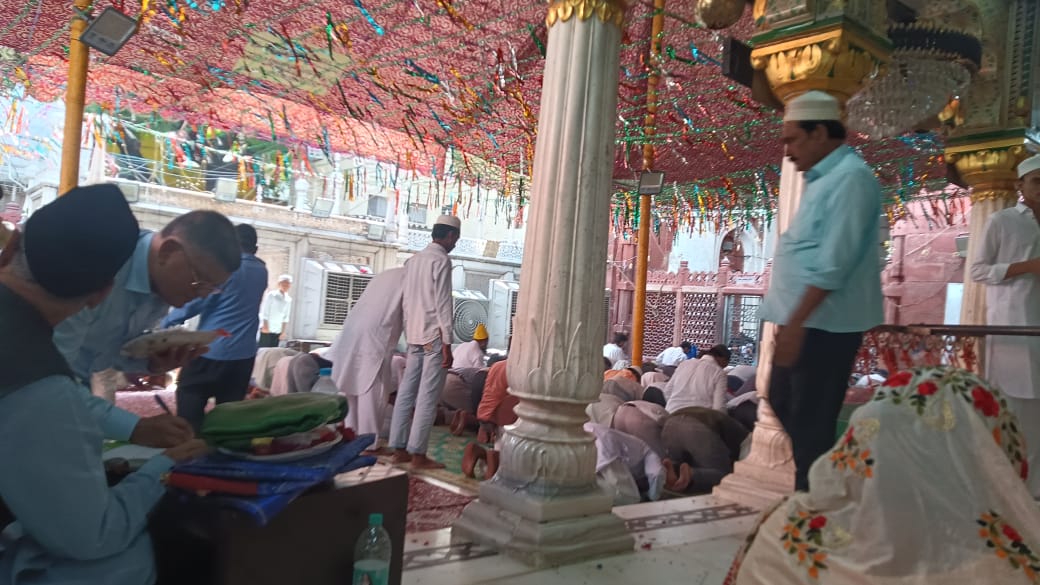
I remember my first visit. I was nervous. The dargah is situated some distance from the main road, and narrow lanes lead to it, flanked on both sides by flower sellers, biryani shops and even meat sellers. Though the roads have expanded considerably since then, the area was crowded even back then.
I asked my driver, a young Sikh, to accompany me, and he obliged. Together, we made our way inside, evading calls to remove our shoes, buy flowers and chadars, and give alms. Finally, having done all three, we entered.
I did not expect to find a wide, spacious courtyard filled with sunlight welcoming me. The courtyard connected two wings housing tombs. My mother had told me that the tradition was to first visit the tomb of Amir Khusro, the great 13th-century litterateur.
The reason? Khusro was Auliya's favourite disciple and follower. The two were almost inseparable. Auliya loved him so much that he had left standing instructions that, after their deaths, their followers must first visit the tomb of Khusro, the younger and junior of the two, and thereafter his own. For many, Auliya's love for Khusro is a metaphor for the Almighty's love for humanity.
That afternoon I was hesitant. I did not have to wait long. Close to the shrine, a young man in a neatly starched, white kurta-payjama and white skullcap stepped forward to help me with my darshan. He took the flowers from me, sprinkled them on Khusro's tomb, lit the incense and then guided me to a place where I could pray and sit.
I learnt then that, as both Khusro and Auliya were celibate, women are not allowed inside the room housing the sarcophagus. They can look in through the doorway or through the marble lattice enclosure and can sit outside on the covered balcony surrounding the shrine.
He beckoned me to sit, which I did, absorbing the ambience around me. A couple of other women sat on the balcony, praying. A few men went into the shrine to pray. Outside, in the open courtyard, an old man sat beside an ornate incense stand, where he kept incense constantly burning and removed the stubs.
People moved back and forth. The sun shone, and a cool breeze blew.
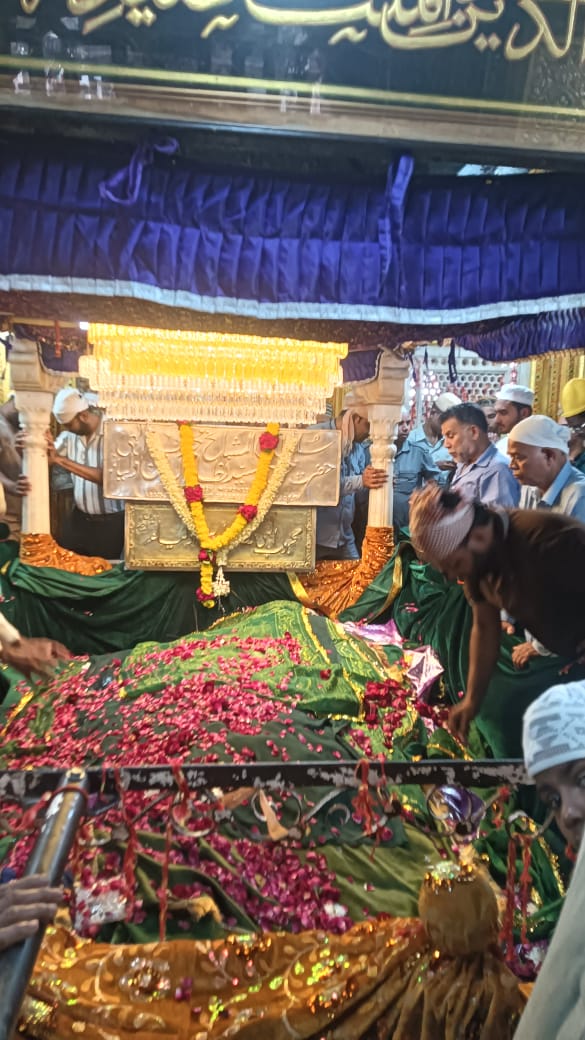
After a few minutes, I got up, and our guide took us down a few stairs, across the open courtyard and into a larger shrine. Here lay Nizamuddin Auliya, a saint of the Chishti Sufi order. His sarcophagus was covered with ornate brocade and silk chadars, on which were sprinkled perhaps a ton of rose petals. Red roses are the only flowers sold here.
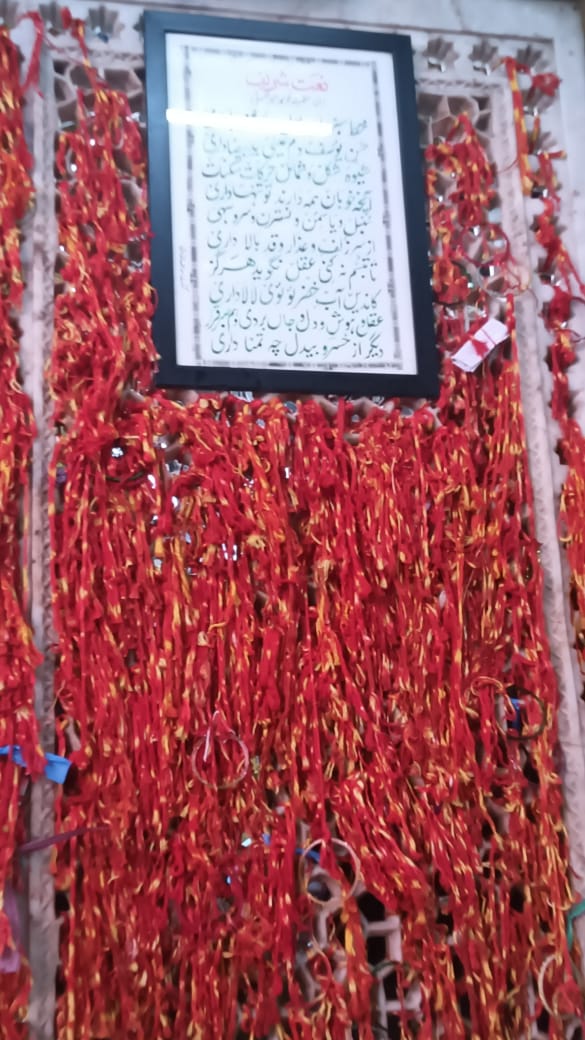
Once again, a similar ritual was followed. As a woman, I could not enter the shrine and could only view it from the doorway. It was enclosed in a similar marble-latticed enclosure, to which people had tied red threads. Each thread represented a distinctive prayer or wish made by a devotee. Whenever a wish was granted, the thread would be untied and removed.
My guide offered me a thread. Though uncertain, I took it, prayed while holding it, made my wish and tied it to one of the crevices in the screen.
And yes, that wish did come true.
After my wish was fulfilled, my guide invited me into a room flanking the courtyard, which served as his "office".
I entered the office with my driver. My guide introduced himself as Nadeem Nizami, a descendant of Auliya's sister. Since Nizamuddin himself had been a bachelor and celibate, he had left no offspring. His only sister, however, had married, and her descendants have been taking care of the shrine for more than 700 years.
Since that day, Nadeemji and many members of his clan have become extended family.
Since that first visit, more than 16 years ago, I have never failed to visit the dargah whenever I have been in Delhi. Over the years, I moved to Delhi from my native Kolkata, then back to Kolkata, and later began dividing my time between the two cities. No matter what the circumstances, each time I come to Delhi, I visit the dargah.
I cannot exactly pinpoint what it is, but there is a pull.
Over the years, the crowds have grown exponentially. The entry is often unpleasant, and one is accosted by beggars and vendors. But once inside, regardless of the temperature or the crowd, a sense of peace descends.
Sometimes I have resisted visiting. Once, I remember being too tired to go and thinking I would skip it just that once.
"Is it okay, Baba?" I asked in my mental conversation with him. The next day, I woke up with a newfound energy and found myself meekly on my way to the dargah.
There was, however, one time when I did skip the visit. It was not intentional. On the day I was preparing to go, I received some bad news. It spoiled my mood and, in anger, I decided to skip the visit.
.jpeg) Devotees at Hazrat Nizamuddin Shrine
Devotees at Hazrat Nizamuddin Shrine
But that evening, on my way to the airport, I was filled with sadness and regret. I even asked the driver if we could stop at the shrine for a few minutes, but he told me it was far out of our route and we did not have enough time.
I prayed to Baba for forgiveness and promised that I would begin my next trip to the city with a visit to him.
Sure enough, two months later, I received an invitation to his annual Urs. Immediately, I began planning a trip to Delhi when, curiously, I also received an invitation to attend a high-profile workshop there, with all my travel arrangements taken care of.
Coincidence? Providence? I would like to think that Baba had made the arrangements.
Time and again, I have experienced such small miracles in my connection with Baba.
So, what exactly is it that draws me to the dargah?
I am, after all, a practising and believing Hindu. Of course, in Hinduism, there is no contradiction in being a devotee of Baba. Those like him are called Mahatmas — realised beings who have reached the ultimate state of perfection and merged with the Divine Spirit that pervades everything in the universe.
Interestingly, many visitors and donors to the dargah are Hindus. On the other hand, many of my Muslim friends have told me that visiting dargahs is an un-Islamic practice.
As Nadeemji once explained to me, it is not we who choose him; it is he who chooses us.
That feels flattering.
Still, I have asked myself: what is special about Nizamuddin Auliya that draws me to his shrine? Perhaps it is the non-stop langars and free meals provided each day at the dargah.
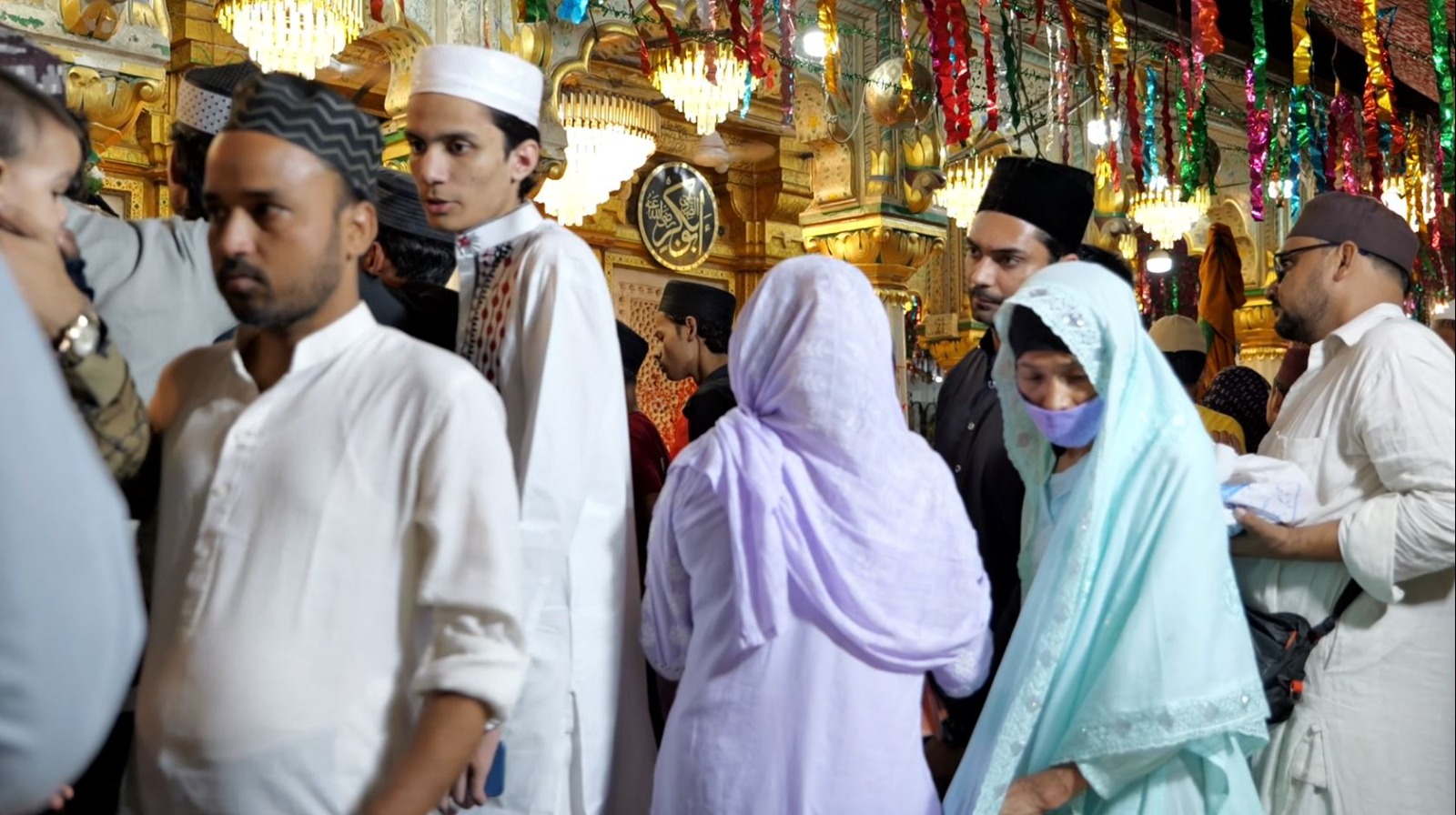 Devotees at Hazrat Nizamuddin Shrine
I am not an expert on Nizamuddin, but I have read and heard about his life. He grew up in abject poverty, having lost his father at a very young age. His mother took care of him and his sister, and they often had little to eat. Sometimes there was nothing at all. On such days, his mother would tell him that it was the day they would be guests of God.
As he grew older and began his spiritual practices, feeding his devotees and followers became his hallmark. When he was finally able to build his khanqah, which now houses his dargah, the free langar became an integral part of it. It has continued all these centuries later.
For me, that is the greatest miracle: a boy who so often went to bed hungry because of poverty left behind a legacy in which at least a hundred poor people are fed every day, without questions about their creed or background.
Anyone is welcome, and people flock here from everywhere.
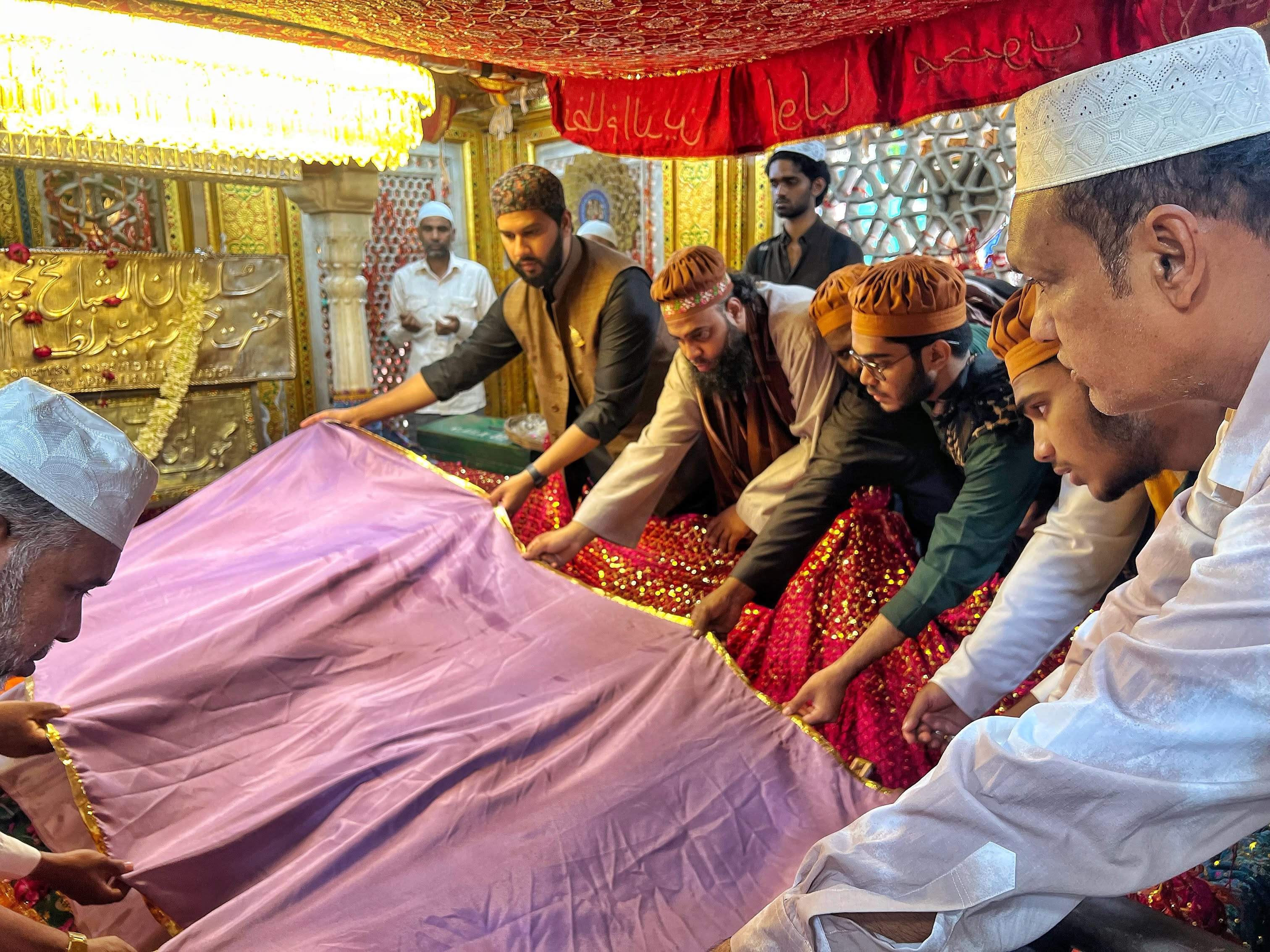 Devotees offering a chador at the grave of Hazrat Nizamuddin Auliya
What could be a greater miracle to witness? What could be a greater blessing to experience?
Over the years, I have also brought friends and family here from far and wide — Muslims and non-Muslims, Indians and foreigners, even Jewish friends from Israel. They have always received the same welcome and warmth.
Some have felt a connection; others have not. That is okay. Faith is deeply personal.
Today, Delhi and Nizamuddin Auliya are indistinguishable for me. I cannot think of one without the other.
The dargah is a reassuring presence. To me, it offers an inexhaustible symbol of support and protection.
I recall the 800th birth anniversary celebrations of Baba at the dargah in December 2014. It was a grand event. People thronged the place around the clock with flowers and chadars. The dargah was brightly lit and festooned with confetti and garlands. The place was a haven of inexplicable joy and happiness.
I attended the evening celebrations, where soulful qawwalis filled the starry night, when the heart-wrenching news came of the Peshawar school massacre.
ALSO READ: Sufi played a key role in promoting social harmony
But in this corner of Delhi, peace reigned supreme. Seeing the crowds of happy, smiling faces, I felt a moment of revelation: as long as Nizamuddin Auliya's dargah stands here, Delhi will always be safe.









.webp)