Saquib Salim
Lal Bahadur Shastri, whose birthday fall on Octoiber 2, rose from poverty to become Prime Minister without compromising his principles. Power did not change him. He often repeated Mahatma Gandhi’s maxim: “In office always sit light, never tight.”
Shastri’s father, a teacher, died when he was barely a year and a half old. His mother called him Nanhe, and he grew up in his maternal grandfather’s household at Mughalsarai. Money was scarce during his childhood, but affection was abundant.
At Varanasi, where Shastri went to high school, some relatives made him run errands and never treated him as an equal. At Harishchandra High School, however, he came under the influence of his teacher, Nishkameshwar Prasad Misra. When Misra’s wife tried to pay him for tutoring her children, Shastri asked whether anyone would charge his own brothers.
At the age of 16, Shastri walked away from a school examination in response to Gandhi’s call for the freedom struggle. His teacher asked him how he could leave his mother and sisters alone. Shastri replied that it was the call of the country. His mother agreed and told him that he must never retrace his steps.
In 1926, Shastri earned the degree of Shastri in philosophy from Kashi Vidyapeeth. He then joined the Servants of the People Society, founded by Lala Lajpat Rai, whose life members lived on a subsistence allowance of Rs. 60 a month. At his wedding in 1928, he accepted only a charkha and a few yards of khadi as gifts.
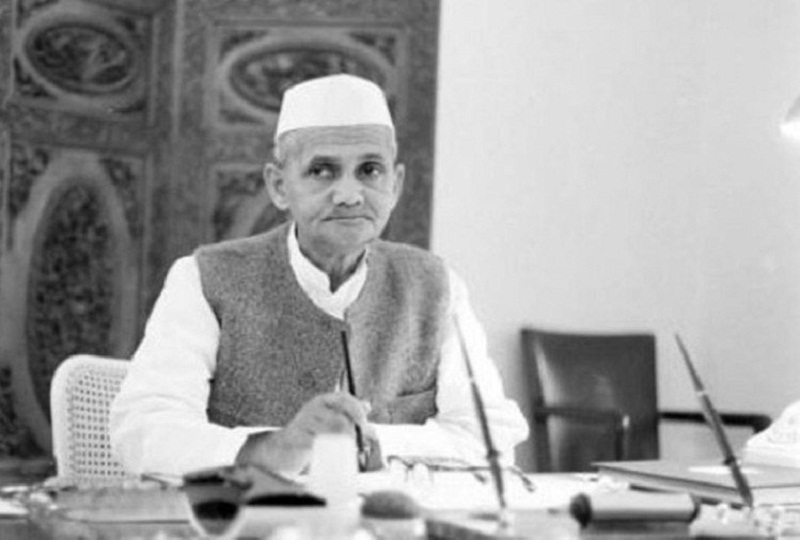 Lal Bahadur Shastri in office
During the freedom struggle, Shastri spent seven terms in jail, totalling nine years.
Once, when his wife hid two mangoes in her dress to take to him at Faizabad jail, Shastri rebuked her for the offence, though he later apologised to her.
When Shastri’s son fell seriously ill with typhoid, the authorities asked him to give a written undertaking that he would stay away from politics as a condition for parole. He refused. He was nevertheless granted a week’s parole. His child was still ill when he returned to prison at the end of the week.
In 1942, during the Quit India Movement, Shastri worked underground. He addressed a banned meeting in Allahabad (now Prayagraj) and was arrested. His wife fed their children roasted wheat balls to save money for visits to the jail. A Muslim neighbour provided provisions and fuel and told her that if Lal Bahadur was sacrificing for the nation, helping his family was the least he could do.
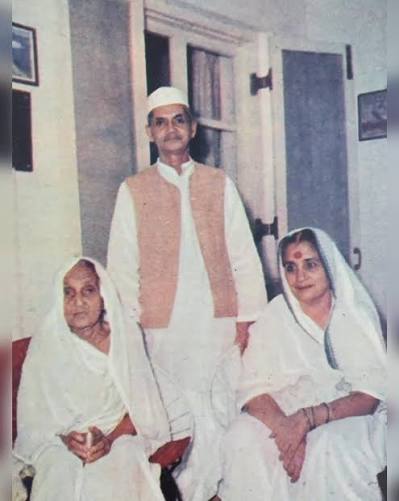
Shastri entered the U.P. Assembly in 1937. He led the House committee that prepared the land reform report. After his release from prison in 1945, Govind Ballabh Pant brought him to Lucknow, first as Parliamentary Secretary and later as Police and Transport Minister. He instructed the police to use minimum force and preferred water cannons to lathis.
Austerity was a way of life for Shastri. He would eat parathas and curry served on an old newspaper. When a friend urged him to hire a cook, he asked how he would pay him.
On another occasion, his teacher’s wife chided him for arriving empty-handed. Shastri replied, “I have not become big; I only have to do big work.”
In 1951, Shastri became General Secretary of the Congress and, in 1952, Railway Minister. He abolished the old first-class category, upgraded the second class and fitted fans in third-class compartments. As Railway Minister, he even declined to travel in the special saloon reserved for a minister.
Shastri resigned after the 1956 Ariyalur railway accident, in which 144 people were killed. He held himself morally responsible for the tragedy. Jawaharlal Nehru reluctantly accepted his resignation and praised his integrity and conscience.
As Home Minister from 1961 to 1963, Shastri helped set up the Central Bureau of Investigation (CBI) and the Santhanam Commission to investigate corruption. Under the Kamaraj Plan, he left office.
Shastri was recalled as Minister without Portfolio in 1964 and helped defuse the Hazratbal relic crisis.
Lal Bahadur Shastri was unanimously elected Prime Minister on 9 June 1964. His household continued to use the same coarse linen, while he wore kurtas frayed at the cuffs and collar beneath his coats. A portion of his salary went to the Servants of the People Society.
The Impala car was reserved for state guests. Once, when his sons used it, Shastri summoned the driver and instructed him to enter “14 kilometres, private use” in the logbook. He then deposited the cost at the rate of seven paise per kilometre.
Shastri died without savings. A small car that he had bought on instalments was still being paid for three years after his death.
Shastri defined socialism through action, seeking to make the masses self-sufficient in food, clothing, shelter, medical aid and employment, while narrowing the gap between the rich and the poor.
Facing a food crisis in which food prices had risen by 22 per cent in 18 months, he wanted the country to stand on its own strength in both food and defence. This creed was compressed into the famous slogan, “Jai Jawan, Jai Kisan.” He appealed to citizens to forgo rice one day a month and urged ministers to practise austerity, even ordering that no new furnishings be purchased for his residence.
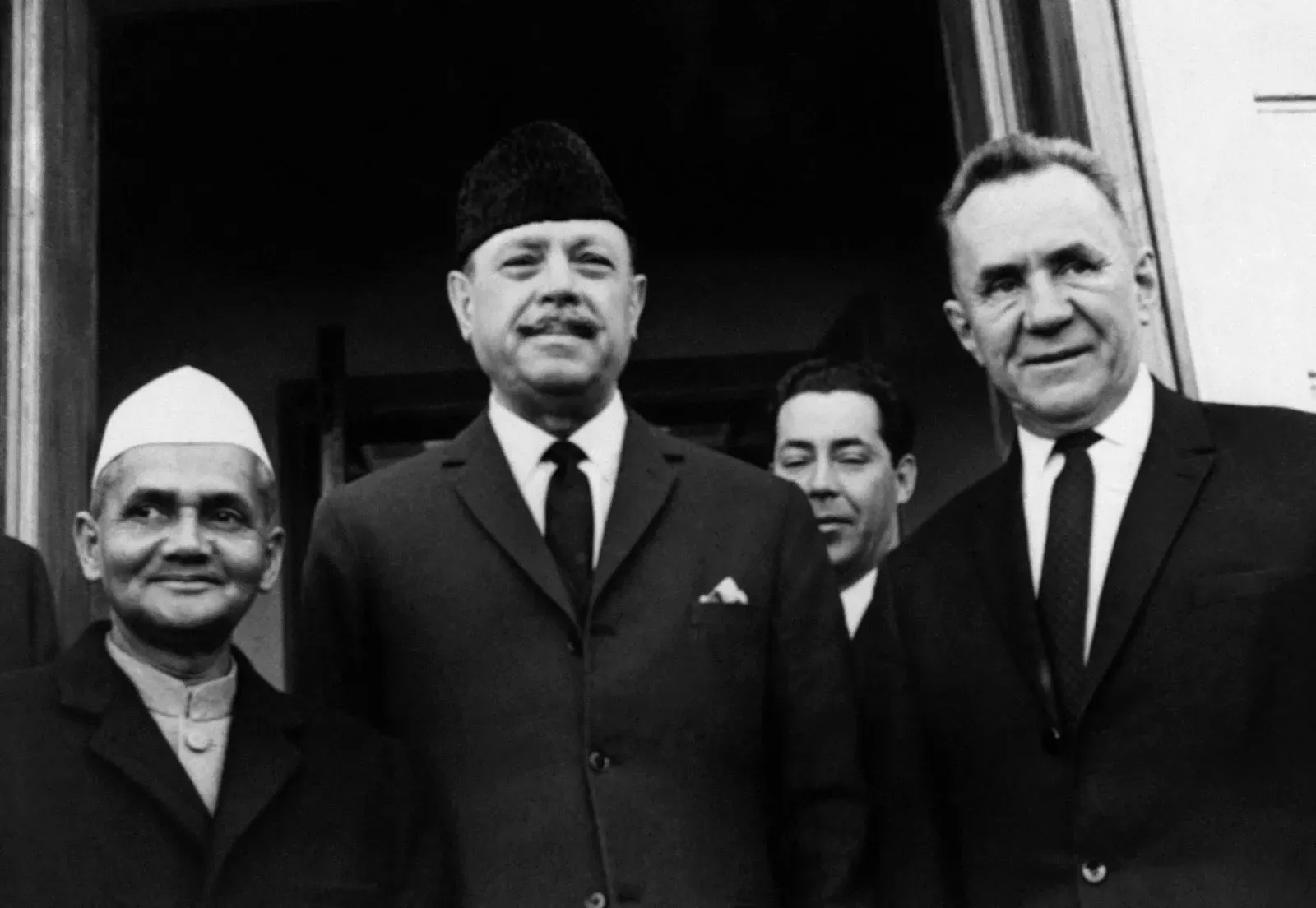 Lal Bahadur Shastri with Pakistan's President Ayub Khan and Russian Premier Alexi Kosygin in Tashkent
During the 1965 war, Shastri told his son that the quarrel was between two governments, not between two peoples, and that civilians should suffer the least. He led India during the war against Pakistan.
The Tashkent Declaration, signed on 10 January 1966, pledged India and Pakistan to settle their disputes by peaceful means. Shastri died early the next morning.
Before his death, Shastri was found scribbling the following Urdu couplet:
Bare Shauq Se Sun Raha Tha Zamana
Hum Hi So Gaye Dastan Kehte Kehte
(The world was listening with great eagerness;
it was I who fell asleep while telling the tale.)