Akhtarul Wasey
Despite many challenges faced by Indian Muslims, India’s democratic system is a blessing for them. There was a period when they ruled this country for centuries. Then came the era of their political decline and the rise of British power, when they became subjects rather than rulers.
On 15 August 1947, they had a new experience. They were neither rulers nor subjects, but equal participants in the country's governance, a position they continue to hold today.
They will be in a democracy, and in a country where Muslims are neither a majority nor an insignificant minority, it is both appropriate and healthy for them.
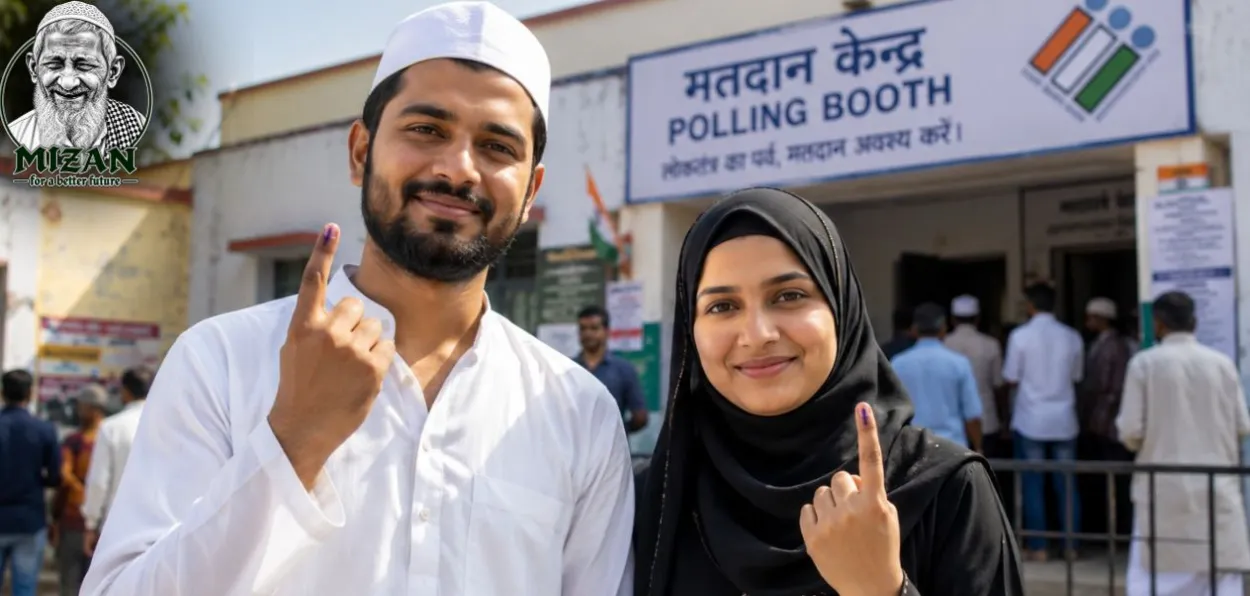
Under this system, just as a Hindu has the right to cast one vote, so too does a Muslim, a Christian, or a Sikh. The Constitution of India guarantees the continuity and effective functioning of this democratic order.
Over nearly eight decades, barring one or two exceptional incidents, no government has been able to tamper with the basic structure of the Constitution, which is founded on democracy. Even when such attempts were made, the judicial system prevented them from succeeding.
As a result, despite Muslims being a minority, the country has seen Muslim Chief Ministers not only in Jammu and Kashmir, where Muslims formed a clear majority, but also in states and Union Territories such as Maharashtra, Bihar, Rajasthan, Assam, Kerala, Manipur, and Puducherry.
There is hardly any important ministry in India that has not, at some point, been headed by a Muslim, whether it be External Affairs, Home Affairs, Food and Civil Supplies, Education, Labour, or any other major department.
This does not mean that Muslims in India have no problems. There is no society without its share of challenges in co-existence. Muslims have survived the tragedy of Karbala, the fall of Baghdad, the aftermath of 1857, and countless turbulent periods in history. They will survive in the future as well. There is, therefore, no reason for despair.
As long as India's judiciary remains strong and civil society remains conscious and sensitive, prolonged injustice and irresponsibility cannot prevail in this country.
When non-Muslims stand with Muslims in safeguarding their constitutional rights, they certainly can do no great harm to the community. All this is possible because Muslims live under a democratic system: a government of the people, by the people, and for the people.
In such a system, power is not monopolised by any one group. Equal opportunities exist for people in every sphere of public life and governance. We do not deny that excesses and shortcomings do not occur; they may sometimes happen. But the remedy for such excesses lies in the courts. Constitutional safeguards exist precisely to correct them.
For example, in 1972, the government of Indira Gandhi passed legislation concerning Aligarh Muslim University. The opposition to it was so strong that the government was compelled to reconsider its position.
Similar developments occurred with respect to the Urdu language and Muslim Personal Law. Urdu was granted the status of a second official language in Delhi, Bihar, and Uttar Pradesh, while the essential provisions of Muslim Personal Law remained intact. All of this was possible because Muslims were living within a democratic framework.
It is important to remember that democracy does not hand everything to its citizens on a platter. Rights must be pursued with effort and commitment.
In a democracy, leadership succeeds neither through confrontation nor through defensive isolation. Rather, it succeeds by building meaningful dialogue among different sections of society.
Democracy flourishes through mutual understanding and persuasion. The age we live in is not the age of disputes or debates alone; it is the age of dialogue.
We must also recognise that secular democracy does not simply mean expecting non-Muslims to stand with us when we face hardship. It also requires us to stand with others whenever they suffer injustice or face threats to their constitutional rights.
As the country’s political landscape and electoral dynamics evolve, Muslim leadership needs to reassess whether reliance on vote-bank politics has delivered meaningful and lasting gains for the community.
ALSO READ: How can Muslim politicians regain relevance?
There is a need for a broader political and social approach rooted in cooperation, inclusiveness and shared participation, with engagement across all sections of society.
Professor Akhtar ul Wassey is Professor Emeritus of Islamic Studies, author and recipient of the Padma Shri