Amir Suhail Wani
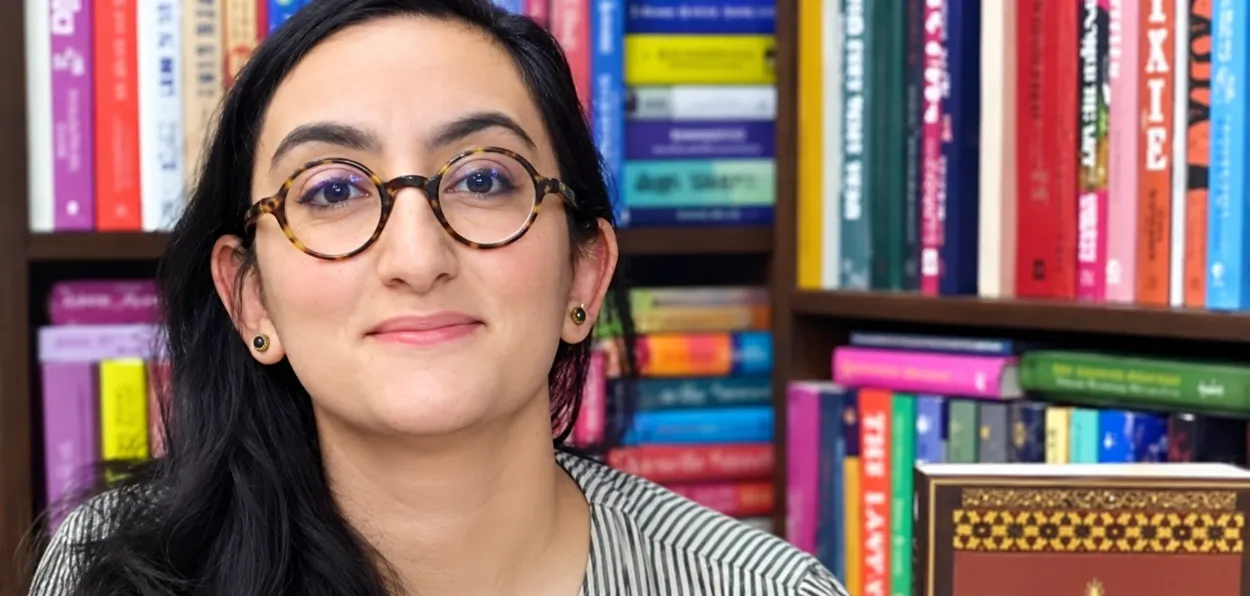
There are moments when a book seems to carry an entire landscape into the room. WhenThe Big Book of Kashmiri Literature by Onaiza Drabu was presented to readers, it was tempting to see before us simply another handsome volume from a major publisher. But the more one looks at the book, the harder it becomes to regard it as merely a literary event.
Between its covers lies something much larger: centuries of memory, voices, songs, longing, laughter, spiritual questioning, social observation and the changing consciousness of a people. It is as though a vast, scattered library of Kashmir—partly preserved in books, partly in songs, partly in memories and partly in the homes and minds of ordinary people—has suddenly walked into the public square.
That is what makes the appearance of The Big Book of Kashmiri Literature significant. Published by Penguin India and edited by anthropologist, writer and translator Onaiza Drabu, the anthology brings together poetry, songs, folk traditions, plays, stories, radio writing, ghazals, flash fiction and excerpts from novels, stretching from the fourteenth century to contemporary times.
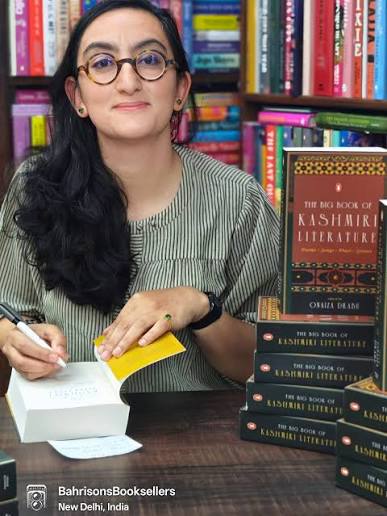
Recent accounts put the anthology at 664 pages, with around 120 pieces and a large group of translators. But numbers do not quite explain its significance. The real story is that Kashmir has been allowed, perhaps for the first time on this scale, to introduce itself to the outside world not through political arguments, headlines or images of conflict, but through its own literary imagination.
For too long, Kashmir has been spoken about more than it has been listened to. It has been described through the vocabulary of politics, geography, security, tourism, tragedy and history. All these dimensions are real, but none of them is the whole Kashmir.
A civilisation is not exhausted by its political circumstances. A society also reveals itself in the stories it tells its children, the songs women sing at weddings, the poems recited at gatherings, the metaphors used by lovers, the prayers of mystics, the jokes of ordinary people, the memories of old houses and the words that survive long after the people who first uttered them have disappeared.
This is where the anthology becomes a social document. It reminds us that Kashmir has never been merely a place on a map. It has been a world of meanings.
One of the most striking features of the collection is its refusal to draw a rigid line between “literature” and “life”. Kashmir's literary culture has historically lived outside the covers of books. It has travelled through oral poetry, folk songs, lullabies, performances, radio programmes, family notebooks and private collections.
#WATCH: ‘The Big Book of Kashmiri Literature’, edited by Onaiza Drabu, launched in #Srinagar amid a strong gathering of literature enthusiasts and people from all walks of life. pic.twitter.com/J4yxzHoYcr
— Greater Kashmir (@GreaterKashmir) September 24, 2026
Drabu has deliberately included these traditions because, in Kashmir, literature has often been something people heard, remembered and passed on rather than something they simply purchased from a bookstore. Recent discussions around the anthology have stressed precisely this point: Kashmiri literature survives through sound and memory as much as through print.
This gives the book another importance. It is testimony to a living literary tradition. It would be easy to place Kashmiri literature in a museum alongside old manuscripts and historical names and congratulate ourselves on having preserved it. But that would miss the most exciting aspect of what the anthology reveals.
In fact, the book arrives at a moment when language itself is undergoing rapid change. Kashmiri has absorbed influences from Persian, Sanskrit, Arabic and Punjabi over centuries, and contemporary speech increasingly incorporates Urdu, Hindi and English.
 In urban areas, some older Kashmiri vocabulary is disappearing from everyday use. Yet this very anxiety about language is producing a new desire among younger Kashmiris to rediscover it. Translation, paradoxically, can become part of that return.
A young Kashmiri who does not read the language fluently may encounter Lal Ded, Nund Rishi, Mahmud Gami, Habba Khatoon or a modern Kashmiri poet first in English and then feel compelled to seek the original. A Kashmiri living outside the Valley may discover in translation something that had always existed in the family but had never been consciously explored. A reader from another linguistic background may suddenly discover that Kashmir possesses a literary universe extending far beyond the names that usually appear in discussions of the region.
Translation gives Kashmir a chance to enter conversations from which it has often remained absent. The question is not merely whether an English reader can now read a Kashmiri poem. The deeper question is whether the reader can begin to understand how a society thinks, remembers, loves, suffers and imagines itself.
Kashmir's intellectual history has never been confined to one tradition. Sanskrit scholarship, Shaiva philosophy, Buddhist currents, Persian literary culture, Islamic scholarship, Rishi and Sufi traditions, folk wisdom and modern literary movements have all contributed to the region's intellectual personality.
Its literature records these encounters not as dry historical facts but as lived experience. The mystical poem, the folk song, the social satire, the modern story and the contemporary poem are different windows into the same civilisation continually negotiating its relationship with the world.
The anthology's importance therefore lies partly in the conversations it makes possible. A reader can move from mystical poetry to folk culture, from devotional verse to modern fiction, from older forms of social observation to contemporary experiences of displacement, memory and change. The result is not a single story of Kashmir but a many-voiced one.
The anthology includes not only established literary figures but lesser-known and sometimes unpublished voices. Some material came through personal collections and family connections. Some writers were musicians, mystics or ordinary people who never imagined that their work would enter a major literary anthology. This gives the project a democratic dimension. Kashmir's literary heritage is not the property of a handful of celebrated authors. It belongs also to those anonymous or forgotten voices through which culture quietly reproduces itself.
A mother writing verses in a notebook, a song preserved in a family, a poem remembered by an elder, a story hidden in an old anthology—these may seem insignificant beside the monuments of history. Yet these are precisely the things through which civilisation survives. Kings leave chronicles; ordinary people leave language.
Recent criticism has rightly reminded us that translation is never a completely innocent act. Something is inevitably lost when a Kashmiri expression enters English; something else may be gained. The translated poem cannot reproduce every cultural association, rhythm or emotional resonance of the original. Nor can any anthology claim to contain an entire literary civilisation. What survives in an anthology is also shaped by what could be found, preserved and accessed.
ALSO READ: Award-winning Arshia Parveen was a reluctant entrant into theatre
But these limitations do not diminish the importance of the enterprise. They actually make it more human. A translation is an invitation, not a replacement. It says: here is a door; come in, and then perhaps learn the language of the house.