 Pallab Bhattacharyya
The unexpected success of movie Hanuman Ansh, which surged from a modest opening to cross major box office milestones in recent times, has done far more than rewrite commercial records; it has reignited national and global conversation about the enduring power of faith. At the very heart of this cultural wave is the enigmatic spiritual figure Neem Karoli Baba, affectionately known as Maharajji, whose life of simplicity and devotion to Hanuman continues to transcend geographic, cultural, and linguistic boundaries.
Maharajji,born in Akbarapur village of UP around 1900 as Lakshman Narayan Sharma, left behind no theology or scriptures. Instead, his teachings were expressed through ordinary human conduct—loving everyone, serving everyone, feeding the hungry, and recognizing the underlying unity of all creation.
His message was disarmingly simple yet revolutionary, converting metaphysical ideals into practical compassion that resonated deeply with those who encountered him. It was this unique combination of radical humility, a plaid blanket, a wooden cot, and an uncanny ability to make people feel completely seen that drew a diverse tapestry of seekers to his orbit.
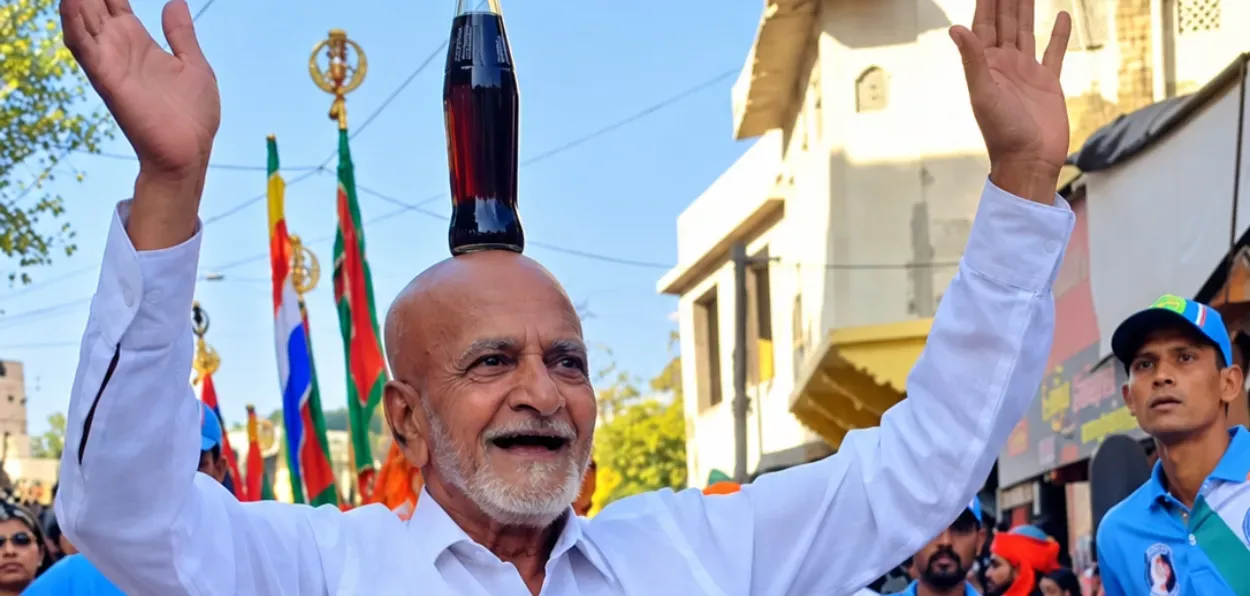
 A scene from movie Hanuman Ansh
His philosophy of love and service possessed a universal ethical consequence that naturally transcended the borders, capturing the imagination of prominent Westerners who journeyed to the East in search of deeper meaning of life. Among them was Richard Alpert, a prominent Harvard psychologist deeply entrenched in psychedelic research, whose life was utterly transformed after meeting the saint and receiving the name Ram Dass.
Through seminal works like the 1971 spiritual classic Be Here Now, Ram Dass successfully translated an intimate Indian devotional experience into a language accessible to a Western generation disillusioned with conventional institutional religion. This bridge allowed fragments of Maharajji's ethos to permeate entirely different fields, inspiring musicians, psychologists, and philanthropists alike.
Figures such as Larry Brilliant translated this spiritual directive into concrete social action, leading to historic global public health campaigns like the eradication of smallpox, while others carried contemplative practices into education and institutional settings.
 Poster of the film Hanuman Ansh
Even iconic technology leaders like Steve Jobs and Mark Zuckerberg were drawn to the spiritual environment and symbolic authority of his Himalayan ashrams, seeking grounding amidst the whirlwind of modern innovation.
This remarkable cross-cultural migration proves that true spiritual wisdom does not rely on aggressive proselytisation or institutional empires, but rather on the quiet, transformative power of authentic human connection and shared grace.
Contemporary devotional accounts explicitly state that Neem Karoli Baba’s circle included Muslims as well as Hindus, Sikhs, Christians, Jews and people without formal religious belief. Rafi Ahmed Kidwai (1894–1954) is the most distinguished Muslim public figure regularly identified in Neem Karoli Baba traditions as a devotee or close admirer. Devotional biographies report that Baba regarded Kidwai as a saintly person and, after Kidwai’s death, visited his grave—although this spiritual relationship is not well documented in Kidwai’s official papers.
Habib Khan, sometimes identified in later accounts as Habibullah Khan, was an Indian Muslim associated with Neem Karoli Baba as a driver during the 1960s and early 1970s and he was very close to Maharajji. Even Ram Dass’s “Miracle of Love”, a major compilation of testimonies about Baba, contains an explicit account of an unnamed Muslim devotee who invited Baba to a religious gathering at his home. His family, Muslim scholars and religious leaders assembled there for Qur’anic readings and Sufi singing.
A devotional story also concerns an unnamed younger brother of Sheikh Mujibur Rahman, who reportedly visited Baba while Mujib was imprisoned in West Pakistan in 1971. Baba assured the visitor that his brother would be released and would lead a new country; Sheikh Mujib was subsequently freed in January 1972 and became Bangladesh’s founding leader.
 Scenes from Hanuman Ansh movie
In our contemporary world, which is increasingly fractured by geopolitical tensions, polarization, and the complex fault-lines of identity, history, and memory, the timeless message of Neem Karoli Baba offers a vital anchor. We live in an era where humanity faces shared challenges that require unprecedented cooperation, yet people are frequently driven apart by narrow divisions of faith, region, and ideology. True resilience and collective flourishing cannot be achieved through material spectacle or division, but through the traditional values of universalism, mutual interdependence, and recognizing the inherent dignity of every human being.
When spirituality is stripped of dogmatic rigidity and expressed simply as service, hospitality, and empathy, it becomes a powerful unifying force that heals communities and breaks the shackles of isolation. The journey of Hanuman Ansh and the global legacy of Maharajji remind us that across all boundaries, our common concerns and shared visions for the future hold immense potential for bringing people together.
READ MORE:Gulab Khan, who gave Nashik Dhol its iconic rhythm
By embracing a worldview grounded in compassion and collective welfare, humanity can find common ground, heal historical wounds, and move forward together with a renewed sense of hope, peace, and shared destiny.
The author is a former Director General of Assam Police