




Bhakti Chalak
A journey along winding roads in the 'Lalpari' (State transport bus) and the earthy fragrance of wet soil spreading across the porches of tiled-roof houses. A person from Konkan waits all year for this experience. The moment Ganeshotsav arrives, the footsteps of the 'Chakarmanis' (working professionals living in cities) from Konkan immediately turn towards their villages. Far from the deafening noise of DJs, they crave the soothing, natural environment of their hometowns.
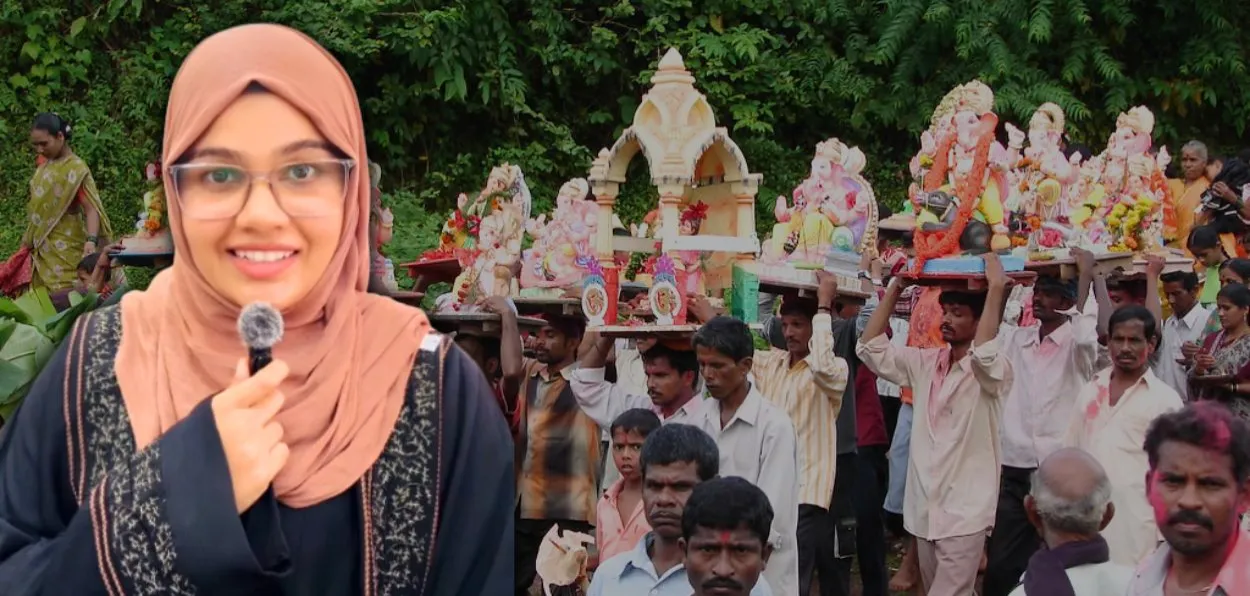
There are no grand tableaus or massive mandals here. Yet, the grandeur of Ganeshotsav in Konkan is something entirely different. This festival in Konkan belongs to every settlement, every lane, and every person living there. Khadija Naik, a content creator who has gained massive popularity in the digital world for her Konkani flair, shares her experiences of Konkan's Ganeshotsav. In an exclusive interview with 'Awaz-The-Voice', she relived her childhood memories.
Bond with Konkan
Khadija Aadil Naik originally hails from Nizampur in the Raigad district. She got married in Chiplun, Ratnagiri district. This allowed her to closely experience the culture, dialect, and lifestyle of both Northern and Central Konkan.
Currently, she lives in Pune with her family. While raising two young daughters and managing household responsibilities, she works as a Technical Consultant in the IT sector. While working in a stressful field like IT, she made way for her innate artistic talent and her love for Konkan to flourish.
Despite living in Pune, the conversations, dialect, and memories of Konkan were completely fresh in Khadija's mind. The thought of making reels sprouted from these very memories. Without any grand preparations, she started presenting simple, everyday life situations in front of the camera.
Speaking about her journey of making reels, Khadija says, "Some situations from our daily lives, the habits of people from the village, their way of speaking, and the little things that happen in every household always fascinated me. One day, I just casually thought of presenting all this through videos."
The videos she shared received an unexpectedly massive response. She says, "Initially, people would comment saying, 'Oh, this happens exactly like this in our house too,' or 'My mother also speaks exactly like this.' That's when I realised that I wasn't just sharing my own memories, but I was providing a platform for the memories hidden in the hearts of thousands of people to be expressed."
Ganeshotsav in Konkan
The true grandeur of Ganeshotsav in Konkan lies in its customs and traditions. Speaking about this atmosphere in Konkan, Khadija says, "Even though we don't install Ganpati at our home, I have seen the village Ganeshotsav very closely since childhood. During those days, the illuminations across the entire village, the decorations in every house, the hustle and bustle of the people, and the joy on everyone's faces were a sight to behold. Neighbours would make it a point to send piping hot modaks to our house."
She adds, "Through the village folks, the joy of Ganeshotsav would reach straight into our homes. People who have moved to other cities specifically gather during these days; old friends and relatives meet, and the entire village is bathed in a unique enthusiasm for a few days."
In today's digital age, children's entertainment is restricted to mobile phones, computers, and OTT platforms. However, Khadija's childhood in Konkan was vastly different and richer than this. Whether it's a wedding or a festival, the tradition of helping one another is kept alive there even today.
Reminiscing about her childhood days, she shares, "During our time, the village, the courtyard, neighbours, and friends were our main sources of entertainment. During the summer days, there would be a rush to make papads and phenyas (a type of Konkani papad) in every house. Even if the work was in one house, all the women from the lane would gather there. Amidst chatting, tea, and laughter, we would never even realise when the work got finished."
Command Over Konkani and Marathi
There is a very different tone and rhythm to the language of Konkan. There is a subtle difference between the dialect of Raigad and the Ratnagiri Konkani spoken in Chiplun. Khadija has experienced this difference very closely.
On the region’s linguistic diversity, Khadija says, "For me, Marathi is the language of everyday life, whereas Konkani is the language of my home. Within Konkan itself, the words, pronunciation, and accent change within just a few kilometres; that is the real beauty of this soil."
While making reels, she deliberately avoids using textbook language. She communicates in the same natural, colloquial language that people use in their homes. Khadija's pronounced Konkoni accent gives away her identity. She feels satisfied that through her content, the new generation gets to hear old Konkani words and customs once again.
ALSO READ: Kashmir's Everester Nahida Manzoor wants more women to climb peaks
Konkan is not just limited to nature, the sea, mangoes, or fish. The simple people there, their pure humour, their way of living, and their deep affection for one another—this is the real Konkan. Thanks to creators like Khadija Naik, this culture of Konkan and the communal harmony witnessed during festivals like Ganeshotsav are emerging even more prominently in today's digital world.







.webp)