 Rajeev Narayan
For years, India has sold the world on the promise of its huge domestic market. But in a world of tariffs, disrupted supply chains and shifting alliances, size alone is not enough. India now needs to become a country global business cannot easily do without.
There is something useful happening amid all the noise over India-US trade, tariffs and negotiations. India is beginning to think beyond the tariff itself. That matters because tariffs are ultimately a price; a price that can make a product cheaper or more expensive, open or close a market, encourage investment or scare it away. But the larger question for India is not what tariff another country imposes tomorrow. It is this: Why should a global company choose India today and still need India 10 years from now?
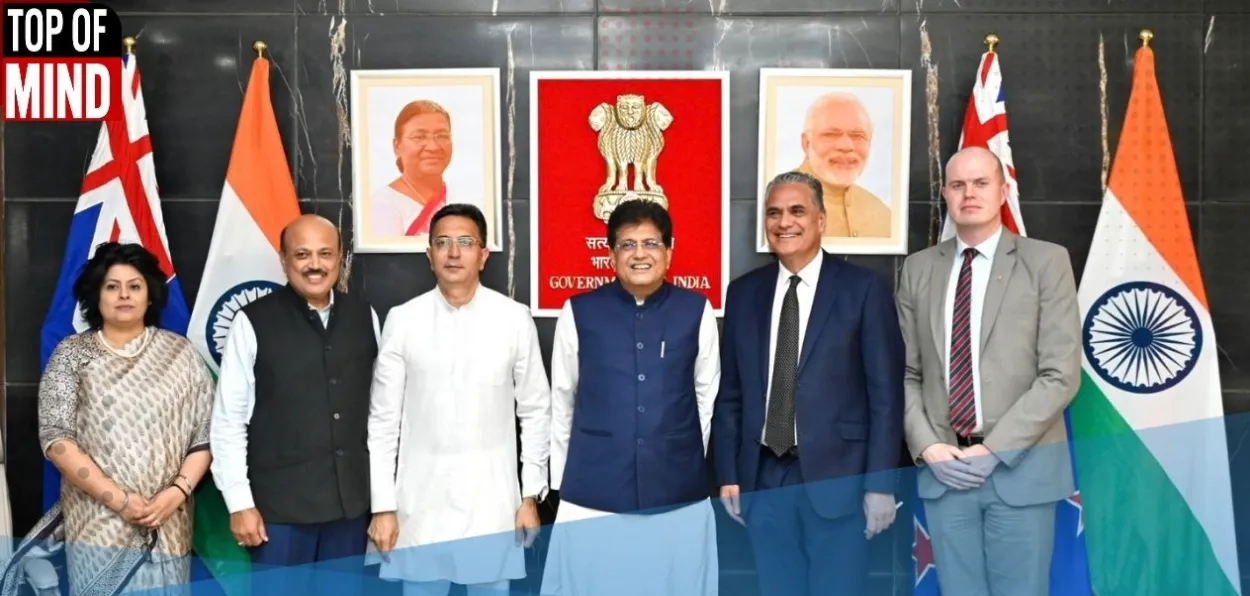
This week, Commerce Secretary Rajesh Agrawal said India’s new free trade agreements are designed to give greater comfort to long-term investors in global supply chains based in India. The agreements also provide tariff predictability and access to a market representing roughly $60 trillion. That is a critical shift in thinking. An FTA is not just about reducing duties on a list of products. It can become part of a larger economic proposition: invest here, manufacture here, export from here and use India as part of your global production network.
That is where the real prize lies.
Market is Not Enough
For decades, India’s biggest economic selling point was obvious. A market with 1.4 billion people. A young population. Rising incomes. But there is also a problem with being merely a large market: other countries can become large markets too. Companies can sell to you without manufacturing inside your borders. India needs to move up that ladder.
The objective should not be to become merely the place where the world’s companies sell their products; it should be to become a place where companies design and manufacture these; source components, develop technology around them and export.
That changes the relationship.
A company selling into India can leave if the market becomes tough. A company with factories, suppliers, engineers, logistics networks and export commitments in India has a different calculation. This is why manufacturing matters. Not because it sounds impressive, but because factories create networks around them.
Any manufacturing plant has an assembly line that needs components. Components need suppliers. And suppliers need machinery, logistics, software, engineers, finance and skilled workers. Some of what is made can then be exported. A factory becomes a supply chain. A supply chain becomes an economic relationship. And an economic relationship, over time, becomes strategic leverage.
From Cheap to Reliable
There is another lesson India needs to learn. The global economy is no longer looking only for a cheap place to manufacture. It is looking for reliable places. COVID showed the world the risks of concentrated supply chains. Since then, geopolitical tensions have made shipping routes, energy supplies, critical minerals and technology components strategic concerns. Trade itself is now increasingly shaped by national-security calculations.
This changing environment has made resilience and diversification important, alongside traditional considerations of comparative advantage.
That should be music to India’s ears. But there is a catch. The world does not build supply chains around potential. It builds them around reliability. That means predictable regulation. Efficient ports. Good roads and railways. Reliable power. Competitive logistics. Fast customs. Consistent quality. Skilled workers. Stable policy. Suppliers who can deliver the same component at the same quality every single time.
The difference between ‘Make in India’ and ‘Depend on India’ is enormous. India needs to get to the second.
Diversification Is Leverage
This is where the India-US trade relationship becomes relevant without becoming the entire story. The US is a large market for Indian exporters. India has every reason to negotiate hard for stable and predictable access to it. But the lesson from tariffs should not be that India needs to find a better argument with the US.
It should be that India needs more arguments everywhere. The more markets Indian companies access, the less vulnerable they will be to problems in any one market. That is why India’s expanding network of FTAs matters. India has been pursuing agreements with the UK, Oman, New Zealand, the European Union and other partners, while continuing negotiations with others as well. This is not just trade diplomacy. It is economic risk management.
If an Indian firm can sell to five major markets instead of one, a tariff shock in one market is painful but manageable. If an MNC manufactures in India and exports to other markets with predictable tariffs, India becomes more attractive as a production base. Diversification, therefore, is not about moving away from the US, China or Europe. It is about being less dependent on any one of them.
There is a difference. That difference is called leverage.
The New Currency
India has spent decades trying to become bigger. Now it needs to become harder to replace. That requires competitive manufacturing, domestic supply chains, better infrastructure, technology capability and companies capable of going global. It also requires India to understand what investors are really buying. They are not simply buying access to 1.4 billion consumers. They are buying the possibility of putting a factory in India and knowing that this factory can serve the world.
That is a bigger proposition. One that changes the meaning of economic diplomacy.
The old version was about better market access. The newer one is about creating economic interdependence on terms that work for India. That is why tariffs should not become the entire story around India-US trade. A tariff can hurt exports. It cannot determine whether India becomes part of a global supply chain. That decision will ultimately be made by factories, investors, engineers, exporters and consumers.
India’s job is to make the decision easier. The ambition should be more than becoming a preferred destination. India should become a destination difficult to replace. A country that supplies markets. Makes components; builds technology; exports products; provides reliable supply chains and, above all, whose absence creates a problem.
ALSO READ: Can India retain freedom not to choose sides amid US sanction threat
India gets attention for one of the world’s largest markets. Being a manufacturing and supply-chain hub would give it economic weight. But becoming difficult to replace gives it something even more valuable - bargaining power.
The writer is a veteran journalist and communications specialist.














.webp)