 Grace Mubashir
India’s relationship with the Uniform Civil Code has always been as much political as it has been legal.
In recent years, the implementation of a UCC has generated intense debate and disagreement. Supporters argue that the existence of diverse personal laws creates uncertainty and conflict, resolving legal disputes more difficult.
Tribal, backwards-class and minority leaders, on the other hand, have pointed to several flaws in the idea and voiced legitimate concerns about its possible ramifications.
In 2025, Uttarakhand became the first state to move the UCC from constitutional aspiration to enforceable legislation. Assam and Gujarat are following suit.
Yet, while the Bharatiya Janata Party’s manifesto invokes “Bharat”, signalling a national aspiration, the party has, in practice, pursued a state-level approach.
.png)
Critics point out that family and succession laws fall under the Concurrent List, under which both Parliament and state legislatures can legislate. But for a code to operate “throughout the territory of India”, as Article 44 envisions, they argue that it must originate from Parliament.
A state-by-state patchwork, they contend, does not fulfil that constitutional vision; instead, it risks creating new layers of legal inconsistency across the country.
The government has also been accused by critics of using the new laws to target Muslims who follow practices under Sharia-based personal law, particularly polygamy and certain forms of divorce that are now prohibited under the UCC.
At the same time, the BJP’s 2024 manifesto placed considerable emphasis on women’s rights, arguing that gender equality cannot be achieved without a UCC that protects the rights of all women.
As this legislative momentum builds, old questions have resurfaced with renewed urgency: What does the UCC actually mean for a country as constitutionally layered as India?
More specifically, what does it mean for minorities, including Muslims, and, more pressingly, for Muslim women, who find themselves at the centre of a debate they cannot afford to misread?
Their legitimate grievances have too often been subordinated — both to the state’s political calculations and to the patriarchal gatekeeping of their own community’s leadership.
.png)
At its most fundamental level, the UCC debate is also about recognising women as equal citizens, entitled to statutory protection in matters of marriage, including protection against polygamy, equitable divorce rights and equal inheritance. These are areas where critics argue that Muslim personal law, in its current form, continues to fall short of constitutional ideals of gender equality.
Politics of Resistance
The contentious history of the UCC predates the current political moment by seven decades. When Jawaharlal Nehru attempted to lay the groundwork for legal uniformity, he found the terrain too volatile to navigate in one move.
As historian Romila Thapar has noted, Nehru could not go the full distance given the severity of the opposition he faced. He settled instead for the codification and reform of Hindu personal law — a more politically manageable first step. Even that proved incendiary. The Hindu Code Bill was described by the All India Hindu Mahasabha in Madras as a “suicidal folly” that threatened the existence of the Hindu community as a whole.
Seven decades on, the anxieties have not disappeared; rather, they have changed hands. The role once played by orthodox Hindu conservatives resisting the Hindu Code Bill is now, in the UCC debate, occupied by sections of Muslim religious leadership resisting state intervention in Muslim personal law.
A considerable degree of opposition has emerged within the Muslim community, with critics alleging that the BJP is attempting to introduce what they describe as essentially a “Hindu code” under the guise of a UCC, thereby undermining the right of religious communities to retain their own laws governing marriage, divorce, adoption and inheritance.
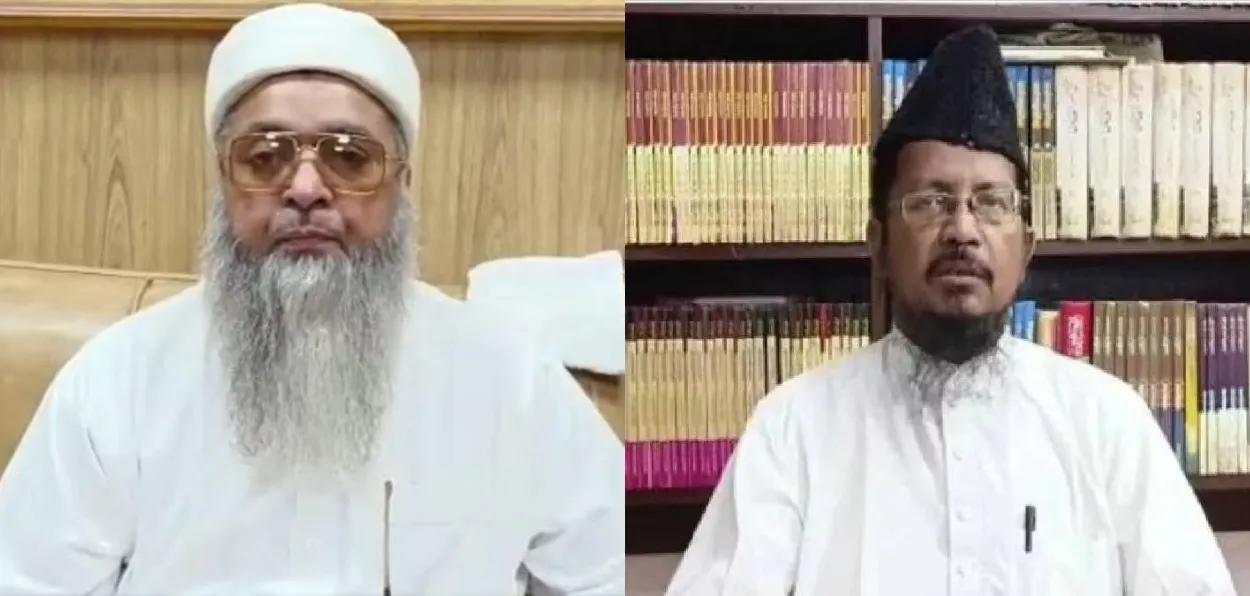
The All-India Muslim Personal Law Board, established in 1973 as an institutional body to safeguard Muslim personal law from legislative encroachment, has been the loudest institutional voice in this resistance.
.png)
When the Supreme Court declared instant triple talaq unconstitutional in 2017 and Parliament subsequently criminalised the practice through the Muslim Women (Protection of Rights on Marriage) Act, 2019, the Board condemned both moves as an attack on Muslim religious autonomy.
AIMPLB president Maulana Khalid Saifullah Rahmani has argued that every religious community in India has its own personal laws and that the UCC threatens not only Muslims but the religious autonomy of all communities. The Board has said it will continue to oppose the UCC through both legal and public means while defending what it considers the constitutional right to religious autonomy.
UCC and Muslim Women
Unlike Hindu personal law, which underwent significant legislative reform and codification after Independence, Muslim personal law remained largely outside the legislative reform process.
The judiciary, too, has adopted an uneven approach to challenges against aspects of Muslim personal law on constitutional grounds. Against this backdrop, the UCC represents a historic proposition: replacing religion-based personal laws with a uniform statutory framework.
The Muslim community itself is far from united on the question.
Organisations such as the AIMPLB argue that Sharia-based personal law is not a relic awaiting replacement but a self-sufficient jurisprudential framework capable of delivering justice within its own terms. From this perspective, any statutory override amounts to cultural dispossession dressed in constitutional language.
.png)
On the other hand, Muslim women’s rights activists broadly agree with the government that a civil code grounded in constitutional equality is necessary to advance the rights of Muslim women.
Yet a solution formulated without the meaningful participation and consensus of Muslim women would be facile, particularly given the historical manner in which elite men have monopolised the discourse on Muslim personal law.
Zakia Soman, a prominent women’s rights activist and founder of the Bharatiya Muslim Mahila Andolan, acknowledges that the Muslim community has often been at the receiving end of Hindutva politics. But, she argues, this should not lead the community to oppose the UCC simply because it is being championed by a Hindu nationalist party.
The UCC, by definition, would apply to people of all religions. It is nevertheless particularly significant for Muslims because Muslim personal law continues to be substantially governed by Sharia-based principles, while several other personal laws have undergone significant legislative reform. From the perspective of gender equality, therefore, Soman and others argue that a UCC grounded in constitutionally guaranteed equality could provide an important avenue for reform.
Women’s rights activist Bushra Tariq argues that Sharia-based personal law, in its present form, is insufficient to achieve substantive equality for Muslim women. In her view, piecemeal reform within Muslim personal law may not deliver the fundamental changes required to address persistent gender inequalities.
She further argues that Muslim women do not always have access to the same secular remedies available to women belonging to other religious communities. Consequently, some Muslim women who have lost faith in reform within the existing personal-law framework may see the UCC as a possible route to achieving greater gender equality.
In this light, an exclusive commitment to preserving the existing framework of Muslim personal law may not provide a complete solution.
Discretionary Remedies for Women
There are broadly two competing discourses on Muslim personal law in India.
The first holds that the UCC could erase culturally specific practices of Muslims without necessarily advancing gender justice. The second argues that a UCC is necessary to introduce greater gender equality into the Muslim community because meaningful reform within Muslim personal law is unlikely.
This tension could potentially be addressed through Catharine MacKinnon’s dual or elective remedy model. She advocates the enactment of a UCC in pursuance of Article 44, but argues that such a code should provide for “sex equality in all respects between women and men on its face and in application”.
At the same time, the UCC need not necessarily override Muslim personal law. Its application could instead be placed at the discretion of the individual woman. A woman could then choose between a secular legal remedy and a personal-law remedy, even where the latter may not fully conform to constitutional principles of equality.
Under such a model, gender equality would not be imposed uniformly on everyone; instead, it would evolve through individual choice. Women who wished to follow the rules and traditions of their communities would retain that option, while women seeking constitutional remedies against discriminatory aspects of personal law would be free to choose the secular alternative.
Such an approach could preserve culturally specific practices while simultaneously providing Muslim women with access to remedies based on constitutional equality. There would be less scope for cultural imperialism because the ultimate choice would rest with the women affected by the law.
As Professor Faizan Mustafa aptly notes, “UCC or not, a law saying no one will have two wives at the same time should not be opposed.”
Certain aspects of personal-law reform, indeed, enjoy broad public consensus. A UCC could therefore be introduced through a phased and flexible approach rather than an immediate and absolute overhaul, particularly if a sudden transition risks social unrest and practical difficulties.
Such an approach would allow reforms to emerge organically rather than appear to be imposed abruptly, reducing the perception of majoritarian overreach. A voluntary UCC, modelled on the principle of choice embodied in laws such as the Special Marriage Act, could also be one way of advancing the mandate of Article 44.
Meanwhile, the government can closely observe how Uttarakhand, Gujarat and Assam navigate the complexities of implementation. Their experiences could help determine whether the conditions are right for a nationwide UCC and, if so, what safeguards would need to accompany it.
ALSO READ: Resolving allegiance to Ummah and nation
For that to happen, however, informed decision-making must take precedence over political mobilisation. Open discourse, meaningful consultation and sustained public-awareness initiatives should be encouraged.
The ultimate objective should be legal harmonisation, not homogenisation.
Mubashir Vattaparamban is an independent researcher based in Delhi.









.webp "AI-made representational image")

.webp)