Zaheeruddin Babar/Kolkata
One of the most beautiful features of West Bengal's cultural heritage is the way its festivals bring people of different faiths together. Whether it is Eid, Durga Puja or Christmas, people across the state often transcend religious boundaries to participate in and celebrate each other's festivals.
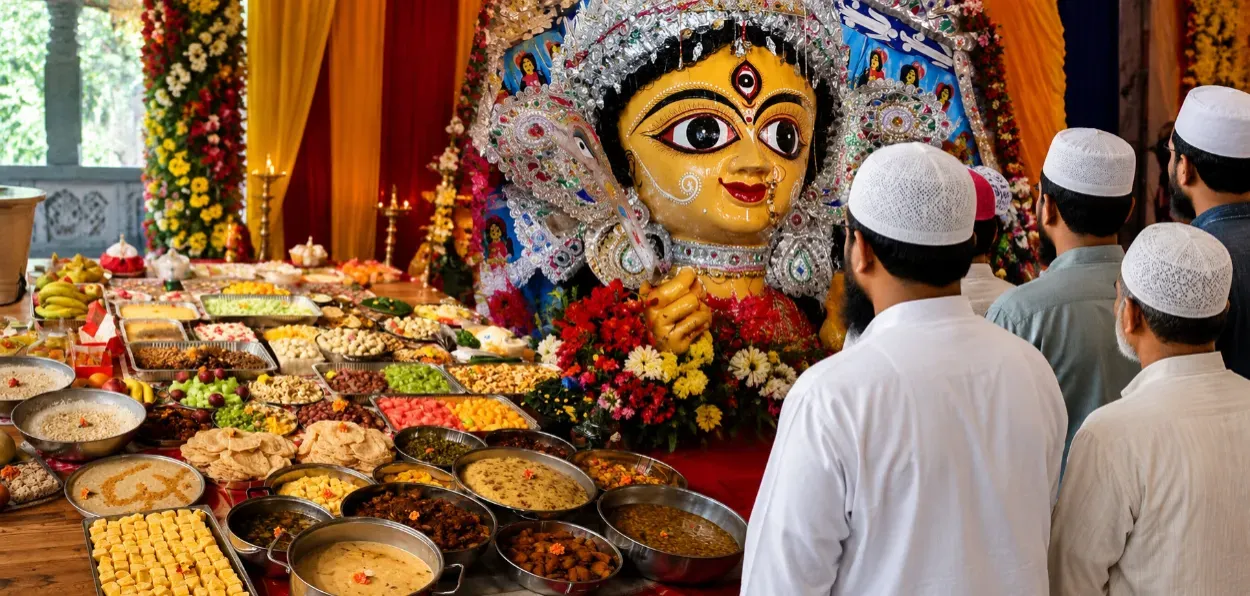
A unique example of this shared tradition is the 600-year-old Koda Khakhi Durga Puja in the Raghunathganj area of Murshidabad. Here, according to local tradition, the first bhog offered to Goddess Durga comes from a Muslim family.
The distinctive Durga Puja is held in Bahura village in the Lakshmi Janardanpur area of Raghunathganj. The puja takes place in a Muslim-majority area, and its most unusual tradition is that the first bhog is prepared and offered by a Muslim family.
Locals believe that every year, a day before Bodhan, a member of a Muslim family receives instructions from Goddess Durga in a dream about what should be offered to her, and when and how it should be prepared.
The tradition has continued for centuries. The bhog prepared by the Muslim family is offered to the goddess first, after which other families make their offerings.
There is an interesting legend behind the name of the puja.
 A Durga Puja Pandal
According to local tradition, the area was once hit by a severe flood that submerged the fields and destroyed the crops. Around that time, a member of a Muslim family saw a dream in which the Goddess instructed him to offer her koda (local variety) rice, sahanjana (drum stick), kathal (Jackfruit) and fresh Hilsa fish from the Ganges.
At the time, kaun rice was known as koda. The tradition of offering it to the goddess eventually gave the puja its name — Koda Khakhi Durga, meaning 'Koda Rice-Eating Durga'. Locals also affectionately refer to the goddess as Maa Koda Khakhi.
According to local tradition, the puja was started by the Banerjee family, who lived in Manigram in Sagardighi. Later, Sarat Chandra Banerjee moved to Bahura. He was a landowner in the Jyotkamal area.
It is said that dacoits once worshipped Goddess Durga in a forest in the area. One day, while returning from work, Sarat Chandra Banerjee saw the bandits perform puja.
The following night, Goddess Durga appeared in his dream and instructed him to worship her at his home. Banerjee installed an idol of the goddess in his house and began the puja.
The Muslim widow and the special 'nara'
One of the most significant traditions associated with the puja is linked to a poor Muslim widow, locally known as 'Lokar Maa', who lived in Bahura village.
Once a landowners' family asked her to prepare and offer bhog to the goddess. But she was so poor that she could barely afford food for herself, let alone cook food for an offering.
That night, Goddess Durga is said to have appeared to her in a dream and gave her instructions. The next day, poor woman went into the forest, collected koda rice and prepared 'naras', a round, rice-based sweet resembling a small laddoo, which she offered to the goddess.
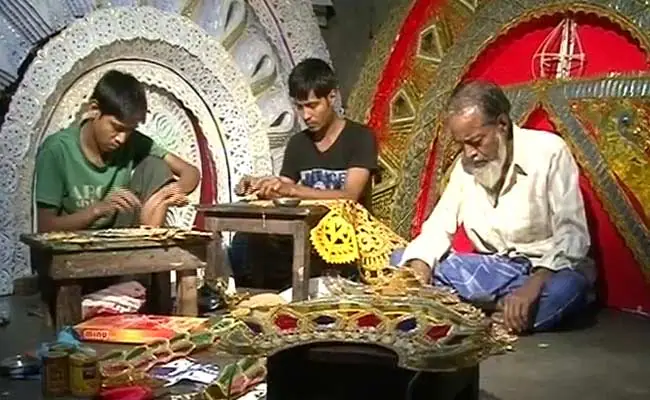 Muslim artisans making a Durga Puja Pandal
Even today, koda rice naras remain a special offering at the puja.
Another distinctive feature of the Koda Khakhi Durga Puja is that, unlike many traditional Durga Pujas, aarti and flower offerings are not performed here.
People of all faiths, however, are welcome to participate in the puja.
Muslim women also play a special role. They wear shakha and pola, the traditional white and red bangles associated with married Bengali Hindu women, on the hands of the Durga idol.
Goat sacrifice is also performed as part of the religious rituals during the puja.
The tradition demonstrates how communities with different religious practices can remain connected through local customs, traditions and shared cultural bonds.
ALSO READ: Biki Hussain's 1500 kg honey business started with one box
In Murshidabad, this 600-year-old puja continues to preserve that legacy. Here, the festival begins with bhog prepared by a Muslim family, while people from different communities come together to participate in the celebration of Goddess Durga.









_(1)_(1).webp)

_(1).webp)


_(1).webp)

.webp)